Black Friday 2026: Why the Shopping Frenzy Is Fading While Spending Grows
Black Friday still draws millions of shoppers, but it no longer owns the holiday season. Retailers expect spending to rise, while early discounts and year-round online shopping have made the once-defining Friday feel less urgent to many consumers.
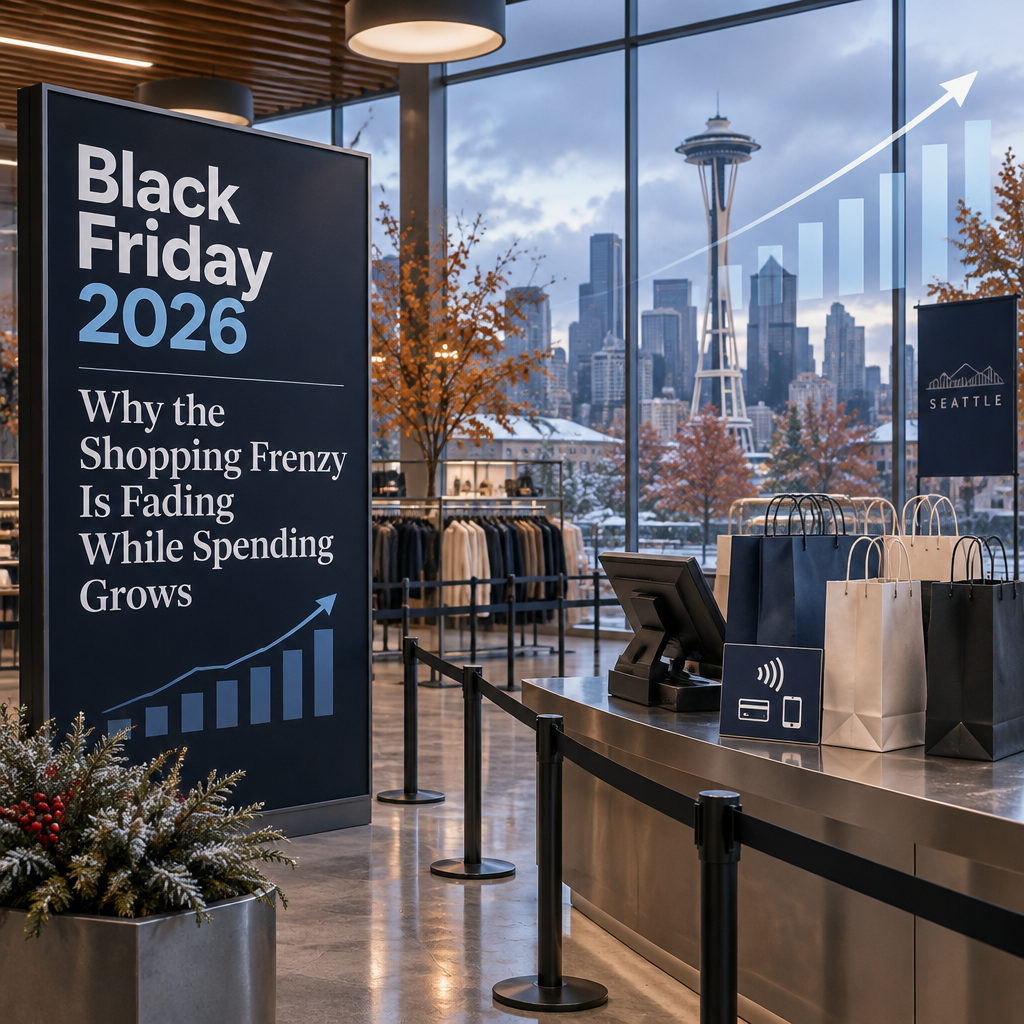
That is the split-screen story of Black Friday 2026: a substantial shopping season in the numbers, a less singular event in the lives of some shoppers. In Seattle, Daniel Flash said the day had lost the magic it held when he was a child. He spent Friday with family, browsing without a specific list. Christian Brauern said a deal might persuade him to buy, but he did not feel he was missing out if he went home empty-handed. Ace Shriner pointed to promotions that last so long they dilute the significance of Friday itself.
Retailers, meanwhile, are counting on strong seasonal sales. The two views are not contradictory. People can spend during November and December without treating one day as an appointment, and they can make purchases online before, during, or after the traditional rush. The important change may be less about whether people shop than about when and how they decide to do it.
What Is Black Friday?
Black Friday is the Friday after Thanksgiving in the United States and has long been treated as the opening of the holiday shopping rush. Retailers use the date to promote discounts, draw shoppers to stores and websites, and encourage purchases ahead of Christmas and other year-end holidays. The day remains a major marker in retail planning, but its role has shifted as promotions have spread across more of the calendar.
The older version depended on scarcity and timing: shoppers expected a limited window, a crowded store, and a reason to get out early. That can still happen, but the Seattle shoppers’ accounts point to a different habit. Flash did not arrive with a must-buy list. Brauern did not plan purchases around the date. Shriner said extended sales made Black Friday feel less distinct. For them, the holiday is now closer to a browsing opportunity than a deadline.
That distinction matters. A calendar event can stay important to retailers even while it becomes less memorable to individual customers. National sales forecasts measure expected dollars across a two-month period; they do not measure whether shoppers feel excitement, whether they wait in line, or whether they think Friday is the best day to buy. Those are different questions, and mixing them together makes for sloppy analysis.
NRF says an estimated 182.7 million people planned to shop between Thanksgiving and Cyber Monday, with 126 million planning to shop on Black Friday alone. These are estimates of planned participation, not verified counts of unique people who completed purchases. They are evidence of reach, not proof that every shopper found a bargain or spent a particular amount.
The broader holiday calendar now includes October promotions, early-November purchases, Black Friday, Small Business Saturday, Cyber Monday, and offers that continue into December. Seattle University marketing professor Mathew Isaac said retailers have introduced discounts earlier, including around Prime Day in October, giving customers more chances to spread out purchases. The NRF’s holiday and seasonal data resources provide wider context for how the trade tracks this period.
Frankly, the word “opening” can be misleading now. For many households, the season begins when a need meets a price they can accept, not when a store declares a shopping holiday. Black Friday still has a name and a place on the calendar; it no longer has a monopoly on the moment.
Core Details and Context
The headline forecast is large: NRF projects November and December retail sales will reach $1.013 trillion, 4.2% above the $972 billion total reported for 2025. NRF President and CEO Jan Himebaugh said October and Halloween retail sales had been strong nationally, and that retailers hoped the momentum would continue through the Christmas and holiday season. That is the industry’s expectation, not a result already recorded.
The difference between a forecast and a result is not a technical footnote. Forecasts help businesses plan inventory, staffing, shipping, and promotions; they also give analysts a benchmark to test later. Actual sales can land above or below projections. Until the holiday period closes and the relevant data are collected, the honest wording is that NRF expects growth—not that the growth has already happened.
There is another caution. The forecast is stated in dollars. A 4.2% rise in sales value does not automatically mean a 4.2% increase in the number of products sold, nor does it establish that households feel better off. Prices, the mix of goods purchased, and the number of transactions can all affect totals. The Census Bureau’s retail trade reporting is one place to follow official sales measures as they are released; the Bureau of Labor Statistics’ Consumer Price Index reports track price changes, a separate but relevant measure.
The timing figures offer a clearer account of the change in shopping habits. NRF says 60% of consumers had begun holiday shopping by the start of November, compared with 56% before the pandemic. Isaac connected the earlier start to retailers’ extended promotions. If a customer can find discounts weeks ahead of Thanksgiving, there is less reason to wait for Friday. That does not mean every early promotion is a bargain, but it does move the decision point.
There is also a difference between planning to shop and spending. The estimate that 126 million people planned to shop on Black Friday is a measure of intended participation. It does not tell us what each person bought, whether they shopped in a store or online, or how much they spent. The figures available here do not identify which product categories led purchases or how many shoppers changed plans. Claims about those details would go beyond what has been reported.
Here’s the kicker: retailers may celebrate strong sales even as shoppers describe a weaker emotional connection to the day. Himebaugh’s optimism concerns the season’s sales prospects; Flash, Brauern, and Shriner describe their own attitudes. Neither group’s statement cancels out the other. One tracks a business forecast; the other describes consumer experience.
For households, the practical question is not whether Black Friday is still “the biggest day.” It is whether a purchase fits the budget, meets a real need, and is actually cheaper than the available alternatives. Stewardship of household resources is a modest but useful discipline: a discount is not a saving if it prompts a purchase that would not otherwise make sense. That plain arithmetic matters more than the banner over the store entrance.
Timeline: How the Holiday Shopping Season Spread Out
- October promotions move earlier. Isaac said retailers have introduced discounts earlier in the season, including around Prime Day in October. The effect is simple: some shoppers see offers before Thanksgiving and can buy ahead of the traditional rush. The reported account does not specify the products involved or how much consumers saved, so there is no basis for treating every early offer as a meaningful discount.
- More shoppers begin before November gets far along. NRF says 60% had started holiday shopping by early November, up from 56% before the pandemic. That shift is modest in percentage points, but it supports a broad change in timing: shopping is no longer held back for one late-November weekend. People may be buying gifts earlier, checking prices, or simply taking advantage of a convenient opportunity; the survey figure does not tell us which motive is most common.
- Thanksgiving opens a concentrated five-day stretch. NRF estimates that 182.7 million Americans planned to shop between Thanksgiving and Cyber Monday. The estimate covers multiple days and shopping channels. It should not be read as 182.7 million Black Friday buyers, nor as a count of purchases. It describes planned activity across the wider period.
- Black Friday remains a major single-day marker. Within that broader stretch, 126 million people planned to shop on Friday. That is a substantial audience. It does not establish that the day is still the emotional center of the season, and it does not show how many shoppers bought anything. The Seattle conversations make the distinction tangible: people may browse or shop without feeling an old-fashioned rush.
- Cyber Monday and December extend the season. Promotions and online shopping continue after Friday. In the interviews, Flash described Amazon as a way to shop whenever he wants, while Shriner said long-running sales have weakened the day’s special status. The season therefore behaves less like one starting pistol and more like a sequence of shopping windows.
I read that timeline as a change in retail rhythm, not a disappearance of Black Friday. Retailers still have reasons to concentrate attention around the holiday weekend, and shoppers still have reasons to compare offers then. But the decision to buy can arrive earlier, later, or on an ordinary weekday. That gives consumers more flexibility, while making it harder to identify one day as the clear winner.
There is a real business trade-off. A long promotion can reach customers who would not shop on a single crowded day, but it may also reduce the urgency that made the event distinctive. A retailer must weigh broad exposure against the possibility that customers learn to wait for another offer. The reported figures do not quantify that trade-off, but Shriner’s observation captures the consumer side of it: when a sale lasts, Friday itself feels less exceptional.
Comparison: Black Friday and Always-Available Online Shopping
The closest competitor to Black Friday is not necessarily another named sales day. It is the broader habit of shopping online whenever a need arises, including through Amazon and other retailers. Flash explicitly described that convenience, and Isaac’s mention of October Prime Day illustrates how online promotions can start well before Thanksgiving. The comparison below concerns different shopping models, not a measured contest between two companies.
| Measure | Black Friday | Always-available online shopping, including Amazon |
|---|
| Main appeal | A widely recognized promotion day, with a concentrated burst of attention | Convenience and the ability to shop when a need or appealing offer appears |
| Timing | The Friday after Thanksgiving, within the larger Thanksgiving-to-Cyber-Monday period | Available throughout the year, with promotions that can appear before and after the holiday weekend |
| Reported participation | NRF estimates 126 million Americans planned to shop on Black Friday | No comparable figure for Amazon or year-round online shopping is reported here |
| Wider holiday context | Part of the 182.7 million estimated to shop over Thanksgiving through Cyber Monday | Can contribute to early or later holiday purchases, but the data presented do not isolate its share |
| Consumer experience | Can feel like a special event, though Seattle shoppers described less urgency | Can reduce the need to wait for one day, according to Flash’s account |
| What the numbers prove | Planned reach, not completed purchases or individual savings | Convenience is described by a shopper; no market-share or sales comparison is provided |
The table’s most important entry may be the one that says “not reported.” Black Friday has an NRF participation estimate in the figures cited here; no comparable Amazon-only figure is available. It would be wrong to invent a head-to-head ranking from unlike measures. A national holiday shopping estimate and one retailer’s annual sales are not interchangeable data points.
Still, the comparison explains the cultural shift. Black Friday’s traditional advantage was coordination: a date, a promotion, and a large group of shoppers paying attention at once. Online access weakens the need for that coordination. If a household can order an item on a Tuesday, the Friday sale must offer a clear enough advantage to make waiting worthwhile. If the deal is not compelling—or the shopper does not need the item—the calendar alone may not persuade them.
Amazon is not the only force changing the routine. Retailers broadly have extended discounts, and consumers can compare prices across websites and stores. A sale that lasts longer may help people plan purchases around paydays or household schedules. It can also make a supposedly limited offer feel less urgent. That balance is the business problem beneath the marketing language: retailers want attention without training customers to believe there will always be another markdown tomorrow.
Common Misconceptions and What to Know
Misconception one: A larger holiday sales forecast means every household is spending freely. It does not. A national total combines spending across many people and businesses. It cannot show whether a specific household is comfortable, buying necessary items, or cutting back elsewhere. The Federal Reserve’s household well-being report offers a separate lens on people’s financial circumstances; it should not be confused with a retail forecast. Big totals and tight budgets can exist at the same time.
Misconception two: Black Friday is fading, so consumers have stopped shopping. The figures do not support that conclusion. NRF estimates 126 million planned to shop on Friday and 182.7 million over the wider Thanksgiving-to-Cyber-Monday period. Those numbers describe a large expected audience. The Seattle shoppers’ comments suggest that some people feel less urgency or nostalgia, not that they have abandoned retail entirely.
Misconception three: A sale is automatically a good deal. A marked-down price only helps if it beats a reasonable alternative and the purchase is useful to the buyer. Shoppers should check the final price, delivery costs, return conditions, and whether the same item has been discounted elsewhere. The reported interviews do not establish how often advertised discounts represent the lowest available price. Claims of guaranteed savings need evidence, not a bright red label.
Misconception four: Planned shopping equals completed shopping. The NRF estimates are about intentions. Some people may change their minds, shop on another date, browse without buying, or make purchases that were not planned. Until sales data are reported, the participation figures should remain exactly that: estimates of planned shopping, not a receipt count.
Misconception five: One day explains the whole season. The $1.013 trillion projection covers November and December, not just Black Friday. Early promotions and later December purchases are part of the same seasonal period. Treating the Friday as a standalone measure hides the very behavior the Seattle shoppers described: buying when convenient rather than when tradition says to.
Most news coverage misses the distinction between activity and meaning. NRF can reasonably focus on the expected scale of spending. Shoppers can reasonably say that Black Friday no longer feels special. The first is an economic projection; the second is a report about culture and habit. Neither should be used to erase the other.
There is also no reason to turn every shift in consumer behavior into a dramatic verdict about the economy. Spending can rise because households buy more, pay higher prices, or purchase a different mix of goods; the forecast alone does not tell us the exact combination. The Census Bureau’s eventual sales reports and price measures such as the CPI help answer different parts of that question. Until those data are available, keep the claims narrow.
Frequently Asked Questions
Is Black Friday still the biggest shopping day of the year?
The figures cited here do not establish that it is the biggest by completed sales. NRF estimates that 126 million Americans planned to shop on Black Friday, but the $1.013 trillion forecast covers all of November and December. Participation estimates and total sales are different measures, and no day-by-day sales comparison is provided here.
How much holiday spending does NRF expect?
NRF projects November and December retail sales of $1.013 trillion, an increase of 4.2% from the $972 billion total it reports for 2025. That is a forecast, not a final result. The realized total will be known only after the season’s sales are measured.
Why are people shopping earlier?
NRF says 60% of consumers had started holiday shopping by early November, compared with 56% before the pandemic. Seattle University professor Mathew Isaac said retailers have introduced discounts earlier, including around October Prime Day. The available figures show the timing shift, but do not identify one motive for every shopper.
Does Black Friday still matter to shoppers?
Yes, in the sense that a large number of people plan to shop that day. But its emotional and practical importance appears to vary. Flash described it as less magical than it once was, Brauern said he did not plan purchases around it, and Shriner said extended promotions had diluted the event. A major retail date can remain useful without feeling essential to every customer.
Final thought: Black Friday does not need to disappear for its old meaning to weaken. The day can remain commercially important while becoming one option among many, and the forecast can point to growth while individual shoppers remain cautious about what they buy. Retailers will watch the receipts; households should watch their budgets. A sensible sale is one that serves a real purpose at a fair price, not one that merely arrives with a countdown clock. That is a quieter version of the holiday season, perhaps, but it is also a more deliberate one.