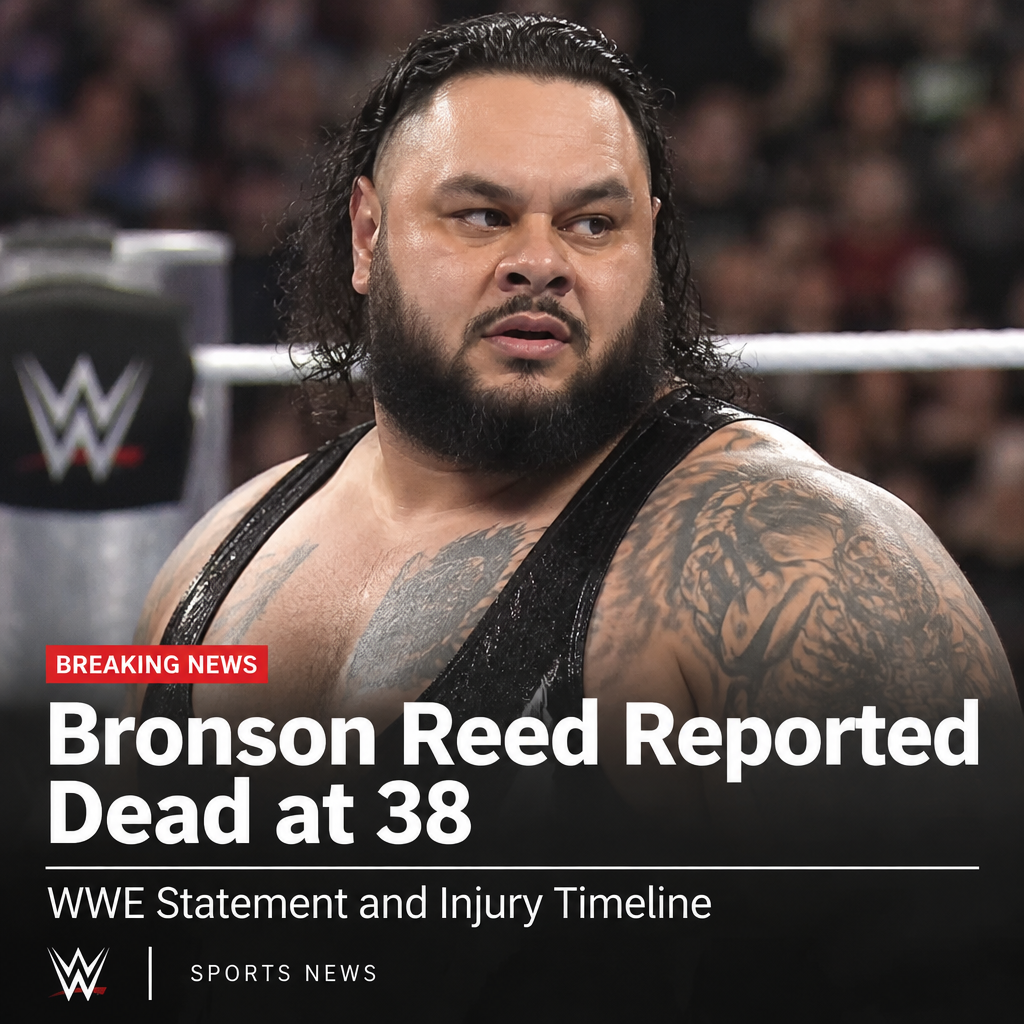
Bronson Reed Reported Dead at 38: What the WWE Statement and Injury Timeline Establish
WWE has reportedly announced that Bronson Reed, the 38-year-old wrestler whose real name was Jermaine Haley, has died from what the company described as “medical complications.” The announcement follows reports of a serious injury and surgery after Crown Jewel, but the available information does not establish that the injury caused his death.
The distinction between a reported statement and a complete medical explanation matters. The account of WWE’s announcement is brief, and the phrase “medical complications” does not identify what condition occurred, when it began, or whether it was connected to an earlier injury. Those details should not be guessed at, even when an emotionally charged timeline invites speculation.
The injury account is also made up of several attributed reports, not a public medical record. Sean Ross Sapp of Fightful was the first to report that Reed was injured at Crown Jewel, while Bryan Alvarez of Wrestling Observer Live later reported the broken ribs, lacerated kidney and surgery. Dave Meltzer of the Wrestling Observer Newsletter reportedly connected the injury to a particular on-screen fall. None of that, by itself, establishes why Reed died.
I separate the reported facts from the gaps because that is the only responsible way to cover a death involving a recent injury. Wrestling storylines are built for drama; medical reporting cannot be. The public deserves a clear account, while Reed’s family deserves privacy and care rather than a speculative diagnosis.
What Is the Bronson Reed Death Report?
The report concerns the death of Australian professional wrestler Bronson Reed, born Jermaine Haley, at age 38. WWE is said to have announced his death on a Friday and attributed it to “medical complications.” The report does not give the exact date, location, or a more specific cause. Those omissions leave important questions unanswered, but they do not justify filling the gaps with assumptions.
Reed had been active in WWE after returning to the company in 2022. His career also included work in New Japan Pro-Wrestling, Impact Wrestling and promotions in Australia and elsewhere, where he performed under names including Jonah Rock, Jonah and J-Rock. WWE’s official Bronson Reed profile is a useful reference for his public wrestling identity, though a profile page is not a medical notice.
In the account, the reported announcement came amid coverage of an injury at Crown Jewel in Saudi Arabia on Nov. 7. Reed did not wrestle a match at the event, according to the report, but entered a World Tag Team Championship bout involving Bron Breakker and Austin Theory of The Vision against Penta and Je’Von Evans. He then brawled with Oba Femi, who threw him from the stage and through tables.
That sequence matters because it gives context to the reports of injury and surgery. It does not prove a cause of death. Frankly, a sequence of events is not the same thing as a medical finding, and the available reports do not say that Reed’s death resulted from the fall, his injuries, the surgery, or any other particular cause.
The wording attributed to WWE should also be treated precisely. “Medical complications” is a broad description, not a detailed diagnosis. Without a more specific statement from the family or company, no responsible account can say what the complication was or whether it had any connection to Crown Jewel.
That restraint is not evasion. It is a basic standard for reporting on a person’s death. A wrestler is not only a public character, and an injury report does not give the public access to someone’s private medical file. The human dignity owed to Reed and his family requires a clear line between what has been reported and what remains unknown.
Core Details and Context
The first public accounts concern an injury, not a death. Fightful’s Sean Ross Sapp was described as the first reporter to say Reed had been hurt at Crown Jewel. He reportedly remained in Saudi Arabia after other WWE wrestlers and staff flew back to the United States. The account says a senior international executive and a member of WWE’s medical team accompanied him.
Alvarez later reported that Reed had suffered broken ribs and a lacerated kidney. The same reporting, cited by WrestlePurists, said he underwent surgery and was continuing his recovery. Another update said he had returned home from Saudi Arabia. These are specific claims, but they remain attributed reports; the information here includes no medical documents, surgical details or physician’s assessment.
Meltzer reportedly said Reed was injured during the spot in which Femi threw him off the stage and through tables. That account connects the injury to a moment in the show. It does not tell readers the severity of each injury beyond the conditions Alvarez reported, the treatment Reed received, or whether he had other health issues. More importantly, no report cited here supplies a medical conclusion connecting those injuries to the later announcement of his death.
The wrestling context is straightforward. Reed was involved in an angle during a tag-team title bout, rather than wrestling as one of the four competitors in that match. The brawl with Femi was part of the event’s on-screen action. Meltzer’s report, as described, says the injury happened on that spot. The physical nature of the segment is relevant, but it cannot stand in for a doctor’s explanation.
Reed’s career provides another part of the story. During his first WWE run, from 2019 to 2021, he won the North American Championship once. After leaving, he wrestled for New Japan Pro-Wrestling and Impact Wrestling, as well as in Australia and other international promotions. He returned to WWE in 2022 and, by the reports, remained with the company through 2026.
His later WWE run brought high-profile victories. Reed defeated major names, including Roman Reigns and Seth Rollins, and won the 2024 Andre the Giant Memorial Battle Royal. His Tsunami splash became a signature finish, a move that made his size and power central to how audiences understood his matches. Since 2025, he had been part of The Vision, a group whose reported membership shifted over time.
The Fightful wrestling coverage and Wrestling Observer coverage are among the outlets named in reports about the injury. The WrestlePurists site is cited for Alvarez’s updates. Readers should distinguish those attributed wrestling reports from an official medical explanation, which is not included in the account.
Here’s the kicker: even a detailed injury timeline cannot answer every question about a death. The date of the announcement, the specific medical complication and any connection to the Crown Jewel injuries are not reported in the details available. Until a reliable statement addresses those points, speculation adds noise rather than knowledge.

Timeline: What Was Reported
- Nov. 7 — Crown Jewel in Saudi Arabia. Reed did not wrestle a match, but reportedly appeared during the World Tag Team Championship bout between The Vision’s Bron Breakker and Austin Theory and the team of Penta and Je’Von Evans. He brawled with Oba Femi and was thrown off the stage through tables.
- After the event — Injury reports emerge. Fightful’s Sean Ross Sapp was reported as the first to disclose that Reed had been injured at Crown Jewel. The account says the injury meant he stayed in Saudi Arabia after other WWE performers and staff returned to the United States.
- During the Saudi Arabia stay — Medical support reported. Reed was said to have been accompanied by a senior international executive and a member of WWE’s medical team. The public account does not identify them, explain the treatment plan, or say how long Reed remained there.
- Later reporting — Details of injuries and surgery. Bryan Alvarez reported broken ribs and a lacerated kidney, with the information cited by WrestlePurists. Dave Meltzer reportedly tied the injury to the fall through the tables. Those reports describe an injury and its reported setting; they do not establish the cause of death.
- Following week — Return home and recovery. Alvarez reportedly said Reed had made it home and was continuing to recover from surgery. The exact date of that update is not provided here, so it should not be presented as a precise medical timeline.
- Friday — Death announcement reported. WWE was said to have announced Reed’s death at 38, using the phrase “medical complications.” The available account does not give a more specific cause, date of death, or an explicit link to the Crown Jewel injuries.
I read this sequence as a timeline, not a diagnosis. The order of reported events is clear enough to describe, but the causal relationship is not. A person can be injured, undergo surgery and later die without the public record establishing that one event caused another. Let’s be real: implying otherwise would go beyond the information available.
Comparison: Bronson Reed and Oba Femi in the Crown Jewel Segment
The closest on-screen comparison in the reported incident is Reed and Oba Femi, the two wrestlers involved in the stage-side brawl. They were not competing for a stated individual prize in that moment, and the comparison below is limited to what the account says about that segment. It is not a ranking of their careers or a claim about a continuing rivalry.
| Detail | Bronson Reed | Oba Femi |
|---|
| Role in reported incident | Entered the tag-team title segment and brawled with Femi | Brawled with Reed during the segment |
| Reported action | Was thrown from the stage and through tables | Threw Reed from the stage and through tables |
| Injury information in the account | Reportedly suffered broken ribs and a lacerated kidney; later underwent surgery | No injury claim about Femi is included in the account |
| Wider career details provided | Former North American champion; 2024 Andre the Giant Memorial Battle Royal winner | No comparable career history is provided in the account |
| What the comparison can establish | His reported involvement and injury timeline | His reported role in the on-screen spot |
The table has a deliberately narrow scope. It does not establish whether the performance was safe, whether anyone violated a rule, or what medical treatment was appropriate. Those questions would require evidence not included in the public account, such as medical findings or an official review. A dramatic wrestling spot is not proof of negligence, and an injury does not automatically establish fault.
It also does not make Femi responsible for Reed’s death. The account attributes the physical action to Femi and attributes the reported injury to that spot through Meltzer’s report. It does not say that Femi caused Reed’s death, nor does it establish a medical link between the injury and death. Those are very different claims.
For readers looking for a “competitor” comparison, the distinction matters. The event’s tag-team match involved Breakker, Theory, Penta and Evans, while the reported injury sequence involved Reed and Femi. Treating the two as opponents in a direct championship contest would misstate the details. The useful comparison is simply who did what in the described segment and what is, or is not, reported about each person afterward.
Common Misconceptions and What to Know
Misconception: The reported death was confirmed to have been caused by the Crown Jewel injury. The available account does not say that. It reports an injury, surgery, a return home and then a death announcement citing “medical complications.” A timeline can raise questions, but it cannot answer them without a medical source that explicitly links the events.
Misconception: “Medical complications” names a specific cause. It does not. The phrase is broad, and no particular condition is identified in the report. A responsible article should preserve that uncertainty rather than converting an umbrella phrase into a diagnosis. Guessing would be unfair to Reed’s family and misleading to readers.
Misconception: The injury reports offer a complete account of Reed’s medical care. They do not. The reports provide a few details—broken ribs, a lacerated kidney, surgery, a reported stay in Saudi Arabia and a return home—but not a clinical record. They do not identify the operation, the course of treatment, any later complications, or a doctor’s assessment.
Misconception: Reed wrestled a full match at Crown Jewel. The account says he did not. He reportedly interfered during a World Tag Team Championship bout and then brawled with Femi. That distinction matters when describing what happened. Calling it a match involving Reed would be inaccurate unless another source establishes otherwise.
Misconception: A performer’s on-screen role tells us everything about what happened backstage. It does not. A wrestling broadcast shows a performance, but it does not provide the full medical or production record. Reports say the injury occurred during a particular spot; the public details do not describe a full investigation or establish whether the spot had been rehearsed, modified or reviewed afterward.
Misconception: Reed’s career can be reduced to one injury report. His reported work spanned WWE, New Japan Pro-Wrestling, Impact Wrestling and promotions in Australia and elsewhere. He performed under several names, held WWE’s North American Championship, won the 2024 Andre the Giant Memorial Battle Royal and scored victories over prominent opponents. The injury is part of the news; it is not the whole account of his working life.
Misconception: The story gives the public a right to every private detail. It does not. Reed’s wife and daughter are named as surviving family, and the report says his wife is pregnant with their second child. Those facts explain the personal stakes, but they do not invite strangers to seek private information or pressure the family for details. The dignity of the people left behind should govern how the story is discussed.
Frankly, the strongest coverage here is not the loudest. It is the coverage that distinguishes an official statement, a reporter’s account, and an unknown medical fact. Wrestling fans can honor Reed’s work and ask fair questions about the sequence without treating rumor as evidence or turning grief into a storyline.
Frequently Asked Questions
What cause of death did WWE report for Bronson Reed?
The account says WWE described the cause as “medical complications.” It does not name a specific condition or provide a fuller medical explanation. No more precise cause should be asserted without a reliable statement that supplies it.
Did Bronson Reed’s Crown Jewel injury cause his death?
The available details do not establish that. Reports say Reed suffered broken ribs and a lacerated kidney at Crown Jewel, underwent surgery and later returned home. The death announcement is reported separately, and no medical source in the account links the injury to his death.
What happened to Bronson Reed at Crown Jewel?
He reportedly did not wrestle a match. He entered a World Tag Team Championship segment, brawled with Oba Femi and was thrown from the stage through tables. Dave Meltzer was reported as saying the injury occurred on that spot.
Who was Bronson Reed outside WWE?
Reed was the ring name of Australian wrestler Jermaine Haley. He also performed as Jonah Rock, Jonah and J-Rock, wrestled for New Japan Pro-Wrestling and Impact Wrestling, and worked in Australia and other international promotions. In WWE, he was a former North American champion and won the 2024 Andre the Giant Memorial Battle Royal.
Final Thought
A wrestling career is built in public, but a death is not a storyline. Reed’s achievements can be named plainly: the North American title, the Battle Royal victory, his work across promotions, the Tsunami splash and the high-profile opponents he defeated. The reports also describe a serious injury, surgery and a return home. Each fact belongs in the account, but none should be stretched into an answer that the medical details do not provide.
The line between the reported sequence and a proven cause matters most when readers are grieving or searching for an explanation. WWE is reported to have used the phrase “medical complications”; the available account does not explain it further. That is an honest boundary, not a failure to report. If the family or company later chooses to release more information, coverage can update the record without guessing in advance.
Reed leaves behind his wife, daughter and a second child on the way, according to the report. Their loss is not a footnote to a wrestling debate. It calls for patience, accuracy and respect—ordinary duties, perhaps, but the ones that matter when the public story touches a family’s private grief. Fans can remember the performer without claiming knowledge they do not have.