Cascadia High-Speed Rail: What the Portland–Seattle–Vancouver Plan Means
Cascadia High-Speed Rail is a proposed passenger-rail corridor linking Portland, Seattle and Vancouver, British Columbia, with trains envisioned at 160 to 220 mph. Washington is collecting public feedback as its service development plan moves toward a 2028 target; the line is still in planning, not construction, and its route, price and delivery date remain unsettled.
The deadline is close, but the larger question will take years to answer: what kind of rail service can the region actually build, and what will it cost? The project is in planning. There is no finished alignment, construction schedule or published final price in the project details described here, so claims that the train is imminent should be treated with care.
Cascadia’s planners are asking residents to weigh in while the service plan is being developed. Program administrator Ben Tripousis says the outreach is intended to help WSDOT understand what communities want to know and what concerns they have. That makes the survey more than a popularity poll: it is one early opportunity for the public to identify practical issues before later planning decisions become harder to change.
The case for studying the corridor rests partly on expected growth. Tripousis cited projections of about 3.4 million additional residents and 1.8 million new jobs in the region by 2050. WSDOT also projects that the share of Washington’s Interstate 5 operating at medium or high congestion could rise from 59% today to about 80%. Those figures point to pressure on existing travel options. They do not, by themselves, prove that a particular rail plan is affordable or feasible.
What is Cascadia High-Speed Rail?
Cascadia High-Speed Rail is a proposed intercity passenger service intended to connect three major Pacific Northwest cities: Portland, Seattle and Vancouver, B.C. The plan is built around faster trains and more direct travel between the corridor’s urban centers. WSDOT’s current work is a service development plan, a planning stage meant to examine how a future service might operate and what it would require.
The proposal should not be confused with a train that is already funded, designed or under construction. The service development plan is expected to conclude in 2028, according to WSDOT. After that, the process would move into formal environmental review, followed by design and construction stages. Each step can bring new questions, revisions and decisions. A target date for completing a plan is not a promise that trains will be running by that date.
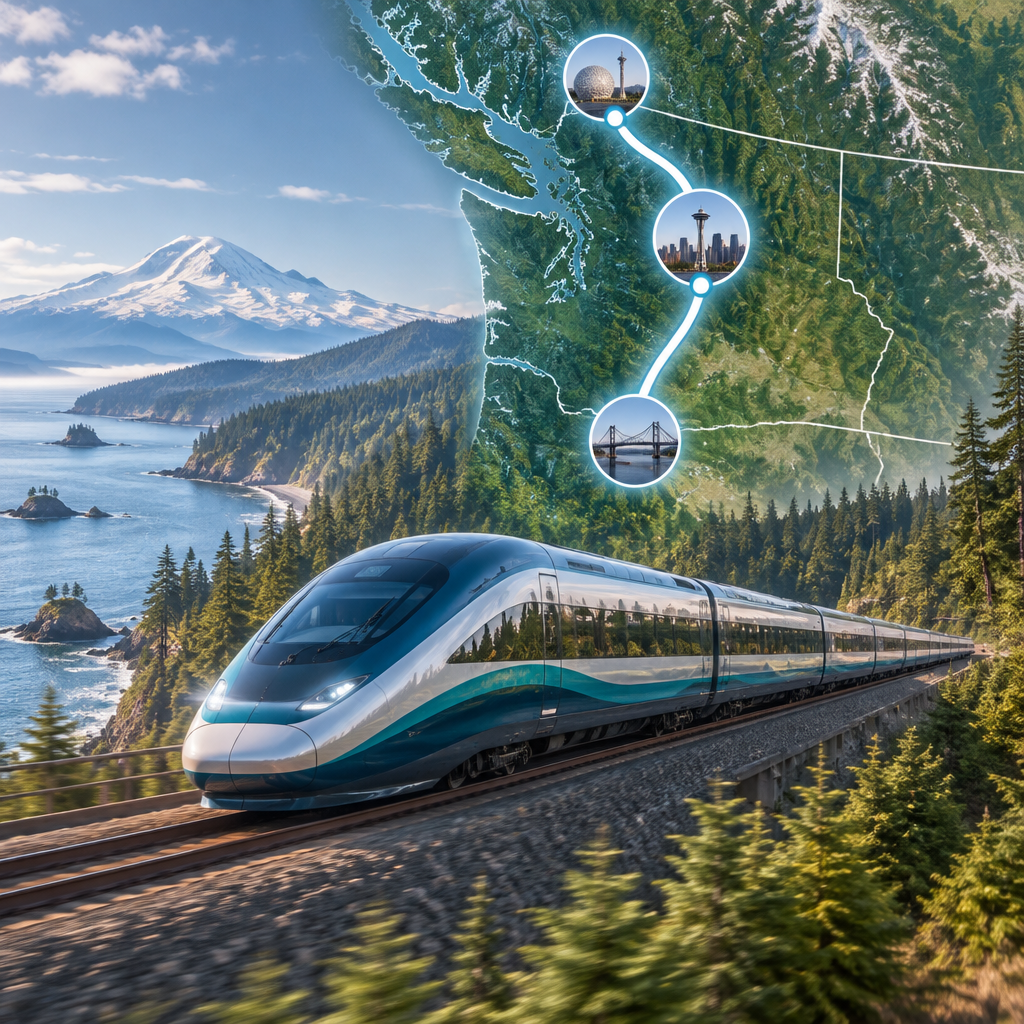
Speed is the distinction that gives the proposal its name. Tripousis said existing Amtrak Cascades trains top out at around 79 mph, while the proposed high-speed service is envisioned at 160 to 220 mph. That range describes a planning concept, not a confirmed operating speed for every part of the route. Curves, station stops, terrain, track design and other engineering choices can affect how fast trains travel in practice.
The city-to-city travel figures also need context. The proposal has been described as offering trips of roughly an hour between Vancouver and Seattle, and between Seattle and Portland, compared with about three hours by car. Those are reported possibilities, not a published schedule or guaranteed end-to-end travel time. The final journey would depend on the route, station locations, border procedures and how the service is designed.
WSDOT says the proposed system would not replace Amtrak Cascades. That distinction matters. The existing service would remain part of the region’s rail network, while the new proposal would be a separate, faster option if it advances. WSDOT’s Cascadia High-Speed Rail project information is the best place to follow the state’s published planning updates.
Core details and context
The proposal has an appealing headline: a much faster train between three busy cities. The harder work is in the details. Here are the main points residents should keep in view.
- A corridor serving three anchor cities. The proposed line would connect Portland, Seattle and Vancouver, B.C. That makes it an international transportation proposal as well as an intercity one. The precise station locations and route have not been settled in the information described here. Those decisions would determine how many people can reach the service conveniently, how much new infrastructure is needed, and how the train fits with local transportation.
- A planning target, not a construction commitment. WSDOT expects the service development plan to wrap up in 2028. A formal environmental review would follow, then design and construction. Those steps matter because a corridor concept must be tested against impacts on communities and the natural environment before a final project can be defined. Until that work is done, no single map or schedule should be mistaken for a final design.
- A large speed difference from today’s service. Amtrak Cascades trains currently reach about 79 mph at their top speed, according to Tripousis. The proposed service is intended to reach 160 to 220 mph. That is a substantial difference on paper, but top speed alone does not tell passengers how long a trip will take. Stops, acceleration, track layout and time spent at stations all count.
- A growth argument with real uncertainties. Tripousis cited estimates of 3.4 million additional residents and 1.8 million new jobs by 2050. WSDOT also projects that 80% of Interstate 5 in Washington could face medium or high congestion by then, compared with 59% today. These forecasts help explain why planners are studying additional travel choices. They cannot tell us, on their own, how many people will use high-speed rail or whether fares and operating costs will work.
- A separate service alongside Amtrak Cascades. WSDOT says the existing Amtrak route would not be replaced. That matters for communities that rely on current stops and service patterns. The relationship between the two systems—including how passengers transfer, where the services stop and how their schedules fit together—will be important in later planning. Amtrak’s Cascades service information provides a reference point for the rail service people can ride today.
- A cross-border operating challenge. Vancouver, B.C., is part of the proposed corridor, so planners must account for an international border. The project details cited here do not set out how border processing would work, how long it would take or what procedures would apply. Those are not minor scheduling details: the answers could affect the usefulness of a fast train for passengers making the full trip.
Frankly, the most important numbers are not only the headline speed and projected population. Riders will judge the service by the full trip: getting to the station, boarding, traveling, clearing any border procedures and reaching their destination. A fast train between inconvenient stations can still leave passengers with a slow day.
There is also a public-interest test. Large transportation projects use public money and reshape access to jobs, schools and services. Responsible planning means weighing cost and environmental effects alongside who benefits, who bears disruption and whether the service is usable for people without a car. That is stewardship in practical terms, not a slogan.
Timeline: what happens next?
The project’s sequence is straightforward on paper. The difficult choices are still ahead, and each phase can change the answer to what the final service looks like.
- Public input now. WSDOT is seeking feedback about questions and concerns related to the proposed rail system. Friday, Nov. 13, is the stated last day to complete the survey. Tripousis says the outreach is meant to help the program understand community views. A survey cannot settle engineering or funding questions, but it can show planners what people want addressed and where public concerns are concentrated.
- Service development plan through 2028. WSDOT says this phase is expected to wrap up in 2028. It is the current planning stage, where the state is developing the proposed service and examining the work needed to make it viable. When I compare that schedule with the project’s current status, the important point is that 2028 marks an expected planning milestone—not the opening of a railway.
- Formal environmental review. WSDOT says a formal review would follow the service development plan. That work would examine the effects of a defined proposal and inform decisions about whether and how to proceed. Details such as the chosen route and station sites matter here because environmental impacts are tied to the actual design, not simply the idea of a fast train.
- Design and construction. Design and construction would come after the planning and environmental stages, according to WSDOT. Their timing, cost and scope are not reported in the project details here. Before those steps can be treated as a schedule, decision-makers would need to settle the project’s design and address the approvals and resources it requires.
- Service begins only after the work is done. No opening date is provided. Even once construction is complete, operating a passenger railway requires trains, staff, stations, operating plans and coordination across the corridor. For an international service, coordination between jurisdictions is another practical requirement. It is premature to give a date for the first passenger trip without those decisions.
That timeline is less dramatic than a ribbon-cutting date, but it is the honest one. Public feedback belongs early in the process, when planners can still hear objections and consider different approaches. It does not mean every request can be met, nor does it guarantee that the project will advance unchanged. It means the record should show what the public raised and how officials addressed it.
The Federal Railroad Administration’s Corridor Identification and Development Program offers useful context on federal corridor planning. It is not a substitute for WSDOT’s project updates, and it does not establish a construction schedule for Cascadia. The distinction between planning programs and a funded, approved project is worth keeping clear.
Comparison: Cascadia High-Speed Rail vs. Amtrak Cascades
The most direct comparison is with Amtrak Cascades, because both proposals concern passenger rail in the same broad corridor. But they are not interchangeable services. One is an existing train network; the other remains a proposal in its service development phase.
| Measure | Cascadia High-Speed Rail proposal | Amtrak Cascades today |
|---|
| Status | In service development planning | Existing passenger-rail service |
| Cities in the proposed corridor | Portland, Seattle and Vancouver, B.C. | Amtrak Cascades serves cities along its current route; current details are published by Amtrak |
| Speed cited in the project information | Proposed range of 160–220 mph | Trains top out at about 79 mph, according to program administrator Ben Tripousis |
| City-to-city time cited | Roughly one hour between Vancouver and Seattle, and Seattle and Portland, described as a potential trip time | No comparable time is provided in the project details cited here |
| Relationship | Planned as an additional service | WSDOT says it would not be replaced by the proposed system |
| Next stated milestone | Service development plan expected to finish in 2028 | Operating service; consult Amtrak for current schedules |
The table shows why a speed comparison can mislead. The proposed 160-to-220-mph range is not the same as an average trip speed, and the roughly one-hour city-to-city figure is not a final timetable. A train’s full journey includes more than its fastest stretch of track. Station access, stops, dwell time and border procedures can all affect the clock.
Amtrak Cascades, by contrast, is a service people can use now. Its trains run at lower top speeds, but it has an established operating role and stops along the corridor. WSDOT’s statement that high-speed rail would not replace it suggests the proposal is meant to add a different option, not simply swap out the current one. Exactly how services might complement each other has not been reported in the details here.
Here’s the kicker: choosing between the two is not currently a choice passengers can make. Cascadia High-Speed Rail is still under study. The useful comparison today is between an operating service and a proposed future one—not between two trains with confirmed schedules and fares. Amtrak’s own service page is the appropriate source for current stops and timetables; the project’s final operating details remain unsettled.
Common misconceptions and what to know
Misconception: The project is already being built. It is not. WSDOT places Cascadia in the service development plan phase, expected to conclude in 2028. Environmental review, design and construction are described as later steps. A planning process can lead to a project, but it is not construction itself. Anyone presenting the line as a railway already under construction is getting ahead of the reported facts.
Misconception: The 2028 date is when the train will open. WSDOT’s stated 2028 target is for completing the service development plan. It is not a passenger-service launch date. The environmental review and subsequent design and construction stages would still lie ahead. No opening date is reported. In infrastructure, confusing a study milestone with a service date is not a small error; it can make a long process sound deceptively near completion.
Misconception: A top speed of 220 mph guarantees one-hour trips. It does not. The speed range is a proposed capability, while travel time depends on the full route and operating plan. The roughly one-hour figures have been reported as potential trips between the anchor cities, not as confirmed schedule promises. Stations, stops, track geometry and cross-border procedures could all affect the result. The precise effect of each has not been reported.
Misconception: High-speed rail will replace Amtrak Cascades. WSDOT says it will not. The existing Amtrak service and the proposal have different statuses and speeds. That does not answer every question about how they might share passengers, stations or connections, but it does rule out the simple claim that the current service is being removed as part of the proposal.
Misconception: Growth forecasts prove the project is necessary. Forecasts can identify pressure on roads and the need to examine more travel choices. They cannot, on their own, determine which option is best. The regional projections cited by Tripousis—3.4 million additional residents and 1.8 million new jobs by 2050—are reasons to plan. The projected increase in I-5 congestion is another reason to study alternatives. Neither figure answers questions about cost, ridership, construction effects or operating support.
Misconception: A survey vote decides the project. Public input can inform planning, expose concerns and help officials understand community priorities. It is not the same as final approval, a funding decision or an environmental determination. Residents can use the survey to raise practical concerns—station access, construction disruption, affordability, local impacts and connections to existing transport—without assuming one response will settle the project’s future.
Most coverage focuses on the attractive headline: two cities in about an hour. The harder questions deserve equal attention. Who can reach the stations? What land and infrastructure would be needed? How would construction affect nearby communities? How much would a ticket cost? The project details cited here do not answer those questions, and it is better to say so than to fill the gaps with guesses.
Frequently asked questions
When is the Cascadia High-Speed Rail survey due?
The stated final day is Friday, Nov. 13. The survey is part of WSDOT’s effort to learn what communities want to know and what concerns they have about a potential high-speed rail system. The project page is the official place to check for current information and survey access. Completing a survey is an opportunity to comment, not a vote that approves or rejects construction.
When will Cascadia High-Speed Rail be finished?
There is no reported opening date. WSDOT expects the service development plan to finish in 2028. Formal environmental review, design and construction would follow. The end of the planning phase should not be confused with the start of passenger service; the project has several major stages remaining.
How fast would the proposed trains go?
The proposed range is 160 to 220 mph. For comparison, Tripousis said current Amtrak Cascades trains top out at about 79 mph. The higher figure is a planning goal, not a statement that every part of the route would operate at that speed. Final operating speeds and travel times have not been reported.
Would high-speed rail replace Amtrak Cascades?
No. WSDOT says Amtrak Cascades would not be replaced by the proposed high-speed rail service. How the two services might connect or operate alongside each other has not been detailed in the information cited here. Amtrak publishes current information about the service it operates today.
Final thought
Cascadia High-Speed Rail is worth examining because the region faces real questions about growth, congestion and access to jobs. A passenger service linking Portland, Seattle and Vancouver, B.C., could offer a different way to travel if planners can make the route useful, affordable and practical. But a promising idea is not yet a working railway. The public should judge the proposal on what the planning process establishes, not on a headline speed alone.
The next responsible step is clear: WSDOT should explain what it heard, show how public concerns shape the service plan and be candid about what remains unknown. That means distinguishing projections from commitments and potential journey times from published schedules. It also means assessing who gains access and who carries the costs or disruption. Transportation spending is a stewardship decision, and the common good depends on more than a fast trip between city centers.
Residents who complete the survey by Friday, Nov. 13, can put specific questions on the record while the service development plan is still underway. They should ask for useful connections, transparent costs, clear environmental review and a realistic account of how the proposed system would serve communities along the corridor. The train may be years away, if it is built at all. The quality of the questions asked now will help determine whether the eventual plan deserves public confidence.