Washington Superintendent of Public Instruction Chris Reykdal says he will not seek a fourth term, but he has left open a possible 2028 run for governor or...
Chris Reykdal Leaves the Door Open to a 2028 Governor’s Race as Ferguson Criticizes School Results
Washington Superintendent of Public Instruction Chris Reykdal says he will not seek a fourth term, but he has left open a possible 2028 run for governor or another statewide or federal office. His announcement, paired with Gov. Bob Ferguson’s sharp criticism of student test scores, has turned a succession decision into an early political test.
This is not yet a two-candidate race. Reykdal told McClatchy he was not ruling out a future campaign, including for governor, while also saying he had not decided and was not shopping around for a position. That distinction matters: an open door is not an announcement, and speculation about a 2028 contest should not be mistaken for a filed campaign or a settled political plan.
The timing has nevertheless made the question hard to ignore. Reykdal announced his decision on Nov. 9; the next day, Ferguson called for a change in the superintendent’s role and described student results as mediocre. Both men are Democrats, although the superintendent’s office is formally nonpartisan. That mix of an early succession announcement, criticism from the governor, and an unconfirmed future bid has created a political story before the candidates are known.
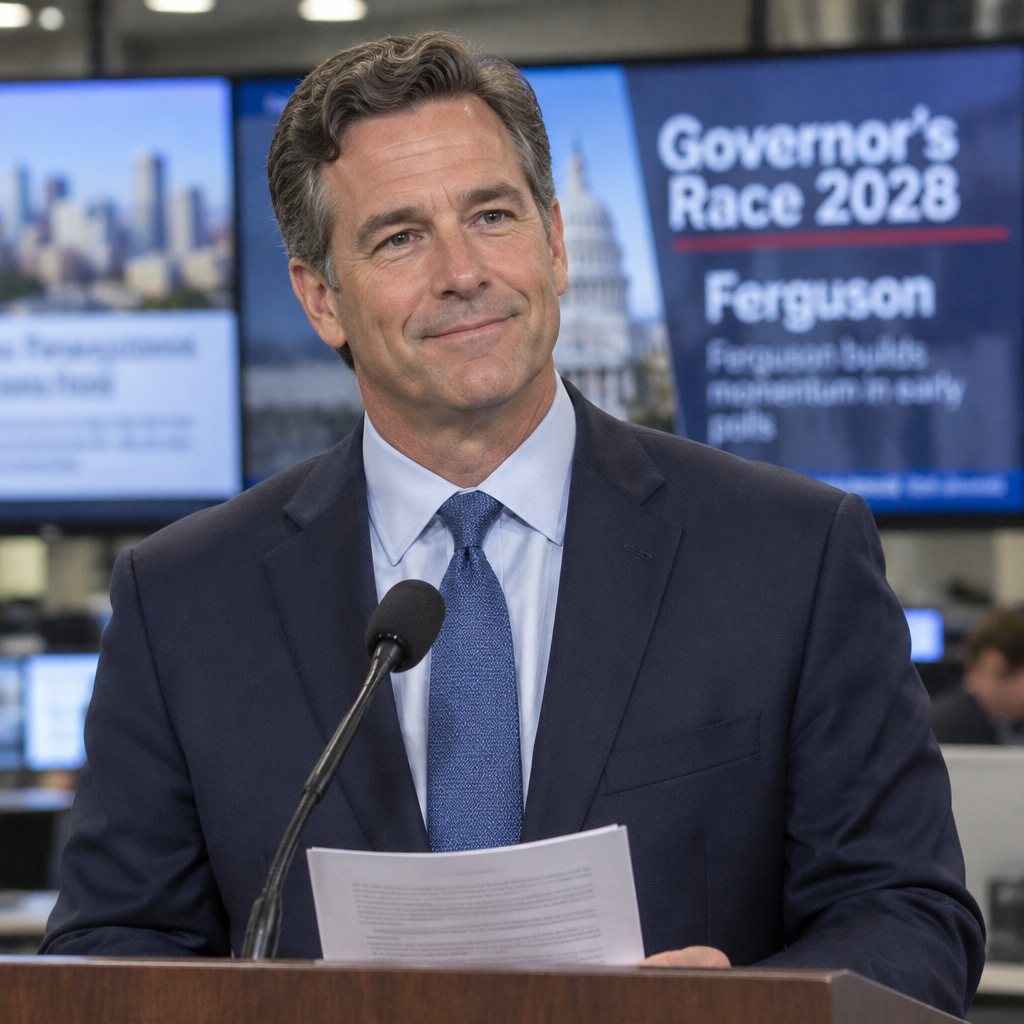
What Is Chris Reykdal’s 2028 Political Opening?
Chris Reykdal is Washington’s superintendent of public instruction, the official responsible for leading the state’s education agency, the Office of Superintendent of Public Instruction, commonly called OSPI. He previously served as a Democratic state representative. In his Nov. 9 announcement, he said he would not seek a fourth term as superintendent and described the decision as an application of his own belief in term limits. OSPI publishes the announcement through its news release page.
The significant part for 2028 is not that Reykdal has declared a new campaign. He has not. In a Thursday call with McClatchy, he said he would consider remaining in elective office or pursuing a statewide or federal position, and acknowledged that a run for governor was one possible interpretation. He immediately added that he had not made that decision. The distinction can sound fussy, but it is the difference between reporting a possibility and reporting a candidacy.
Reykdal said he was considering where he could make the biggest difference, not looking for a job title. That is a useful description of his stated position, but it leaves the central political question unanswered: which office, if any, will he pursue? He did not name another specific office. Nor did he say that a run against Ferguson was settled. The available record supports talk of an option, not a campaign timetable or platform.
The governor’s response sharpened the story. On Nov. 10, Ferguson posted a video on Facebook saying Washington was “past due for a change” in the superintendent’s role and criticizing student test scores as “mediocre.” Reykdal told McClatchy he suspected his announcement put the incumbent governor in “attack mode.” He said he does not dehumanize people, adding that “everyone has their own style.” Those are Reykdal’s descriptions of the exchange, not an independent finding about Ferguson’s motive.
Frankly, a few pointed remarks do not prove that two politicians are preparing to compete for the same office. They do show why the possibility has become politically salient. The sitting governor publicly criticized the performance of the sitting superintendent just as the superintendent announced he would leave his post. That sequence invites questions about ambition, policy, and accountability, but it does not answer them. A fair account has to preserve that uncertainty.
Core Details and Context
The dispute involves more than personalities. It touches education policy, state accountability, leadership, public opinion, and the use of student assessments in political arguments. Test scores can reveal serious gaps; they cannot, on their own, identify the cause of those gaps or prove that replacing one official will fix them.
The figures at the center of Ferguson’s criticism deserve careful handling. The Washington State Standard reported earlier this year that Washington had fallen from 27th to 31st in one national education ranking. The report also cited the 2026 Annie E. Casey Foundation report, which said that in 2024, 68% of Washington fourth graders were not proficient in reading and 70% of eighth graders were not proficient in math. The foundation’s 2026 KIDS COUNT Data Book provides a broader context for state-level child and education indicators.
Those numbers are troubling. They are not the same thing as saying that every student is failing, nor do they establish that scores have worsened in every subject, school, or year. “Not proficient” is a defined assessment category; it does not mean a child knows nothing or cannot improve. The figures also describe results from 2024, while the public argument occurred in 2026. The lag does not make the data useless, but it should be stated plainly.
There is also a difference between a ranking and a test result. A state ranking is a relative measure that depends on the indicator set and comparison method used. A change from 27th to 31st may be a warning, but without the ranking’s full methodology it cannot carry the whole argument. A single reading or math percentage is more direct, yet it still needs context: which students took the assessment, what proficiency means, how results compare over time, and what programs were in place.
When I compare the cited evidence with Ferguson’s video, the main gap is straightforward: the video made a broad judgment but, according to the report, did not cite specific research. The underlying figures reported elsewhere give the criticism some factual context. They do not show that Ferguson’s preferred response is effective, because the video as described did not present a detailed policy proposal or evidence tying a particular leadership change to improved scores.
Reykdal’s response was political too. He suggested Ferguson was responding to his announcement and said the governor wants to win again. That is Reykdal’s interpretation, not proof of the governor’s calculation. A skeptical reader should resist both easy stories: that the governor’s criticism is purely a campaign maneuver, and that Reykdal’s interest in future office is purely public service. Motives are difficult to establish from remarks alone; policy plans and public records will be more revealing.
The office itself matters. The superintendent is not simply a campaign spokesperson for a party, even though Reykdal previously served as a Democrat in the Legislature and both men are Democrats. The superintendent’s role is formally nonpartisan. That makes the public argument about education performance especially consequential: voters need to judge administrative decisions and policy results, not rely on party labels as a substitute for evidence.
Education is a shared public responsibility, not just a scorecard for elected officials. Stewardship of public resources and respect for the dignity and potential of each child should guide the debate, especially for families who have the least ability to make up for weak schools on their own. That principle does not excuse poor results. It demands honest measurement and practical remedies.
Timeline: What Happened and When
- Nov. 9 — Reykdal announces he will not seek a fourth term. In an OSPI news release, he says he believes in term limits and is applying that principle to himself. He does not identify a new office he plans to seek. The announcement begins a succession discussion, but does not itself launch a campaign.
- Nov. 10 — Ferguson criticizes education results. In a Facebook video, the governor says the state is “past due for a change” in the superintendent role and calls student scores “mediocre.” The reported video did not cite specific research. That omission matters because a strong political judgment is easier to assess when officials name the measures and policy changes behind it.
- The following Thursday — Reykdal discusses possible future office. In a call with McClatchy, he says he is not ruling out elective office, a statewide position, or federal office. He confirms that a possible run for governor fits the interpretation, while stressing that he has not decided. I would read this as an intentionally open answer, not a declaration.
- In the same interview — Reykdal answers the governor’s criticism. He says his announcement may have put Ferguson in “attack mode,” and describes the governor’s political style in pointed terms. He also says he does not dehumanize people. The exchange adds friction, but it remains an exchange of public statements, not proof of a formal contest.
- The next campaign question remains open. Reykdal names no specific alternative office and says he is not shopping around. Meanwhile, the story turns to two congressional possibilities raised in public discussion: a House race tied to his South Sound base, or a possible Senate opening. Those are hypotheticals, not confirmed plans.
The timeline is short, which is one reason caution is warranted. The announcement and criticism arrived close together, but timing alone cannot establish that one caused the other. Reykdal himself connected the governor’s reaction to his announcement; Ferguson’s own explanation was not available in the reported account. McClatchy had reached out to the governor’s office for comment. No response was reported there.
Comparison: Reykdal’s Possible Bid vs. Ferguson’s Position
The most obvious comparison is between Reykdal as a possible challenger and Ferguson as the incumbent governor. But the table describes a hypothetical political matchup, not a declared race. The available information puts the two men at very different levels of commitment.
| Question | Chris Reykdal | Bob Ferguson |
|---|
| Current position | Washington superintendent of public instruction | Washington governor |
| Public status for 2028 | Has not ruled out another statewide or federal office; no decision announced | Incumbent governor; publicly criticized the superintendent’s performance |
| Direct evidence of a governor’s campaign | Said a run could be considered, then said he had not decided | Reykdal said Ferguson wants to win again; the reported account does not establish a formal campaign announcement |
| Recent political action | Announced he will not seek a fourth superintendent term | Posted a Nov. 10 video calling for change in the superintendent role and criticizing test results |
| Main unresolved issue | Which office, if any, he will seek | Whether he will seek another term and what education policy he would advance |
Here’s the kicker: the apparent matchup is more vivid than the evidence behind it. Reykdal’s statement leaves several paths open, including no run at all. The report says Sen. Patty Murray, 76, reportedly plans to run again in 2028, which makes a Senate opening uncertain; Reykdal has not said he wants her seat. Speculation about that possibility is not a substitute for a statement from either candidate.
A House path has also been discussed because Reykdal lives in Tumwater, in Washington’s 10th Congressional District, which includes parts of Thurston and Pierce counties and is represented by Rep. Marilyn Strickland, according to the Northwest Progressive Institute. The reported discussion noted that a House member does not have to live in the district represented. Even so, geographic fit is not proof of intent. A familiar base may make a hypothetical more plausible, but it does not reveal whether Reykdal would run or whether voters would support him.
The comparison also shows why policy substance should outrank campaign chess. Ferguson is the elected governor and has criticized education results; Reykdal leads the state education agency and has an announced departure date from its top job. Voters should ask what each says about reading instruction, math performance, school funding, accountability, and implementation. Until they do, the argument risks becoming a contest about who criticized whom first.

Common Misconceptions and What to Know
Misconception: Reykdal has announced a run for governor. He has not. He said a gubernatorial campaign was one option he would consider and explicitly said he had not decided. A headline or social post that turns that answer into a candidacy would overstate what he said. The distinction is not technical hair-splitting; it affects how voters interpret fundraising, endorsements, and political strategy.
Misconception: Ferguson’s criticism proves he is trying to force Reykdal out. The governor’s video criticized the superintendent’s role and test results. Reykdal offered his own interpretation that Ferguson was reacting to the announcement. Neither fact, by itself, establishes the governor’s motive. The public can assess the words and timing; claims about private intent require more evidence.
Misconception: A state ranking tells the whole story about schools. Rankings compress multiple measures into a single position. They can attract attention, but they can also hide the methods and details that matter to families: grade, subject, student group, year, and the size of the change. The reported 27th-to-31st movement should be treated as a signal worth investigating, not a complete diagnosis of Washington education.
Misconception: The proficiency figures mean most students cannot learn the material. The cited report says 68% of fourth graders were not proficient in reading and 70% of eighth graders were not proficient in math in 2024. “Not proficient” describes performance against an assessment benchmark. It does not label a child permanently or tell us what instruction, support, or time the student needs. The figures identify a broad problem; they do not define individual students.
Misconception: A new superintendent would automatically improve scores. Leadership can matter, but outcomes also depend on decisions across schools and districts, the clarity of state policy, the quality of classroom support, and whether promised programs reach students. Ferguson’s video, as reported, did not cite evidence that changing the officeholder would cause scores to rise. Nor does the absence of that evidence prove a change could never help. The fair question is what specific action is proposed and how success would be measured.
Misconception: The possible congressional options are established plans. Reykdal did not name Strickland’s House seat or Murray’s Senate seat as a target. The South Sound connection and discussion of the two seats make useful political context, not an announcement. The Senate possibility is especially uncertain because the report says Murray reportedly intends to run again. Treating either scenario as decided would turn rumor into supposed fact.
Let’s be real: the easiest version of this story is a drama about two Democrats circling the governor’s mansion. The more useful version asks what each official will do about the results, what evidence supports their proposals, and whether their stated plans can be carried out. Campaign speculation will keep attention. Students and families need answers that survive after the speculation fades.
Frequently Asked Questions
Is Chris Reykdal running for governor in 2028?
He has not announced a run. Reykdal said he would consider a statewide office and acknowledged that a run for governor could be under consideration, but he also said he had not decided. His public position leaves the possibility open; it does not establish that he will enter the race.
Why is Chris Reykdal leaving the superintendent’s office?
In his Nov. 9 announcement, Reykdal said he believes in term limits and is applying that principle to himself. He has said he will not seek a fourth term. The announcement does not, by itself, identify a single successor or confirm which role he may pursue next.
What did Bob Ferguson say about Washington student test scores?
In a Nov. 10 Facebook video, Ferguson called the scores “mediocre” and said the state was “past due for a change” in the superintendent role. The reported video did not cite specific research. The figures discussed in coverage include 2024 proficiency results reported by the Annie E. Casey Foundation, as well as Washington’s position in one education ranking.
Could Reykdal run for Congress instead?
That remains speculation. The reported discussion pointed to the 10th Congressional District because Reykdal lives in Tumwater, and also raised the Senate as a theoretical possibility. Reykdal did not identify either seat as a target. The report also said Murray reportedly plans to run again in 2028, making a Senate vacancy uncertain.
Final Thought
Reykdal’s decision not to seek another superintendent term is clear. His next move is not. That gap is where political conjecture tends to multiply, especially when the governor’s criticism arrives a day after an announcement that could eventually put the two officials in the same contest. The sensible approach is to keep the confirmed facts separate from the scenarios: Reykdal has left the door open, Ferguson has criticized education performance, and no head-to-head 2028 campaign has been established by the reported statements.
The sharper question is what evidence and policy follow the rhetoric. Washington’s reported reading and math figures warrant serious attention, not a quick round of blame. Officials should identify which students are struggling, which measures they use, what interventions they support, and how they will judge whether those interventions work. A ranking can alert the public; a plan should explain what happens next. Neither an attack video nor an unconfirmed candidacy does that work on its own.
I find the strongest test of this story is not whether Reykdal can make a plausible political move. It is whether elected leaders can discuss school performance without turning students into props in a partisan argument. A government owes the public candor about disappointing results and care in choosing remedies. That means giving families clear data, giving educators workable direction, and treating every child’s prospects as more than a campaign line. The 2028 question may eventually have an answer. The school questions are already here.