Christina Applegate and the MS Misdiagnosis Claim: What’s Verified
Christina Applegate’s multiple sclerosis diagnosis is part of the public record, but the claim that she was later told she does not have MS needs stronger evidence than a short, unattributed excerpt. Applegate disclosed her diagnosis in 2021. A report of a later reversal would be significant; without a dated episode, complete quotation, or reliable corroboration, it should not be presented as established fact.
The distinction matters. A person may discuss uncertainty, an additional condition, a mistaken test, or an earlier misunderstanding without their overall diagnosis being withdrawn. The wording in the excerpt—“you don’t have MS”—sounds definitive, but a quote without the surrounding conversation can mislead. I would not turn that sentence into a medical update until the original recording or a credible report confirms its meaning. This is not a judgment about Applegate’s health; it is a basic standard for reporting sensitive claims about any person.
What is the Christina Applegate MS misdiagnosis claim?
The claim, as supplied, says that Applegate returned to her podcast, “MeSsy,” after a seven-month break and described a doctor telling her, “Congratulations, you don’t have MS.” It frames the exchange as evidence that she had been misdiagnosed with multiple sclerosis. But the excerpt gives no episode title, publication date, link to the recording, description of the medical visit, or explanation of what the doctor meant. Those gaps are not minor details. They determine whether the headline is accurate.
Applegate announced in August 2021 that she had been diagnosed with multiple sclerosis. That announcement was widely reported, including by People’s coverage of her diagnosis. A public disclosure does not give reporters access to private medical records, and it does not mean a person’s health can never change. It does mean that a later claim overturning the diagnosis deserves careful sourcing. A brief quote, detached from its context, is not enough to establish that a diagnosis was formally withdrawn.
Multiple sclerosis, commonly called MS, is a disease involving the central nervous system. It affects the brain, spinal cord, and optic nerves, and symptoms vary considerably from person to person. The National Institute of Neurological Disorders and Stroke describes MS as a condition in which the immune system damages myelin, the protective covering around nerve fibers. That damage can disrupt communication between the brain and the body. It is a complicated condition, not a label that can be confirmed or erased from one sentence alone.
Here is the kicker: online headlines often flatten complicated medical conversations into a clean reversal—diagnosed, then “not MS”—because that version is easy to repeat. A person might instead be discussing a test result, a suspected complication, a second opinion, or a separate illness. I cannot infer which, if any, applies here from the supplied excerpt. The responsible description is that the excerpt makes a claim; it does not, by itself, verify one.
That caution is not evasiveness. Applegate’s medical privacy deserves respect, and readers deserve reporting that separates a confirmed disclosure from an unverified interpretation. Both standards can be upheld at once.
Core details and context
MS diagnosis is not usually based on one symptom or one laboratory result. A neurologist considers a person’s history, neurological examination, imaging, and, where appropriate, other tests. The Mayo Clinic’s overview of MS diagnosis and treatment explains that doctors may use MRI scans, spinal-fluid analysis, and other investigations to assess whether findings fit MS and to rule out other causes. No single test settles every case. The process can take time, especially when symptoms overlap with those of other conditions.
That complexity cuts both ways. It makes an initial diagnosis a serious medical judgment, and it means a later clinician may revisit that judgment if new evidence appears. Reassessment is a normal part of medicine, not proof that a doctor was careless or that a patient’s earlier account was untrue. But a report claiming a diagnosis has been overturned should specify what was reassessed, who explained the result, and whether the person herself says the diagnosis changed.
Several distinctions matter when reading a story like this:
- A diagnosis versus a suspicion: Doctors sometimes investigate MS before they can confirm it. A suspected condition is not the same as a final diagnosis.
- An additional condition versus a replacement: Someone can have MS and another illness. Finding a second explanation for a symptom does not automatically cancel the first diagnosis.
- A test result versus a full clinical assessment: One scan or test may alter a doctor’s thinking, but diagnosis draws on the complete medical picture.
- A quotation versus its context: A striking line may refer to one test, one concern, or a conversation about someone else. The full recording matters.
- A personal account versus independent confirmation: A public figure can describe private medical news directly; a news outlet should still quote accurately and identify what is known.
I’ve covered health claims long enough to be wary of dramatic certainty without documents or context. “Misdiagnosed” is a heavy word. It can suggest that an earlier clinician made an error, even when the actual story might be a careful revision of a provisional diagnosis. Frankly, the label should be used only when the person or a reliable, well-sourced report establishes that the earlier diagnosis was wrong.
There is also a human cost to careless framing. People with chronic illness routinely face suspicion, unsolicited theories, and pressure to prove that their symptoms are real. Responsible coverage protects human dignity: it does not turn a person’s health into a guessing game, nor does it treat uncertainty as a scandal. The public interest lies in getting the facts right, not in making private medical details more dramatic than the evidence supports.
For now, the strongest points available from the supplied text are limited: it attributes a quote to Applegate and says it came during a return to “MeSsy.” It does not provide the original audio or enough information to verify the supposed reversal. Any article repeating the claim should state that limitation plainly and update the account if reliable details emerge.
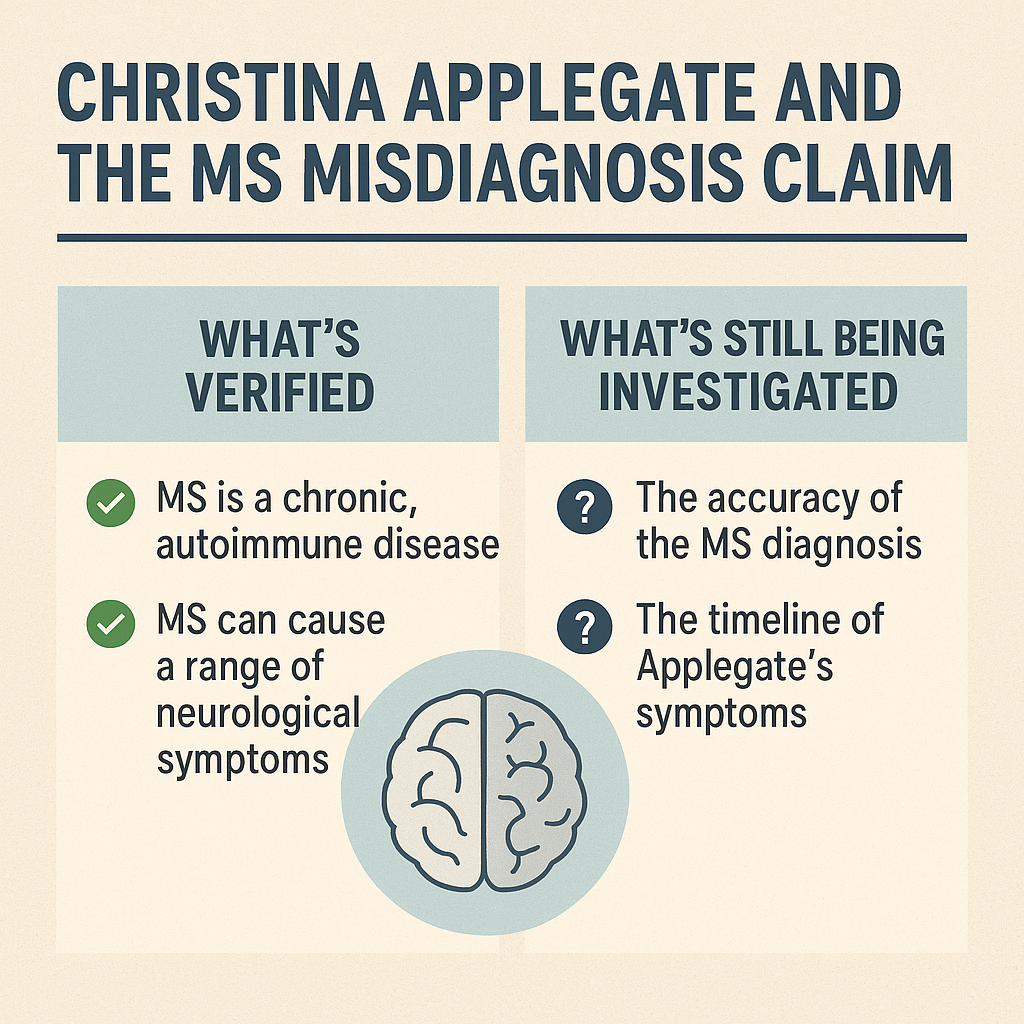
Timeline: what is established and what remains unclear
- August 2021 — Applegate discloses an MS diagnosis. She announced publicly that she had been diagnosed with multiple sclerosis. The statement was reported at the time by major media outlets. That is the verified starting point for coverage of her diagnosis.
- After the announcement — She speaks publicly about living with MS. Applegate has discussed the difficulty of her health and its effect on her life. Such public comments can provide personal perspective, but they are not a substitute for medical records and should not be stretched into claims she did not make.
- The supplied excerpt — A later statement is attributed to her. It says that she returned to “MeSsy” after a seven-month break and quotes a doctor as saying she did not have MS. The excerpt does not provide a date, an episode link, or the surrounding exchange. That makes independent verification necessary.
- The necessary next check — Listen to the full episode and inspect credible reporting. The full conversation could clarify whether the doctor was addressing Applegate, a particular test, a provisional diagnosis, or some other issue. A reputable report should identify the episode and distinguish the speaker’s exact words from the writer’s interpretation.
- Until then — Keep the claim attributed, not definitive. A careful headline would say the excerpt “claims” or “reports” a reversal, rather than declare that Applegate was misdiagnosed. If the full recording and reliable coverage establish that her diagnosis changed, the account can be updated with those specifics.
When I assess a timeline like this, I separate the event from the interpretation. The public diagnosis is documented; the alleged reversal, as presented here, lacks enough supporting detail. That is a real difference, even if it makes for a less sensational headline. A timeline should not fill its gaps with assumptions.
The distinction also protects the reporting from a common trap: presenting a later development as if it erases all earlier information. If a person receives a new assessment, the accurate account records both the original disclosure and the later change, with dates and attribution. It does not silently rewrite the history or imply that someone knowingly misstated their health.
Comparison: MS diagnosis and a misdiagnosis claim
| Point | Established MS diagnosis | Claim of later misdiagnosis |
|---|
| Public evidence in this case | Applegate publicly disclosed an MS diagnosis in 2021; the announcement was reported by People and other outlets. | The supplied excerpt provides a quote but no episode link, date, or independent confirmation. |
| What the phrase means | A clinician’s diagnosis is based on medical assessment; public disclosure reports what the person has said about that assessment. | “Misdiagnosed” means an earlier diagnosis was wrong. That conclusion needs clear support, not just a decontextualized line. |
| What a reporter should check | The original public statement and reputable contemporaneous coverage. | Full podcast audio, precise context, and a reliable source confirming what changed. |
| Safe wording | “Applegate disclosed an MS diagnosis in 2021.” | “An excerpt attributes a statement about not having MS to Applegate; the claim requires verification.” |
This is not a contest between Applegate and a rival person or organization. The prompt asks for a comparison with a “biggest competitor,” but a health diagnosis has no meaningful competitor. The useful comparison is between what is documented and what the excerpt alleges. Pretending that another celebrity, disease, or treatment competes with this claim would add noise, not reporting.
Common misconceptions and what to know
Misconception: A quote proves the diagnosis changed. It does not. A quote can be genuine and still be incomplete. The doctor may have been referring to a specific result, a possibility ruled out at that moment, or an issue other than the overall diagnosis. Without the surrounding exchange, readers cannot know. The full episode and the speaker’s own clarification are more useful than a clipped quotation passed along without a source.
Misconception: If doctors reassess a diagnosis, the original disclosure was dishonest. That conclusion does not follow. Medicine develops as evidence accumulates. An initial assessment can be revised in good faith, and an illness can coexist with another condition. Someone describing what they were told at one point is not necessarily making a permanent claim about every later test or opinion.
Misconception: MS is easy to confirm or rule out. It is not. Symptoms may resemble those of other neurological conditions, and doctors use several kinds of evidence. The National Multiple Sclerosis Society’s MS information explains the condition and its varied effects. General medical information can explain how diagnosis works, but it cannot establish what happened in Applegate’s private medical care.
Misconception: Public figures have surrendered their medical privacy. They have not. Applegate’s decision to discuss MS publicly does not make every detail of her care public property. Journalists can report what she chooses to disclose while refusing to speculate about unshared test results, doctors, or treatment. That boundary is not special treatment; it is ordinary respect for patient privacy.
Misconception: A dramatic headline is the same as a verified update. Headlines are claims, too. Readers should look for a date, a named source, links to the original interview, and clear language about what is confirmed. If the story does not provide those basics, treat the strongest assertion with caution. Let’s be real: emotionally charged medical news spreads faster than careful corrections, which is exactly why the initial wording matters.
A practical reader’s test is simple. Ask: Is this an original recording or a summary? Does the story quote the full relevant exchange? Does it distinguish a confirmed medical fact from a reporter’s interpretation? Has the person herself described a formal change in diagnosis? If the answers are missing, the claim may still be true, but the available evidence does not justify stating it as settled fact.
The same discipline applies to health coverage generally. Don’t diagnose from a distance. Don’t imply that a person’s illness is imaginary because a claim is unverified. And don’t turn a question mark into a declaration just to make a headline sharper. Good reporting is a form of stewardship: it handles information carefully because readers and the people named in a story both bear the consequences of careless words.
Frequently Asked Questions
Did Christina Applegate say she was misdiagnosed with MS?
The supplied excerpt attributes to her a doctor’s statement that she does not have MS and frames it as a misdiagnosis. It does not include the original episode, date, or context, so the claim cannot be confirmed from that excerpt alone. Check the full “MeSsy” recording and reliable reporting before repeating it as fact.
When did Applegate publicly disclose her MS diagnosis?
Applegate publicly disclosed that she had been diagnosed with multiple sclerosis in August 2021. Her announcement was covered by outlets including People. The disclosure is a verified public statement; it does not, by itself, establish whether a later medical assessment occurred.
Can doctors change an MS diagnosis?
Yes. Clinicians can reassess a diagnosis when they receive new information or reconsider earlier findings. MS evaluation can involve symptoms, neurological examinations, imaging, and other tests. A specific case cannot be assessed from a quote alone, and only Applegate or a reliable report with direct sourcing can clarify what happened to her diagnosis.
What should readers look for in coverage of the claim?
Look for the complete podcast episode, a publication date, the exact context of the quotation, and reporting that separates confirmed details from interpretation. Be cautious if a headline says “misdiagnosed” but the article offers no source showing that the diagnosis was formally withdrawn.
Final Thought
A clear correction, if one exists, deserves accurate coverage. So does the original announcement. Those facts can sit beside each other without turning a person’s health into a spectacle. The supplied excerpt raises a potentially important question, but it does not answer it: what exactly did the doctor mean, and was Applegate’s overall diagnosis formally changed?
Until a full recording or credible report supplies those details, the honest answer is that the excerpt’s claim remains unverified here. That is less tidy than announcing a shocking reversal, but the work of news reporting is not to make an account tidier than its evidence. It is to show what is known, mark what is not, and correct the record when better information arrives.
I would apply the same standard whether the person in the headline were a famous actor or someone no one recognized. Medical claims can affect public understanding of a disease, shape how patients are treated, and spread far beyond their original source. Accuracy is not a nicety. It is part of the duty owed to readers and to the people whose lives have become news.