Connor Bedard Shoulder Surgery: What the Blackhawks Have Confirmed
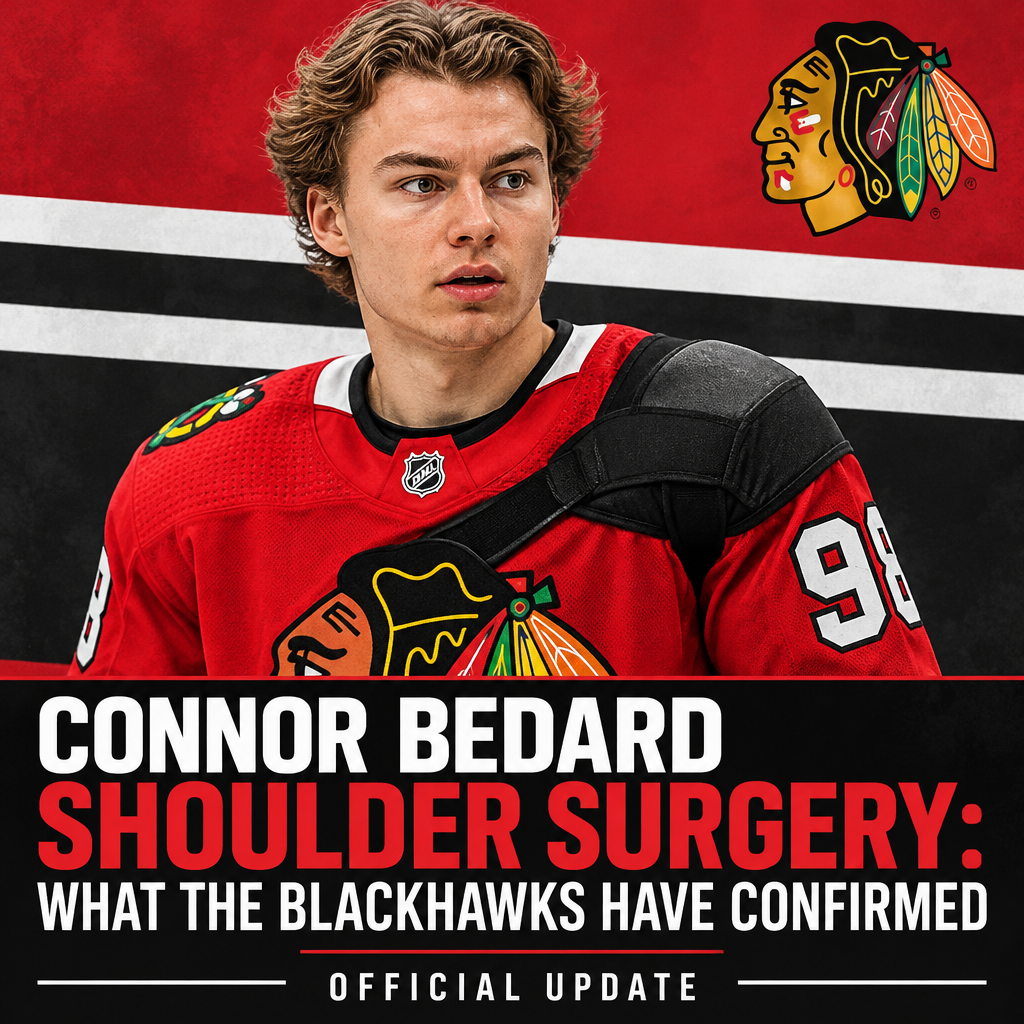
The Chicago Blackhawks say Connor Bedard will undergo surgery on his right shoulder this week, after a Tuesday injury against Toronto; general manager Kyle Davidson said Saturday that the recovery timeline will follow the procedure, while the club expects Bedard to return to center and faceoffs in the future.
What Is Connor Bedard’s Shoulder Surgery?
The reported procedure is a planned operation on Bedard’s right shoulder after he was injured in a game against the Toronto Maple Leafs on a Tuesday. The announcement came Saturday from Blackhawks general manager Kyle Davidson. The injury occurred less than five months after Bedard had surgery on his left shoulder in July, making the back-to-back shoulder procedures the central fact in this update.
That is the confirmed outline, not a complete medical account. The available details do not identify the precise structure injured, the severity of the damage, or the operation planned. They also do not say whether the right shoulder injury is related in any way to the earlier left shoulder operation. Without those details, it would be careless to label the injury a tear, a dislocation, or any other specific diagnosis.
Davidson said Dr. Peter Millett, a Colorado-based surgeon who operated on Bedard in July, will perform the new surgery. The account describes Millett as having a long record of successful operations on NHL players. That history helps explain the choice of surgeon, but it does not tell the public what Bedard’s individual prognosis will be. A surgeon’s past work is not a substitute for the patient’s diagnosis or post-operative assessment.
The decision also closes one immediate question: whether Bedard would try rehabilitation without surgery or proceed with an operation. The report says he spent several days considering those options. It does not describe the medical advice he received or the particular risks his doctors weighed, so the choice should not be treated as a general recommendation for other athletes.
I read the central news here as two separate developments: surgery has been chosen, and the Blackhawks are confident Bedard can return to his regular position and faceoff duties. Neither statement supplies a return date. The Blackhawks newsroom and Bedard’s official NHL player profile are useful places to check for subsequent team updates and basic player information.
Core Details and Context
The facts matter because they set limits on what can responsibly be said. Bedard injured his right shoulder Tuesday against Toronto, considered surgery and rehabilitation, and is now expected to undergo surgery. Davidson said the procedure would happen this week and would be performed by Millett, the same surgeon who operated on Bedard’s left shoulder in July. The team expects to establish a recovery timeline after the new operation.
The likely season impact is serious, but the wording remains qualified. Davidson said Bedard will presumably miss most or all of the rest of the season. “Presumably” matters: it communicates the team’s expectation, not a final schedule or a confirmed date when Bedard will be cleared. A precise return estimate before the procedure and subsequent assessment would be guesswork.
The reference to center and faceoffs is important for a different reason. A player’s position includes more than where he lines up on a roster sheet. Centers have particular responsibilities, and faceoffs are a repeated part of the job. Davidson’s confidence suggests the Blackhawks do not currently expect the operation to force a permanent change in Bedard’s role. It does not prove exactly when he will return to that role, or describe how he will progress through recovery.
Here’s the kicker: the information fans most want—what is damaged, what operation is planned, and how long recovery will take—is not in the account. That absence is not evidence of a worse injury or a hidden complication. It is simply a gap in the public information. Until the club provides more, the sound approach is to keep confirmed statements separate from online speculation.
There is also a practical consequence for Chicago. If Bedard misses most or all of the remaining schedule, the team will have to play without a central offensive presence for a substantial stretch. The account does not provide lineup plans, standings, or a list of players who might fill his minutes. Naming a replacement as though the choice were settled would go beyond the facts. The Associated Press NHL coverage page offers broader league reporting, but any specific update on Bedard’s status should be attributed to the team or a named reporter.
When I assess an injury announcement, I look for what has changed and what remains open. The clear change is the decision to operate. The open questions include the procedure, the precise diagnosis, the rehabilitation plan, and the date of a possible return. Those distinctions are more useful than confident predictions built from incomplete medical information.
Timeline: What Happened and What Comes Next
- July: Bedard has surgery on his left shoulder. The report places the earlier operation less than five months before the right shoulder procedure. It identifies Millett as the surgeon for that operation. It does not provide the diagnosis, recovery details, or a connection between the two shoulders.
- Tuesday: Bedard injures his right shoulder against Toronto. The account identifies the opponent as the Maple Leafs. It does not state the calendar date, the play on which the injury occurred, or how much time Bedard played before leaving or finishing the game. Those details should not be filled in by assumption.
- The following days: Bedard weighs surgery against rehabilitation. The report says he spent several days deciding between an operation and trying to return through rehabilitation alone. That tells us the options were under consideration; it does not reveal the medical reasoning or suggest that one path is generally better for shoulder injuries.
- Saturday: Davidson announces the decision. The general manager says surgery will take place during the coming week and that Millett will perform it. Davidson also says the club will determine a timeline afterward. The account supplies no calendar date for that Saturday, so it cannot establish a precise schedule from the relative wording alone.
- After surgery: the recovery estimate remains to be set. The Blackhawks expect to assess the situation after the procedure. Davidson says Bedard will presumably miss most or all of the rest of the season, but no specific return date or formal timetable is announced.
- Longer term: Chicago expects him to resume center duties and faceoffs. Davidson expresses confidence that Bedard will be able to play center and take faceoffs after recovery. That is a statement of the club’s expectation, not a guarantee of a particular date or a detailed medical clearance plan.
Frankly, the most important next update is likely to be a post-operation assessment, not another round of guesses about the injury. Even then, a preliminary estimate can change as recovery proceeds. A responsible report should identify who supplied any new information, distinguish an expected absence from a confirmed one, and avoid turning a broad forecast into a firm date.
The original account also says the story will be updated. That is a signal that its details may be incomplete, not a license to treat later developments as already known. Readers checking the Blackhawks’ official news page should look for a dated update and clear attribution before relying on a new timeline.
Comparison: Surgery Versus the Rehabilitation-Only Option
The relevant comparison is not Bedard against another player. The report gives no direct rival or performance data to compare. The meaningful choice described is between the surgery Bedard has selected and the alternative he considered: attempting a return through rehabilitation alone. The table below sticks to what is reported and marks the unknowns plainly.
| Question | Surgery | Rehabilitation without surgery |
|---|
| Status in this case | Bedard is expected to have an operation this week. | Bedard considered this route before deciding on surgery. |
| Who made the decision? | Bedard’s decision was announced by GM Kyle Davidson. | It was one of the options Bedard considered. |
| Medical details available | The surgeon is named; the specific diagnosis and procedure are not reported. | No rehabilitation plan or medical rationale is reported. |
| Return timeline | Davidson said the timeline will be determined afterward. | No estimate for this option is reported. |
| Season outlook | Davidson said Bedard will presumably miss most or all of the rest of the season. | The report does not say whether this route might have allowed an earlier return. |
| Longer-term role | Davidson expects Bedard to return to center and faceoffs after recovery. | No separate forecast for this option is reported. |
This table does not establish which treatment is medically superior. It records the choices and outcomes discussed in this particular case. Without the diagnosis and clinicians’ reasoning, even a seemingly simple comparison would overreach. The fact that surgery was selected does not prove rehabilitation was impossible; likewise, the fact that rehabilitation was considered does not prove it would have worked.
The distinction also matters to fans weighing short-term games against long-term health. A player’s return should not be reduced to whether the next game is important or whether a team needs scoring. Medical decisions involve an individual’s condition and professional assessment. There is a plain principle of stewardship here: a player’s health is not merely a resource to spend for a few more shifts.
The NHL’s official Bedard profile provides player background, while the Associated Press NHL page can help readers follow wider league developments. Neither should be mistaken for a clinical record. For this particular decision, Davidson’s reported comments establish what the team has said; they do not disclose the medical file behind it.
Common Misconceptions and What to Know
Misconception: The injury’s exact diagnosis is public. It is not in the details reported here. The account identifies the shoulder and the decision to operate, but not the injured structure or a formal diagnosis. Calling it a specific tear, separation, or other condition would add information the announcement does not contain.
Misconception: A season-ending absence has been formally confirmed. Davidson said Bedard will presumably miss most or all of the rest of the season. That is a strong indication of the club’s expectation, but the same comments say a timeline will be determined after surgery. The careful phrasing is that a lengthy absence is expected, while the exact timetable remains unannounced.
Misconception: A second shoulder operation means Bedard cannot play center again. Davidson said the Blackhawks are confident he will return to center and take faceoffs. That directly counters the claim of an assumed permanent position change. It does not mean the team has announced a date for his return, or that every detail of his on-ice workload is settled.
Misconception: The two operations must be connected. One procedure was on the left shoulder in July; the new one is planned for the right shoulder after an injury against Toronto. The report does not say one caused the other or that either shoulder problem affected the opposite side. Similar body parts do not, by themselves, establish a causal relationship.
Misconception: Choosing surgery reveals exactly how serious the injury is. It confirms that surgery was selected after Bedard considered another path. It does not reveal the full diagnosis or prognosis. Treatment choices depend on information not included in the public account, so a conclusion about severity based only on the word “surgery” is speculation.
Misconception: The surgeon’s record guarantees a particular result. Davidson identified Millett as the surgeon and noted his history of successful operations on NHL players. That is relevant context, but no surgeon’s past results can promise an individual outcome. A return depends on Bedard’s condition and subsequent medical evaluation, details not yet described.
Misconception: There is already a reliable return date. There is not. The timeline is to be determined after the procedure. Treat any precise date circulating without named, attributable reporting as unconfirmed. A useful update should explain whether a date comes from the team, the player, or an independently sourced report, and whether it is an estimate or formal clearance.
Most news coverage gravitates toward the most dramatic version: either a catastrophe or a quick comeback. Neither is justified by the facts available here. The honest account is less dramatic but more useful: surgery is planned, a long absence is expected, and the club anticipates Bedard will return to his position when recovered. The rest remains open.
Frequently Asked Questions
When will Connor Bedard have right shoulder surgery?
The report says surgery is expected during the week Davidson spoke on Saturday. It does not provide a calendar date. The specific day should not be inferred from the relative wording alone.
How long will Bedard be out?
The Blackhawks had not set a timeline before the operation. Davidson said Bedard would presumably miss most or all of the rest of the season. A more precise estimate was expected after surgery.
Who will perform the operation?
Davidson said Colorado-based surgeon Dr. Peter Millett will perform it. Millett also operated on Bedard’s left shoulder in July, according to the reported details.
Will Bedard return as a center and take faceoffs?
Davidson said the Blackhawks are confident he will be able to resume playing center and taking faceoffs after recovery. The team has not announced when that return will happen.
Final Thought
The central update is straightforward, even if the medical picture is not: Bedard will undergo surgery on his right shoulder, and the Blackhawks expect a substantial absence. Davidson’s confidence about a future return to center and faceoffs offers a useful answer to one concern, but it does not erase the uncertainty around recovery. A position expectation is not a timetable, and a likely season-long absence is not a precise medical forecast.
The responsible standard is to leave the unknowns visible. The diagnosis, operation details, rehabilitation milestones, and return date have not been reported in the available account. That may frustrate supporters who want a clean answer, but accuracy is worth more than a confident guess. A player’s work matters to a team and its fans; his health matters beyond the next game, too. Good reporting respects both facts and the person behind the roster spot.
As the Blackhawks provide further updates, the useful questions are simple: what did the procedure find, what does the medical team recommend next, and when will Bedard be cleared for each stage of play? Until those answers arrive, the prudent reading is neither panic nor premature optimism. It is a planned operation, a likely lengthy absence, and a team that says it expects its young center to return to his role.