An East Olympia house fire prompted a defensive response Tuesday night, Nov. 10, after crews dispatched for a brush fire learned a single-family home was...
East Olympia House Fire: Crews Kept Flames From Reaching a Propane Tank and Woods
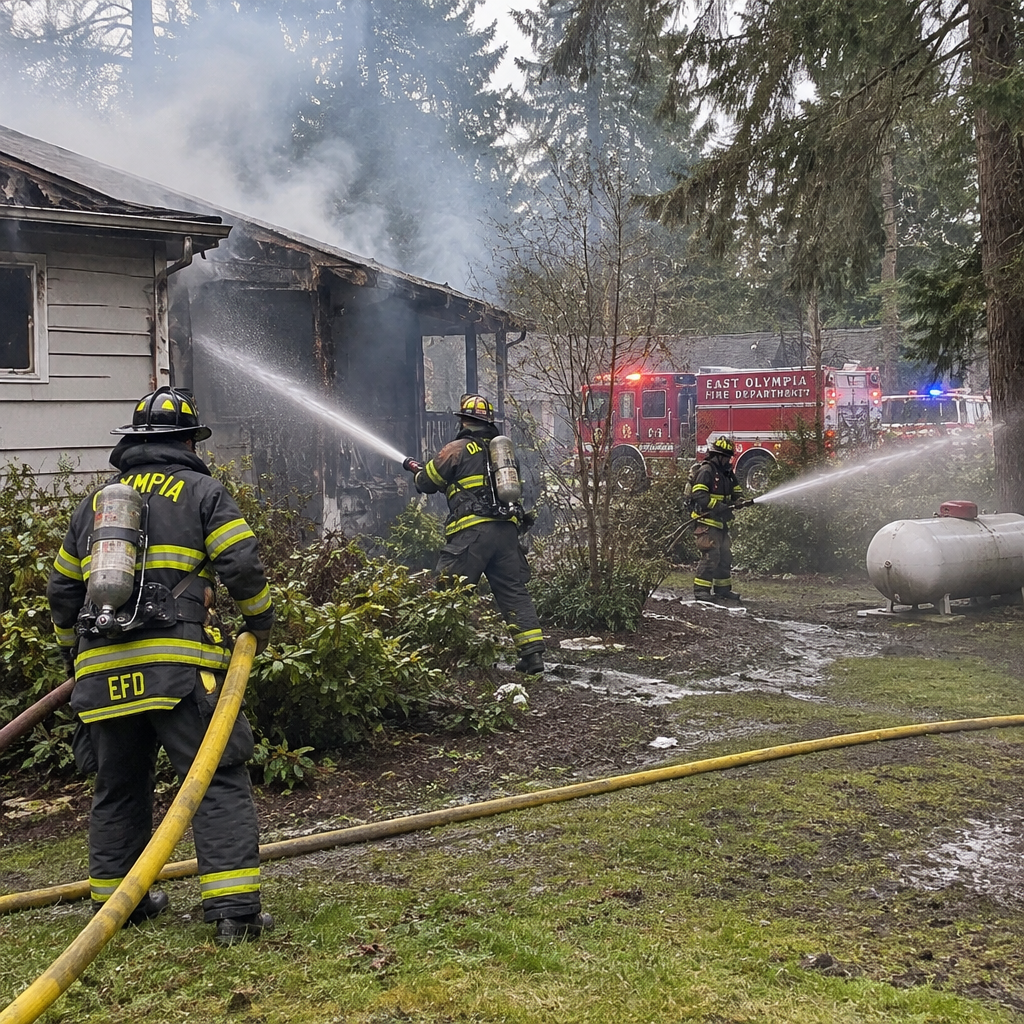
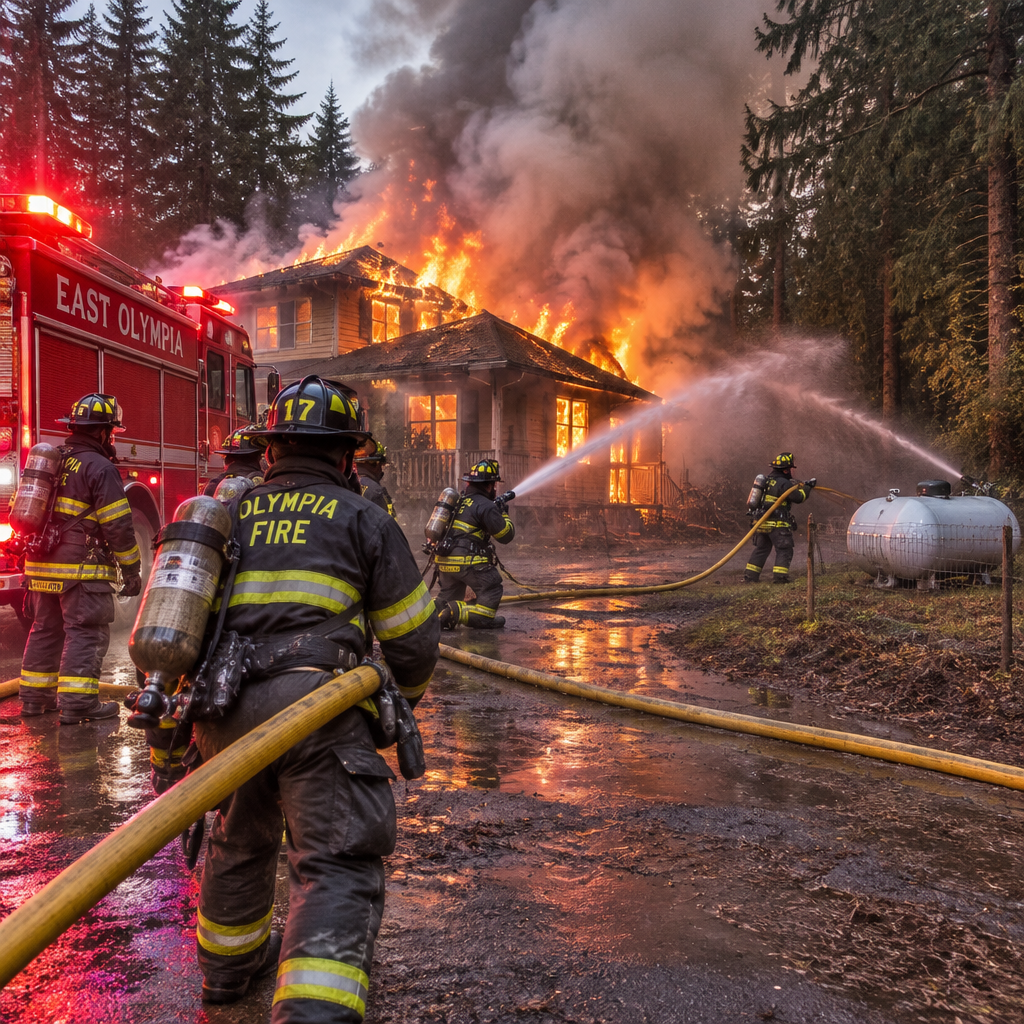
An East Olympia house fire prompted a defensive response Tuesday night, Nov. 10, after crews dispatched for a brush fire learned a single-family home was burning. Firefighters judged entry too dangerous, stayed outside, and worked to keep the fire from reaching a propane tank, nearby structures, or wooded land. No injuries were reported; the cause remains under investigation.
The incident was south of Tumwater and northwest of Millersylvania State Park. East Olympia Fire District 6 said crews worked Tuesday night and remained at the scene Wednesday. Its release does not report the extent of damage, whether anyone was inside when the fire began, or what investigators believe caused it. Those gaps matter: a fire call gives the public a reason to pay attention, not permission to fill in details.
This account sticks to what the district reported and separates it from general fire-safety context. When I analyze an incident with limited public details, the most useful questions are practical ones: what responders knew, why they chose their tactic, what exposures they were trying to protect, and what remains unknown. A measured account is less dramatic than guesswork. It is also more useful to residents.
What happened in the East Olympia house fire?
The East Olympia house fire was a residential structure fire reported on Tuesday evening in the 800 block of 113th Avenue Southeast. East Olympia Fire District 6 said dispatchers initially sent crews to a brush fire at about 6 p.m. Responders then learned that a single-family residence was on fire. The initial call description and the incident crews found were therefore different; the district has not reported why the first information characterized the call as a brush fire.
The address is in a rural area south of Tumwater and northwest of Millersylvania State Park. That geography helps explain why the district’s account mentioned not just the home, but also a propane tank, other structures, and wooded land as potential exposures. It does not establish how close those features were to the flames, how much damage occurred, or whether any of them were affected. The release says firefighters prevented the fire from spreading to those exposures; it does not provide a detailed property-by-property damage report.
Firefighters decided that entering the home was too dangerous. They used a defensive approach, meaning they fought from outside rather than sending crews into the structure, according to the district. That is a tactical decision based on conditions responders face at the scene. The release does not describe the building’s condition, the particular hazards inside, or the specific observations behind that judgment, so those details should not be guessed at.
The district reported no injuries. It did not say whether residents were home, whether anyone was displaced, or whether pets were involved. It also did not announce a cause. The cause remains under investigation, and no conclusion about accident, equipment failure, or intentional action is supported by the information released so far.
Crews stayed on scene into Wednesday to address hot spots and make sure the fire was fully extinguished. That follow-up matters because a visible reduction in flames does not, by itself, establish that all burning material or heat has been eliminated. The district’s update gives the public a clear endpoint for the response, but it does not say when investigators expect to determine the cause or whether more updates are planned.
Core details and what the response tells us
The central operational fact is simple: crews chose not to enter the burning home because doing so was too dangerous. That decision may sound counterintuitive to people who imagine firefighters always move directly inside, but fireground tactics change with conditions. Protecting life includes the lives of residents and responders; sending firefighters into a structure judged unsafe can create additional emergencies without improving the outcome.
The release calls the tactic defensive. In practical terms, the account describes firefighters working from outside the home and concentrating on the fire’s spread and nearby exposures. It does not specify the equipment used, where crews positioned vehicles, how many firefighters were assigned to each task, or whether water supply posed any challenge. Those omissions are not evidence that a particular problem existed. They simply mark the limit of what has been reported.
The district identified three things crews worked to protect: a propane tank, other structures, and a wooded area. Preventing a fire from spreading is different from reporting that every nearby feature was untouched or undamaged. The release says the crews prevented spread to those exposures; it does not provide an inspection report or measurements. Readers should retain that distinction rather than turn a concise response update into a fuller account than officials have given.
Several departments assisted East Olympia Fire District 6: Lacey Fire District 3, South Thurston Fire & EMS, Southeastern Thurston Fire Authority, Tumwater Fire Department, McLane/Black Lake Fire Department, and Olympia Fire Department. Their involvement shows that the response drew support across local agencies. The release does not list the number of units or personnel, identify which department performed each task, or say how long every assisting agency remained. A list of responding organizations is not a staffing roster.
The extended scene presence is another useful detail. Crews were there Tuesday night and remained into Wednesday to address hot spots and ensure the fire was fully extinguished. The agency did not report a precise demobilization time or describe any later monitoring. The sequence nevertheless makes clear that the incident required work beyond the initial attack.
For general home-fire preparedness, residents can consult the U.S. Fire Administration’s home-fire prevention guidance and Ready.gov’s home-fire guidance. Those resources offer broad safety advice; they do not explain the cause or specific conditions of this East Olympia incident. Frankly, keeping those categories separate is the difference between useful context and invented reporting.
Timeline: from dispatch to Wednesday follow-up
- About 6 p.m. Tuesday, Nov. 10: Fire crews were dispatched to what was initially described as a brush fire. The release does not identify who placed the call or detail what the caller observed.
- Crews identify a house fire: Responders learned that a single-family residence in the 800 block of 113th Avenue Southeast was burning. The district has not said how much time passed between dispatch and that updated understanding, or whether the initial description changed before crews arrived or after they reached the area.
- The address is located: The residence was south of Tumwater and northwest of Millersylvania State Park. That locational description places the incident in the broader area but is not a substitute for an exact parcel map or a report of the surrounding properties.
- Crews choose a defensive operation: Firefighters determined that entering the home was too dangerous. They fought the fire from outside and focused on preventing it from spreading to a propane tank, other structures, and wooded land, according to East Olympia Fire District 6.
- Neighboring departments assist: Lacey Fire District 3, South Thurston Fire & EMS, Southeastern Thurston Fire Authority, Tumwater Fire Department, McLane/Black Lake Fire Department, and Olympia Fire Department provided assistance. The district’s release does not assign individual duties to those agencies.
- No injuries are reported: The district said no one was injured. It did not provide information about residents’ whereabouts, displacement, or property loss.
- Work continues Wednesday: Crews remained on scene to address hot spots and ensure the fire was fully extinguished. The cause was still under investigation in the district’s announcement.
When I lay out the sequence, the important shift is from an initial brush-fire dispatch to a confirmed residential fire, followed by a decision to operate defensively. The available account does not give a minute-by-minute log. Any more detailed chronology—including exact arrival times, the moment the fire was controlled, or when each department left—has not been reported.
Comparison: the residential fire and the initial brush-fire dispatch
The strongest comparison available is not with another fire department or a competing incident. It is between the first dispatch description and what crews subsequently learned. The distinction is useful because early call information can change as responders gather evidence, but the district has not explained the reason for the difference in this case.
| Detail | Confirmed residential fire | Initial brush-fire dispatch |
|---|
| What the release says | A single-family residence was on fire | Crews were first dispatched for a brush fire |
| When it appears in the account | After responders learned more about the incident | At about 6 p.m. Tuesday, Nov. 10 |
| Location | 800 block of 113th Avenue Southeast | Same call area; no separate location reported |
| Response detail | Crews fought defensively because entry was too dangerous | No separate brush-fire tactics were described |
| Stated concern | Prevent spread to a propane tank, other structures, and woods | No distinct brush-fire exposure details reported |
| What remains unknown | Cause, damage, occupancy, and specific hazards | Why the initial description differed from the confirmed fire |
A brush-fire label describes how the call was first presented; it is not the final finding about what was burning. Conversely, the fact that crews later identified a house fire does not show that the initial caller acted carelessly or that dispatchers made an error. The information available does not establish how the first description arose, and assigning blame would be speculation.
The comparison also shows why incident updates should be read in sequence. The first report can be incomplete, while the later account reflects what responders learned. Here, the district’s release gives the public both stages, but not a full communications log. It is reasonable to say the call description changed; it is not reasonable to invent a reason for the change.
A defensive strategy is also not a competitor to an interior attack in the sense of one always being preferable. The fire district said entry was too dangerous in this case, which explains why crews chose the approach they did. The public account does not offer enough detail to judge the scene independently, and the right question is not whether a different tactic sounds more dramatic. It is whether the tactic reflected the conditions crews encountered and their obligation to limit danger.
Common misconceptions and what residents should know
A dispatch description is not a final diagnosis. The first call was described as a brush fire; crews then learned a single-family home was burning. Early descriptions can be revised as responders obtain information. The release does not say why the label changed, so claims about a mistaken caller or a dispatch failure would go beyond the facts.
A defensive attack does not mean firefighters did nothing. East Olympia Fire District 6 said crews fought the fire defensively after deciding entry was too dangerous. The account describes active work to keep the fire from spreading to identified exposures. It does not give a full account of tactics, equipment, or the fire’s size, and the phrase should not be treated as a measure of effort.
No reported injuries does not answer every question about people or property. The district said no one was injured. It did not state whether the home was occupied, whether anyone had to leave, or whether the structure was damaged beyond repair. Those are separate facts and should not be supplied by inference.
Mentioning a propane tank does not establish that it leaked or exploded. The release says crews worked to prevent the fire from spreading to the tank. It does not report a leak, explosion, or other tank-related incident. The same caution applies to nearby structures and the woods: the district named them as exposures it sought to protect, not as places where damage was confirmed.
The cause is not established. An investigation is not a finding. Until the fire district or another responsible authority releases a cause, it would be irresponsible to suggest a particular appliance, electrical fault, heating source, or human action. No such detail appears in the announcement.
Residents looking for general advice can review the National Fire Protection Association’s home fire safety information, along with the federal guidance linked above. Those resources can help with prevention and preparedness, but they cannot tell someone what happened inside this house. For incident-specific updates, the relevant source is the responding fire district or investigating authority.
There is a broader point here about public safety and stewardship. Rural properties can place homes, fuel tanks, buildings, and natural areas in close proximity, so preventing spread can protect people, property, and land at once. The release does not describe the exact layout at this address. Still, the stated priorities reflect a practical duty to protect the common good without placing responders in avoidable danger.
Frequently asked questions
Where did the East Olympia house fire happen?
East Olympia Fire District 6 placed the fire in the 800 block of 113th Avenue Southeast, south of Tumwater and northwest of Millersylvania State Park. The release provides a general location, not a street address or detailed map. No further property information was reported.
When did crews respond?
Crews were initially dispatched at about 6 p.m. Tuesday, Nov. 10, according to the district. They fought the fire that night and remained at the scene Wednesday to address hot spots and ensure it was fully extinguished. The announcement does not give a precise time when the response ended.
Was anyone injured, and what caused the fire?
The fire district reported no injuries. It said the cause was under investigation and did not identify a suspected source. The announcement also does not say whether the residence was occupied or provide details about damage.
Why did firefighters fight the fire defensively?
East Olympia Fire District 6 said entering the home was too dangerous. Crews fought from outside and worked to prevent spread to a propane tank, other structures, and a wooded area. The district has not publicly described the particular hazards or conditions that informed its decision.
Final thought
The most important facts are straightforward: a residence was burning, crews judged interior entry too dangerous, no injuries were reported, and firefighters worked to keep the fire from spreading to nearby exposures. East Olympia Fire District 6 also said crews stayed into Wednesday to address hot spots and confirm extinguishment. That is a substantial response, even though the release is brief.
What the public does not yet know is just as important. The cause remains under investigation. The district has not reported the damage, occupancy, residents’ circumstances, or the specific hazards that led crews to avoid entry. None of those gaps should be filled with guesses dressed up as explanation. When investigators release more information, the account may become fuller; until then, restraint is part of accurate reporting.
I find the practical lesson less dramatic than the headline and more valuable: emergency decisions are made to preserve life while controlling danger, and a safe outcome includes responders as well as residents. The stated effort to protect nearby buildings and wooded land also reflects careful stewardship of places people depend on. For now, the district’s account supports a clear conclusion, not a theory about the cause: crews faced a serious house fire, took a defensive approach, and reported no injuries.
FAQPage Schema