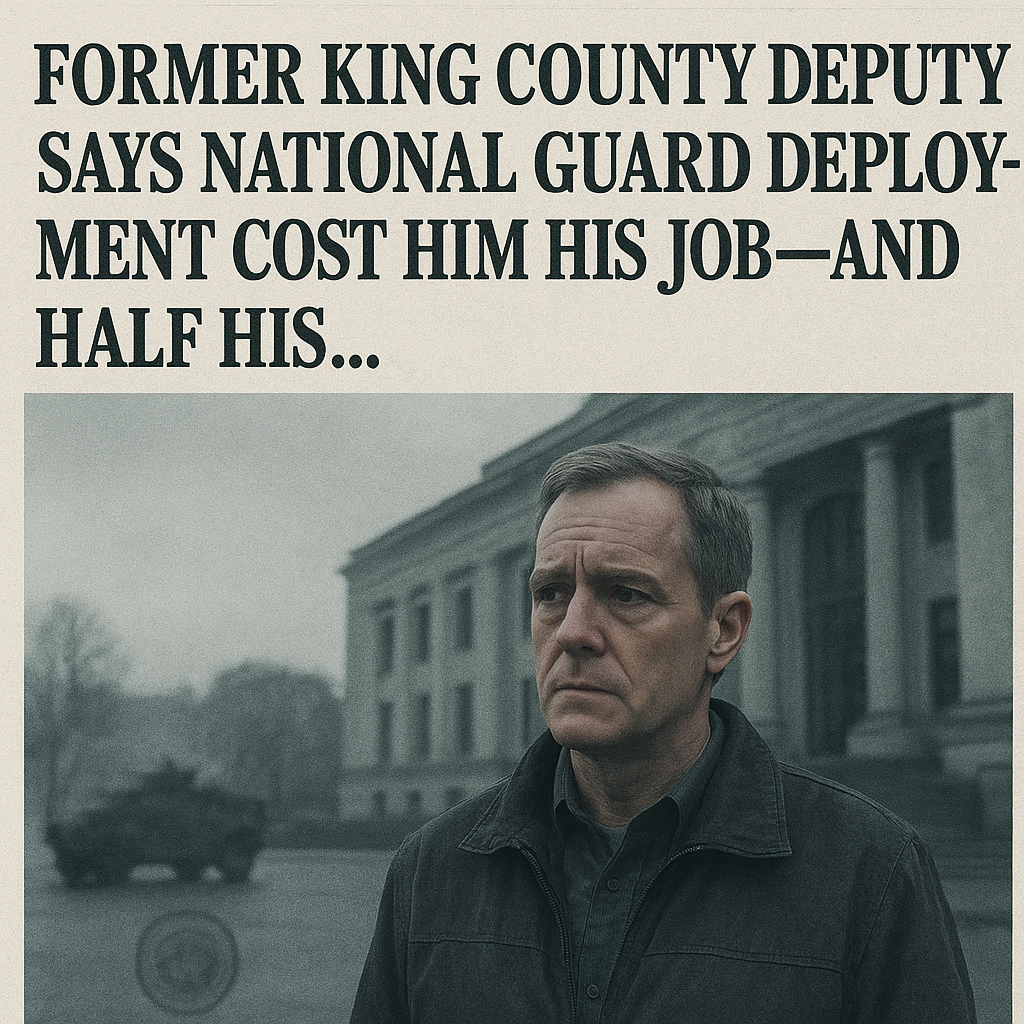
Former King County deputy says National Guard deployment led to half pay and firing. The claim is blunt, and the complaint is bigger than one paycheck, because...
Former King County deputy says National Guard deployment led to half pay and firing. The claim is blunt, and the complaint is bigger than one paycheck, because it raises a plain question about how a public employer treats military service when the employee is supposed to be protected by federal law. If the allegations hold, this is not just a workplace dispute. It is a test of whether government agencies honor the people who serve both in uniform and at home.
Key Takeaways:
- The lawsuit says King County reduced the deputy’s pay after his National Guard obligations and later fired him.
- The case centers on alleged retaliation tied to military service, which federal law is designed to prevent.
- The complaint also says supervisors resented his absences before his termination in January 2025.
- The dispute could turn on timing, documentation, and whether the county can show a lawful reason for its actions.
- The broader issue is simple: employers do not get to treat military duty as an inconvenience to be punished.
What is this case? It is a legal fight over whether a public employer punished a deputy for serving in the National Guard. The former employee, Pelzer, says the county’s response to his military obligations went beyond annoyance and crossed into retaliation, reduced compensation, and then termination. That is the core allegation. Frankly, it is the sort of claim that makes people roll their eyes until the paperwork arrives. Then it gets serious fast.
I have covered labor disputes long enough to know this much: the public statement is almost never the whole story. If an agency says it fired someone for performance, and the worker says the real issue was military service, the difference usually lives in emails, supervisor notes, leave records, and who said what when. That is where the truth hides. Not in press releases.
Federal protections for service members exist for a reason. The Uniformed Services Employment and Reemployment Rights Act or USERRA is supposed to keep employers from penalizing workers because they serve in the military. That principle is not flashy, but it matters. A society that praises service while quietly docking pay or ending a job when that service becomes inconvenient is not practicing justice. It is performing it.
Here is the kicker: this case is not only about one deputy’s lost income. It also speaks to the obligations of government itself. Public agencies are supposed to model fair dealing, not improvise grudges. When a county resents military duty, the question is bigger than HR. It reaches into public trust, the dignity of work, and whether civic institutions can be counted on to keep their word.
What is the King County deputy lawsuit?
The lawsuit is an employment and retaliation case brought by a former King County deputy who says his service obligations in the National Guard led to reduced pay and eventually to his firing. According to the allegation, supervisors did not simply accommodate his military schedule and move on. They allegedly treated those obligations as a problem, then responded in ways that cost him money and his job.
That matters because military service is not a hobby, a side gig, or a negotiable inconvenience. It is a legal obligation, often undertaken with sacrifice and uncertainty. Civilian employers are expected to manage around it. When they do not, or when they punish the worker for it, the issue becomes both legal and moral.
Most reporting on these disputes flattens the story into a simple yes-or-no question: did the worker perform well, or not? That misses how retaliation cases work. A strong work record does not guarantee protection if a supervisor is irritated by military leave. And a company can invent performance complaints after the fact. I’m not saying that happened here. I’m saying that is exactly why courts look for timelines, patterns, and documents instead of slogans.
The lawsuit reportedly alleges that supervisors resented Pelzer’s obligations before the county terminated him in January 2025. If that claim is supported by records, it could matter a great deal. Courts do not love vague feelings. They care about specific acts, specific dates, and whether a protected activity preceded an adverse action. Military leave is protected activity. Punishment for it is not supposed to happen.
The public sector has a higher standard here, or it should. Government agencies ask citizens for trust, taxes, and compliance. In return, they owe honesty and fair treatment. That includes treating service members with something close to reverence for their sacrifice, not bureaucratic irritation. Common good stuff. Not a fancy phrase, just a plain duty.
For readers trying to place this in context, similar labor and retaliation disputes often turn on whether an employer can show a legitimate business reason. If you want a broader look at public-sector accountability and how agencies handle misconduct claims, see coverage of public-sector retaliation cases, USERRA employment protections, and Justice Department military rights guidance.

Core details and context
The complaint sits at the intersection of employment law, military service, and public administration. That is not glamorous, but it is where real accountability lives. The details that matter most are the ones people often skip over.
- Military obligation: Pelzer’s National Guard service allegedly required absences that his supervisors viewed negatively.
- Pay reduction: The lawsuit says he ended up with roughly half pay, which, if accurate, is not a minor clerical issue.
- Termination: King County ended his employment in January 2025.
- Supervisory conduct: The suit claims resentment toward his military duties preceded the firing.
- Possible legal theory: The case likely invokes USERRA and related retaliation principles.
The pay issue is especially important. Half pay is not a small annoyance. It can mean missed rent, delayed bills, and real household strain. That is where legal fights stop being abstract. A person’s vocation and income get tangled together, and the burden lands on the family too. Scripture has a lot to say about fair wages and honest weights for a reason. People need the fruit of their labor to mean something.
Let’s be real. Employers sometimes act as if military obligations should fit neatly between shifts, like a dentist appointment. They do not. Training, drills, activation, and communication gaps all create friction. A decent employer plans for that. A resentful one punishes it. The complaint says King County fell into the second camp. The county may deny that, and it likely will. That is what litigation is for.
The phrase “supervisors resented” is doing heavy lifting here. Resentment is not proof by itself. It is motive. And motive matters when paired with timing and adverse action. If comments, messages, or staffing choices show irritation about Guard obligations, the defense gets weaker. If the county has a clean record of performance problems unrelated to service, the plaintiff’s case gets harder. That is the real battleground.
The legal and ethical frame is straightforward. Service members should not have to choose between serving the country and keeping their jobs. A county government should know that better than most. It is public-facing, publicly funded, and bound to higher expectations. When it forgets that, it invites lawsuits and distrust.
For readers wanting more background on workplace disputes and public institutions, related reporting on labor conflict can be useful, including coverage of retaliation claims in public employment and EEOC retaliation guidance. Different facts, same basic rule: employers cannot punish protected activity and then call it routine management.
Timeline of what happened
- Pelzer served in the National Guard. His military obligations created scheduling conflicts that the lawsuit says became a source of friction. That is the beginning, even if the public only notices the ending.
- Supervisory irritation allegedly grew. According to the complaint, supervisors resented his absences and obligations before any final employment action. That sequence matters more than people think.
- His pay allegedly dropped. The lawsuit says the county’s actions left him with about half his pay. If accurate, this is the part that turns a personnel dispute into a financial hit.
- The county terminated him in January 2025. The firing is the sharp end of the claim. Once termination enters the record, the legal stakes climb quickly.
- The lawsuit followed. The complaint now asks a court to sort out whether the county’s explanation survives scrutiny or whether the military-service allegations tell the truer story.
When I look at timelines like this, I ask one thing first: what happened before what? Courts do the same. If the military service came first, then the pay cut, then the firing, the plaintiff has a cleaner sequence to argue retaliation. If the county can show earlier performance issues, policy violations, or documentation unrelated to service, that changes the picture. The order of events is not trivia. It is evidence.
Here is what nobody tells you about these cases: they often turn on boring administrative details. Who approved the leave. Who wrote the memo. Whether HR was looped in. Whether the worker was coded correctly in payroll. Whether a supervisor’s frustration leaked into an email. Small things. Ugly little things. Yet they decide big outcomes.
That is why journalists and courts alike need to resist the urge to turn this into a hero story or a villain story too early. Maybe the deputy was mistreated. Maybe the county had legitimate reasons. Maybe both things are partly true. The facts, not the slogans, should rule the day.
Comparison table
| Issue | Former King County Deputy’s Claim | Typical Employer Defense |
|---|
| Military obligations | Guard duty triggered resentment and retaliation | Military leave was accommodated, with no bias |
| Pay | Pay was cut to about half | Pay changes were administrative or performance-based |
| Termination | Fired in January 2025 after protected service | Fired for legitimate, unrelated workplace reasons |
| Evidence that matters | Emails, leave records, supervisor comments, payroll records | Performance reviews, policy violations, attendance records |
| Legal frame | USERRA and retaliation | Non-discriminatory management action |
| Public interest | Government should model fair treatment | County must manage employees and operations efficiently |
This table is not about picking a winner. It is about the kinds of proof each side will need. The plaintiff has to connect the dots. The county has to show a lawful chain of decisions. And if the record is sloppy, the county will regret it. Public agencies often do.
The biggest competitor to Pelzer’s claim is the county’s likely assertion that employment actions were based on neutral reasons. That is the standard defense in these cases. It is also sometimes true. But “we had a reason” is not enough if the reason is a cover. Courts know the difference when the documents are honest.
Common misconceptions and what to know
One common mistake is to assume any firing after military service must be illegal. Not true. Employers can still discipline or terminate workers for legitimate reasons. Attendance, misconduct, poor performance, and policy violations still matter. The law does not make anyone untouchable.
Another mistake is the opposite one: assuming public employers would never retaliate. That is naive. Bureaucracies can be petty. Supervisors can be petty too. I’ve seen enough workplace disputes to know that resentment rarely announces itself with a trumpet. It shows up in scheduling, tone, paperwork, and suddenly impossible standards.
A third misconception is that pay disputes are always payroll errors. Sometimes they are. Sometimes they are not. A cut to half pay can come from benefits changes, status changes, hours changes, or a disciplinary move. The question is not whether the number changed. It is why it changed. Motivation is the whole game.
The public also tends to miss the human cost. A military reservist is not just “out for training.” That person is juggling two obligations, often with little grace from either side. There is a reason the law protects them. Stability matters. Family life matters. Work should not become a trap simply because someone answered a call to serve.
Here’s the kicker: when a government employer mishandles service-member rights, it damages more than one employee. It sends a message to every Guard or Reserve member on the payroll. That message is corrosive. Serve us, and we may punish you. That is not how a decent civic order should operate.
For readers following the legal side, it helps to understand that retaliation claims often depend on circumstantial evidence. There may be no single smoking gun. Instead, plaintiffs show patterns: bad timing, inconsistent explanations, shifting reasons, or comments that reveal bias. That is enough sometimes. Courts are not blind to human behavior.
Frequently asked questions
What is USERRA?
USERRA is a federal law that protects people who serve in the uniformed services from job discrimination and retaliation because of their military obligations. It also helps preserve reemployment rights after service.
Can an employer fire someone who serves in the National Guard?
Yes, but not because of the service itself. An employer still needs a lawful, non-retaliatory reason. Military duty cannot be the reason for punishment.
Why does the pay issue matter so much?
Because a large pay reduction can be evidence of retaliation, and because it creates direct financial harm. Courts look closely at why compensation changed.
What happens next in a case like this?
The court reviews the complaint, the county responds, and both sides exchange evidence. Emails, payroll records, and supervisor testimony usually matter a great deal.
The deeper question here is not legal jargon. It is whether public institutions keep faith with the people who serve them and the country. A county can defend itself in court. Fine. But it should first be able to defend its conscience.
Final thought: the law can sort out liability, but it cannot manufacture character. That has to come from the institution itself. If King County mishandled a deputy’s military service, the remedy should be plain and the accountability public. If it did not, the record should clear it. Either way, the standard should remain the same: respect the work, respect the service, respect the person. That is not radical. It is basic justice.