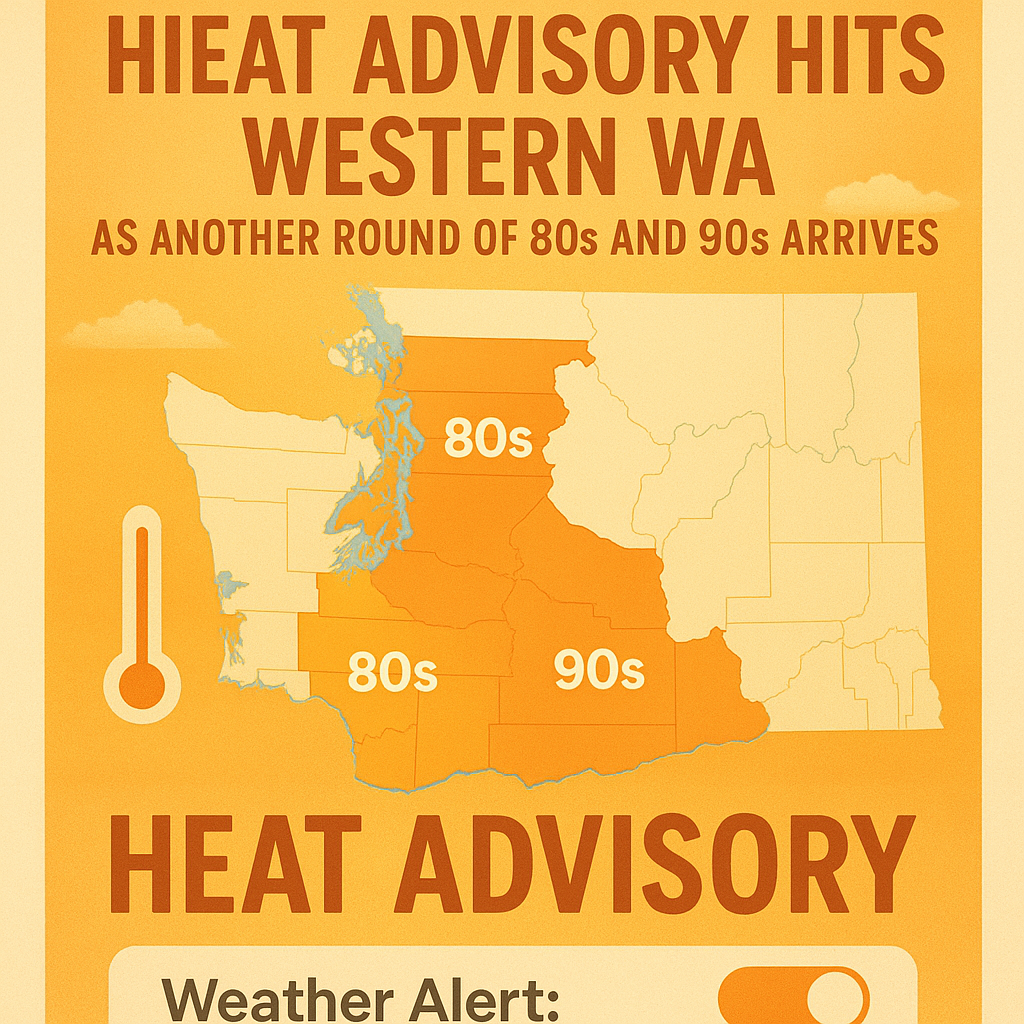
A heat advisory is now in effect for parts of western Washington. It runs from 10 a.m. Tuesday through 11 p.m. Wednesday, covering sections of the Olympic...
Heat Advisory Hits Western WA as Another Round of 80s and 90s Arrives
A heat advisory is now in effect for parts of western Washington. It runs from 10 a.m. Tuesday through 11 p.m. Wednesday, covering sections of the Olympic Peninsula, Kitsap Peninsula, and the lowlands and foothills, as another stretch of 80s and 90s settles in.
Key Takeaways- The advisory covers vulnerable parts of western Washington for two days.
- Temperatures in the 80s and 90s can strain people, pets, power demand, and outdoor workers.
- The biggest risk is not dramatic headline heat — it is steady exposure, especially without cooling.
- Local guidance matters more than generic summer advice.
What is a heat advisory?
A heat advisory is an official weather alert issued when heat is expected to create conditions that can affect health and daily activity. It does not mean the worst heat in the country, and that is part of the problem. People hear “advisory” and think it is mild. Frankly, that is how trouble starts.
For western Washington, where many homes are built for damp, mild weather rather than long hot runs, even a brief stretch in the 80s and 90s can hit hard. Indoor temperatures can climb faster than people expect, especially in older buildings, top-floor apartments, and homes without air conditioning. Workers outside feel it first, but the risk spreads widely — children, older adults, people with chronic illness, and anyone who cannot cool down are all exposed.
The National Weather Service uses advisories to warn that heat can cause illness if people do not take precautions. That includes heat exhaustion, dehydration, and in severe cases, heat stroke. I’ve covered enough weather events to say this plainly: the real danger is not only the thermometer. It is how long the heat lasts, how much relief the nights give, and whether people have somewhere cool to go.
The National Weather Service heat safety guidance emphasizes water, shade, and checking on others. That sounds simple because it is simple. The catch is that many people still do not do it.
A second point gets less attention. Heat is a matter of stewardship, not just comfort. If a community can reduce preventable illness by opening cool spaces, adjusting work schedules, and checking on neighbors, that is the responsible thing to do. Human dignity is not optional when the weather turns rough.
The current setup is especially important because western Washington often treats heat as a novelty. It is not. Not anymore.
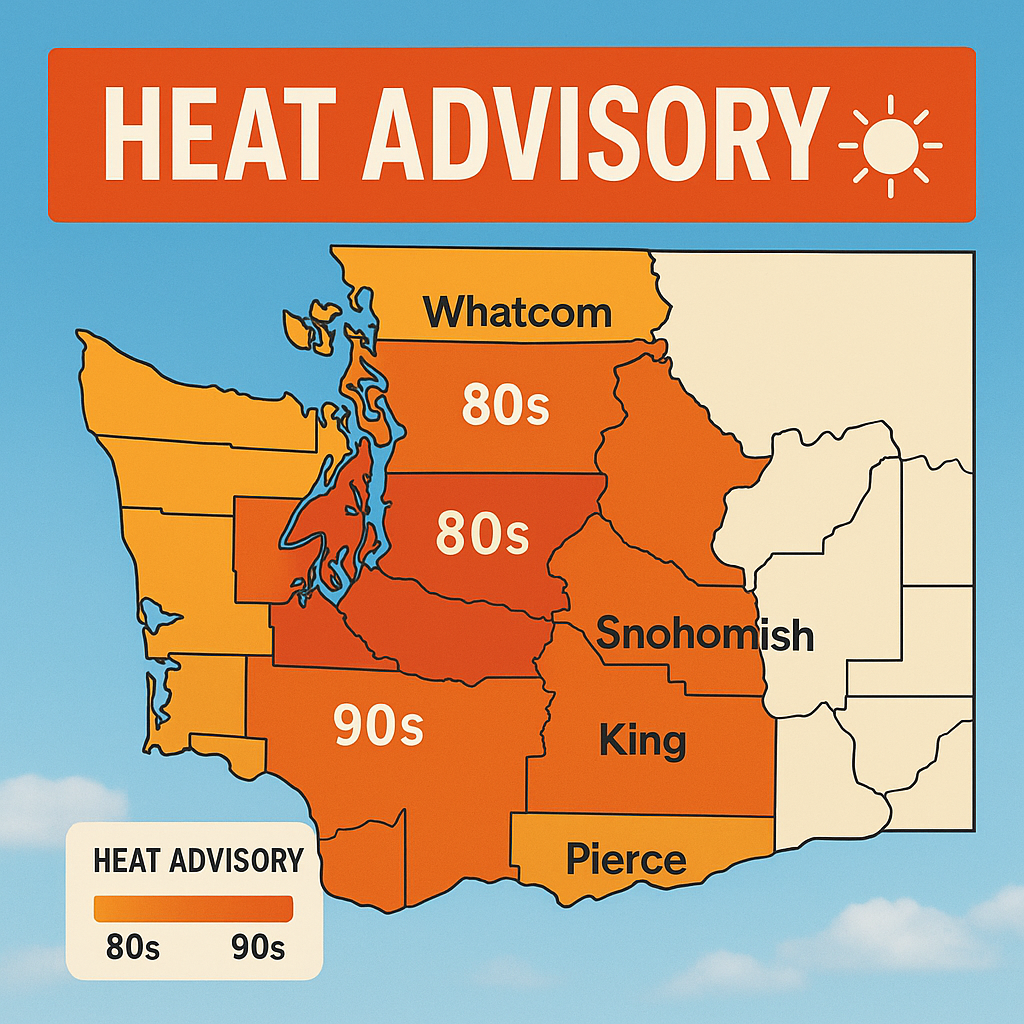
Core details and context
The advisory covers a specific slice of the region, but the effects can spill farther.
- Timing matters. The alert starts late morning Tuesday and lasts through Wednesday night, which means daytime heating and limited overnight relief.
- Geography matters. The Olympic Peninsula, Kitsap Peninsula, lowlands, and foothills can trap heat differently, especially in sheltered areas.
- Humidity can make it worse. Even when temperatures are not extreme by national standards, muggy air reduces the body’s ability to cool itself.
- Homes vary a lot. Some houses, apartments, and mobile homes warm rapidly and stay hot after sunset.
- Schools and work sites face practical strain. Outdoor labor, sports practices, and indoor buildings without cooling need adjustments.
Most coverage talks about “another stretch” of warm weather as if it is just a pleasant late-summer run. That misses the point. Repeated heat days are harder than one hot afternoon because bodies and buildings do not fully recover. The heat stacks up.
Here is the kicker: the Pacific Northwest has seen more serious heat events in recent years, and public memory has not fully caught up. The 2021 extreme heat wave killed hundreds across the region and exposed how unprepared many places were for prolonged heat. That disaster changed the conversation, but habits lag behind memory.
The region’s infrastructure remains partly built for a cool, rainy climate. That means:
- fewer homes with central air,
- more indoor spaces that trap heat,
- more reliance on fans that move hot air around,
- and more people who assume they can “ride it out.”
That last one is risky. Fans help only so much when indoor temperatures rise too high. The CDC heat risk guidance notes that older adults, young children, pregnant people, outdoor workers, and those with heart or lung disease face higher danger. That is not an abstract list. It is your neighbor, your co-worker, your grandfather, your kid’s coach.
There is also a public health angle that gets brushed aside too quickly. Heat can worsen chronic illness, increase emergency calls, and stress local medical systems. It can also hit people with low incomes hardest, because cooling costs money. Small choices — a shaded room, a cold drink, a ride to a cooling center — often matter more than sweeping slogans.
When I look at these events, I keep coming back to the same thing: good policy is supposed to protect the vulnerable before they end up in crisis. That is not sentimental. It is basic justice.

Timeline and step-by-step: what actually happens
- The advisory takes effect Tuesday morning. Meteorologists flag the area in advance because heat impacts start before the high temperature peaks. The body begins taking a hit while people are still pretending the day is ordinary.
- Temperatures climb through the afternoon. Afternoon sun raises indoor and outdoor conditions fast, especially in sheltered lowlands and urban spots with less tree cover.
- Heat stress builds in exposed groups. Outdoor workers, athletes, older adults, and people without cooling feel it first. It is often not dramatic at first. Then it is.
- Nighttime relief may be limited. If temperatures stay warm after dark, people cannot recover well. That leads to worse fatigue the next day and a higher cumulative risk.
- The second day can be worse than the first. Once a home, vehicle, or body heats up, recovery is slower. Buildings hold warmth. People miss sleep. Small mistakes become bigger ones.
- The advisory ends late Wednesday. But impacts can linger. Heat stress, dehydration, and exhaustion do not necessarily vanish when the warning expires.
I’ve seen people make the same mistake every summer: they wait for “extreme” heat before taking heat seriously. That is backward. Advisory-level heat can still send people to urgent care, especially when it arrives in a place that is not built for it.
A practical step-by-step response looks like this:
- Drink water before you feel thirsty.
- Avoid heavy exertion in the hottest hours.
- Check on older relatives, neighbors, and anyone living alone.
- Never leave children or pets in parked cars.
- Seek out air-conditioned public spaces if home gets too warm.
- Move indoor exercise and chores to early morning or evening.
For people trying to track what the region is facing more broadly, local reporting on weather hazards remains useful, including coverage of weather events across the world and regional public safety updates. The same principle applies across stories: the details matter more than the noise.
Comparison table
| Factor | Western Washington heat advisory | A more typical mild Pacific Northwest day |
|---|
| Temperature range | 80s to 90s | 60s to low 70s |
| Health risk | Elevated for vulnerable groups | Lower, though still possible in rare cases |
| Nighttime recovery | Limited if overnight temps stay warm | Usually better cooling overnight |
| Home comfort | Many homes can overheat quickly | Buildings generally remain manageable |
| Outdoor work impact | Significant, especially mid-day | Moderate |
| Public response needed | Cooling plans, hydration, check-ins | Routine caution |
The nearest comparison is not just “a cooler day.” It is the difference between a region that can function normally and one that has to make adjustments to keep people safe. That may sound obvious. It is not. People love to underestimate heat because it does not always look dramatic on radar.
Common misconceptions and what to know
A lot of heat coverage gets flattened into clichés. That is lazy.
Misconception 1: If it is not 100 degrees, it is not serious.
Wrong. Serious heat impacts depend on humidity, exposure, duration, and vulnerability. The 80s and 90s can absolutely be dangerous, especially in buildings that hold heat.
Misconception 2: Fans solve the problem.
Not always. Fans move air, but they do not lower the temperature. If indoor air is too hot, fans can become little more than noisy decoration.
Misconception 3: Only the elderly are at risk.
Also wrong. Children, athletes, construction crews, farmworkers, and people with health conditions are all at risk. So are people taking certain medications.
Misconception 4: The advisory is only about comfort.
No. It is about health, work conditions, school schedules, transit, and access to safe shelter. That is a real civic issue, not a weather footnote.
The truth is, heat waves expose gaps in planning. Some households can cool a room easily. Others cannot. Some employers move quickly to protect workers. Others push until someone gets sick. Some cities open cooling centers and communicate clearly. Others post a notice and hope for the best.
That unevenness matters. If a community values the dignity of work and the safety of children, it should act like it. A heat alert is not the time for cheap bravado.
From a public policy angle, heat readiness includes:
- accessible cooling centers,
- outreach to isolated residents,
- worker protections,
- school activity adjustments,
- and clear public messaging.
If you want a broader sense of how heat and public systems interact, recent coverage of climate and infrastructure issues in Health, Politics, and Technology often shows the same pattern: the least glamorous preparations save the most trouble later.
For official guidance, people should rely on the National Weather Service and local emergency updates, not social media guesses or one-size-fits-all advice from someone who has not spent a summer in a second-floor apartment with no AC.
Frequently asked questions
What does a heat advisory mean in western Washington?
It means temperatures and conditions are expected to create health risks, especially for vulnerable people and those without cooling. It is a warning to change plans, not a decorative notice.
Who is most at risk during this heat advisory?
Older adults, young children, outdoor workers, athletes, people with chronic illness, and anyone in a hot home or vehicle face greater risk.
How can people stay safe during the advisory?
Drink water, avoid intense afternoon activity, stay in cool places when possible, check on neighbors, and never leave people or pets in parked cars.
Why are heat advisories a bigger issue in western Washington than many assume?
Because many homes and buildings are not built for sustained heat, and repeated warm days can make indoor conditions worse even if the forecast does not sound extreme.
Final thought
Western Washington does not need to become Phoenix to have a heat problem. That is the lazy way to think about it. The danger here is quieter, more local, and easier to dismiss until somebody gets sick or worse.
A heat advisory is one of those rare public warnings that asks very little and can prevent a lot. Drink water. Find shade. Check on people who may not ask for help. Adjust the day instead of pretending the day will adjust to you. That is common sense, but common sense is in short supply when the air turns heavy.
I’ve written through enough weather scares to know the pattern. The people who plan early do fine. The people who shrug tend to regret it. And the difference between those two groups is usually not luck. It is attention.