Kent Crash at South 212th Street Kills 43-Year-Old Woman; Investigation Continues
A 43-year-old woman died after a multi-vehicle collision at South 212th Street and 91st Place South in Kent, Washington, on Monday. Police say an 87-year-old man’s westbound truck entered the intersection against a red light and struck two vehicles coming from the WinCo parking lot. The collision remains under investigation.
The first account from Kent Police gives a sequence, not a complete explanation. Investigators will need to establish how the vehicles entered the intersection, what the physical evidence shows, and whether any additional factors contributed. The initial statement does not report the drivers’ names, vehicle speeds, possible citations, or whether any driver was impaired.
That distinction matters. A preliminary description can identify the movements police believe preceded a crash, but it should not be treated as a final finding of fault. The department’s Traffic Unit has taken over the case, and the investigation is ongoing. For now, the central public facts are the location, the reported sequence, the fatal outcome, and the work still to be done.
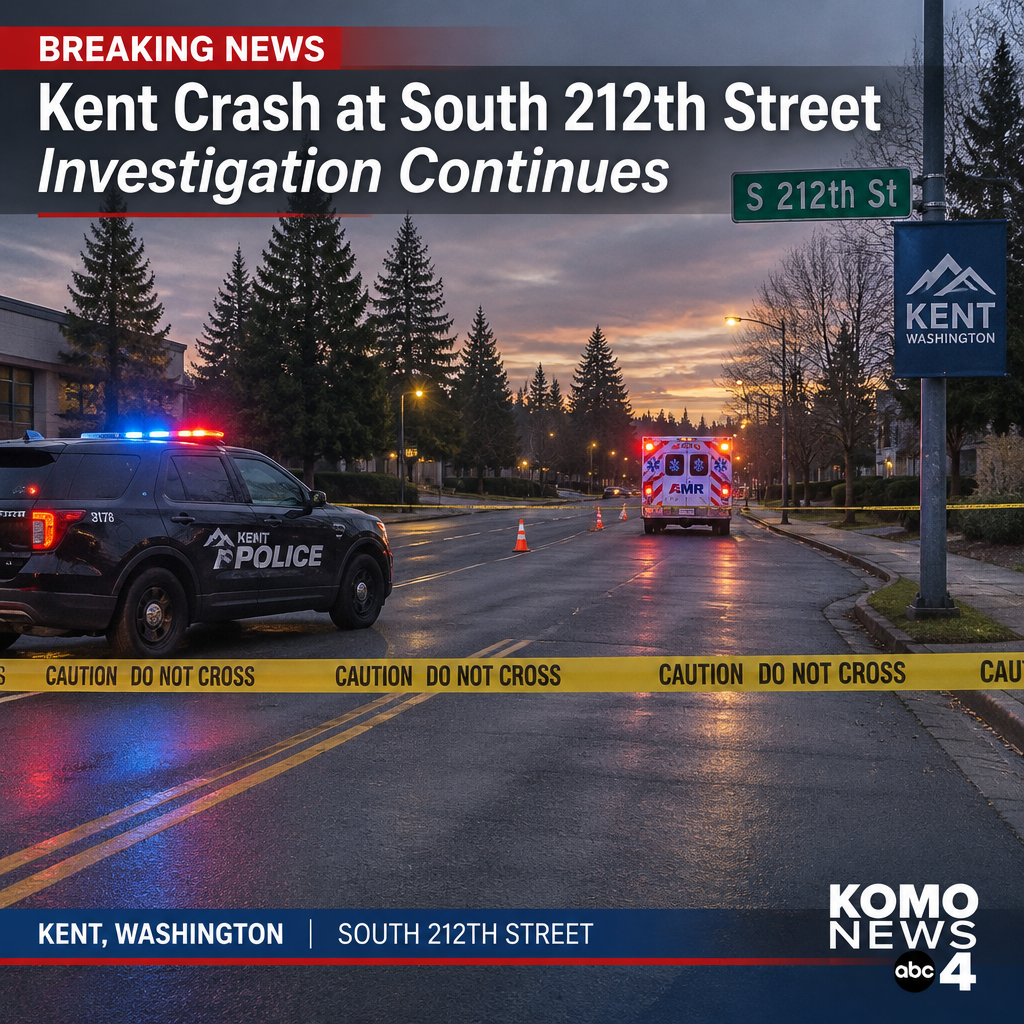
What Happened in the Kent Crash?
Kent Police said officers were dispatched at about 3:45 p.m. Monday to a collision involving several vehicles at South 212th Street and 91st Place South. The intersection is next to the WinCo parking lot, whose vehicles were part of the sequence described in the initial police account. Police have not supplied a calendar date in the information available here, so the event is identified as occurring on Monday rather than assigned an unverified date.
According to investigators’ preliminary account, an 87-year-old man was driving a truck west on South 212th Street. Police say the truck entered the intersection through a red light and hit the driver’s-side quarter panels of two vehicles coming out of the WinCo lot. One was positioned to turn eastbound; the other, driven by the 43-year-old woman, was positioned to turn westbound. The truck then hit two additional vehicles.
Police said the woman was ejected from her vehicle. Officers arrived within minutes and initially found a faint pulse, beginning CPR when the pulse faded. Puget Sound Fire and King County Medics continued lifesaving efforts, but they could not revive her. She was pronounced dead at the scene.
The department has not publicly identified the woman in the account described here. Nor does the account state whether she was wearing a seat belt, what speed any vehicle was traveling, or how the truck came to enter the intersection. Those points should not be filled in by guesswork. I separate what police have said from what remains unknown because that is the only fair way to report a fatal collision.
The investigation is being handled by the Kent Police Traffic Unit. That assignment indicates the case is receiving traffic-crash investigation, but it does not itself tell us whether police will issue a citation, recommend charges, or find a particular driver legally responsible. The Kent Police Department is the agency leading the inquiry; any later account should be judged against its findings and the evidence it releases.
Core Details and Context
Several details define the known sequence. None should be stretched beyond what the police account supports.
- Time and location: Officers were sent at about 3:45 p.m. Monday to South 212th Street and 91st Place South in Kent.
- The truck’s reported movement: Police say the 87-year-old driver was traveling west on South 212th Street and entered the intersection against a red light.
- The first impacts: The truck struck the driver’s-side quarter panels of two vehicles coming from the WinCo parking lot. One was positioned for an eastbound turn and one for a westbound turn.
- Further impacts: Police say two other vehicles were struck after the first collision.
- The fatal injury: The 43-year-old woman was ejected from her car. She died at the scene despite CPR and continued treatment by fire and medical crews.
- Other injuries: Multiple drivers were taken to local hospitals with injuries described as minor.
- Investigation: Kent Police’s Traffic Unit is handling the case. Police say the investigation remains open.
The red-light detail is important, but its status is equally important: it is part of the initial investigation, not a final court finding. Washington law sets out how drivers must respond to traffic-control signals. The state’s traffic-signal statute provides the legal framework; the facts of this collision still have to be established through evidence and the investigative process.
A signal-controlled intersection brings several movements together. A driver traveling through may meet vehicles turning from a side entrance, and a parking-lot exit can add another stream of traffic. That general feature does not establish that the intersection’s design caused this crash. Police have not announced a finding about signal timing, sight lines, road design, or any malfunction.
Frankly, people often leap from the most striking detail to a complete explanation. A reported red-light entry is a serious fact, but it does not answer every question about impact sequence, visibility, reaction time, or the injuries that followed. Investigators typically need to examine vehicle damage, roadway evidence, statements, and any available video before they can describe a collision with greater confidence. Kent Police have not said which of those materials are available in this case.
The reported ejection also calls for restraint in public discussion. The account does not say whether the woman was wearing a seat belt, and it would be wrong to infer her choices from the injury outcome. The National Highway Traffic Safety Administration explains seat-belt safety in its vehicle safety guidance; that general information cannot establish what happened inside this particular car. A person’s dignity does not depend on whether the public has answers to every medical or mechanical detail.
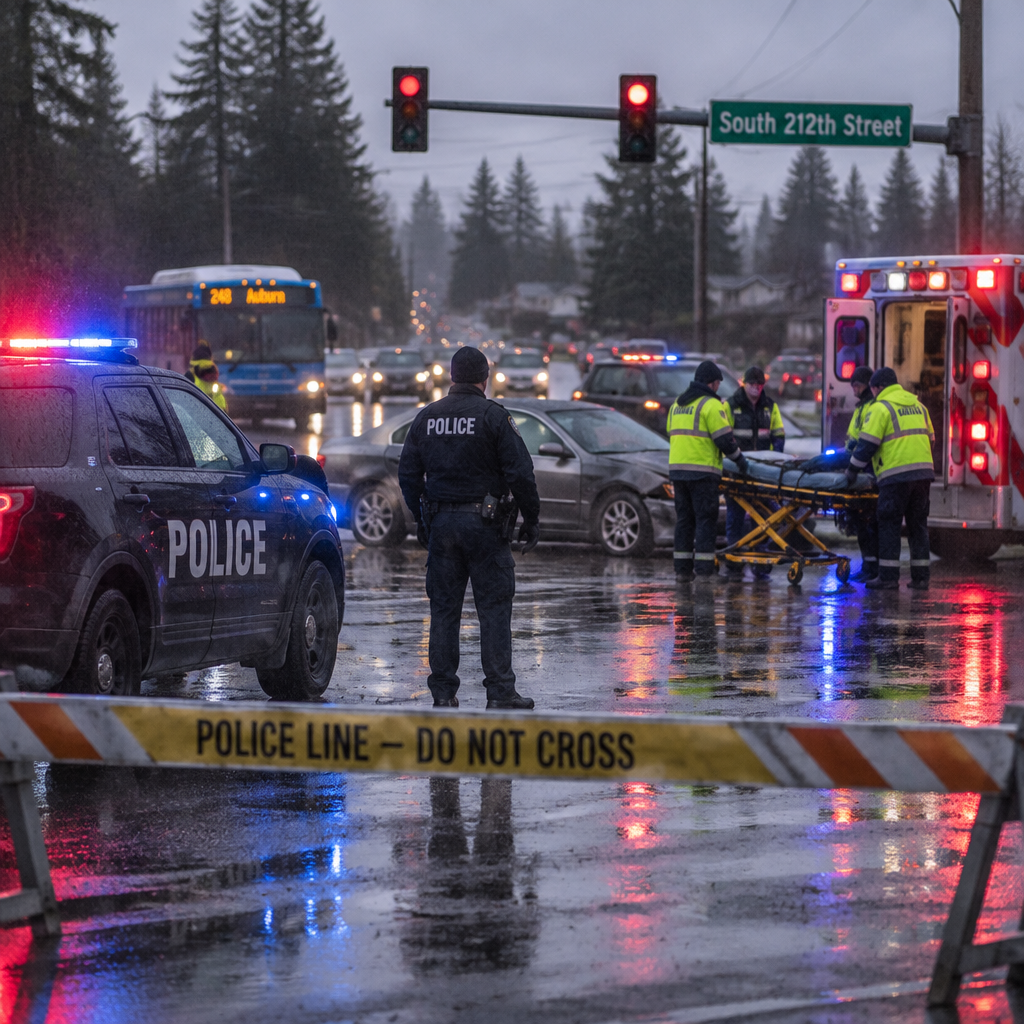
Timeline of the Collision and Response
- Before the crash: Police say the truck was traveling west on South 212th Street. Two vehicles were coming from the WinCo parking lot and entering the intersection, one positioned to turn east and one to turn west. The account does not provide a more detailed second-by-second sequence.
- The reported signal violation: In its preliminary account, police said the truck entered the intersection through a red light. That is the key asserted movement in the initial description. Investigators have not publicly reported whether they have completed a review of signal timing, video, or other evidence.
- The first impacts: Police say the front of the truck hit the driver’s-side quarter panels of the two vehicles from the parking lot. The 43-year-old woman was driving one of them. The other vehicle was positioned to make an eastbound turn.
- Additional vehicles are struck: The truck hit two more vehicles after the first collision, according to police. The initial account does not specify the exact order of those later impacts or the precise positions of all the vehicles afterward.
- Emergency response begins: Officers arrived within minutes. They initially detected a faint pulse from the woman and began CPR after it faded. Puget Sound Fire and King County Medics then took over lifesaving efforts.
- The woman is pronounced dead: Emergency crews were unable to resuscitate her, and she was pronounced dead at the scene. Police say multiple drivers were taken to local hospitals with minor injuries. No further medical details have been reported.
- Traffic investigation continues: Kent Police’s Traffic Unit took over the investigation. Police have not announced a final determination, a citation, or a criminal charge. I would not treat the opening account as the last word; it is a starting point for evidence review.
The timeline shows the difference between response and investigation. First responders must act on immediate medical needs; crash investigators later reconstruct movements and assess evidence. Those jobs overlap at the scene, but they answer different questions. The emergency response addressed whether people could be treated. The Traffic Unit’s work is to establish how the collision unfolded and what the available evidence supports.
That process can take time. The current public account does not say when investigators expect to finish or whether they will release a more detailed report. Until then, the safest summary is the one supported by police: a truck reportedly entered on red, several vehicles were hit, one woman died, other drivers had minor injuries, and the investigation remains open.
Comparing the Vehicles’ Reported Movements
This crash has no meaningful business-style competitor, and treating one vehicle as a rival to another would obscure what matters. The useful comparison is between the two streams of traffic described by police: the westbound truck on South 212th Street and the vehicles entering from the WinCo parking lot. The table separates reported facts from details not yet supplied.
| Detail | Westbound truck | Vehicles from WinCo parking lot |
|---|
| Reported direction or position | Traveling west on South 212th Street | Entering the intersection from the parking lot |
| Signal detail in the initial account | Police say it entered through a red light | The signal status for each vehicle is not described in the account |
| First reported contact | The front of the truck struck two vehicles | The truck hit driver’s-side quarter panels of two vehicles |
| Intended movement | Not reported beyond westbound travel | One vehicle was positioned to turn east; the woman’s car was positioned to turn west |
| Later impacts | Police say the truck struck two additional vehicles | The order and exact movements of the later vehicles are not reported |
| Driver outcome | The 87-year-old driver’s injuries or condition are not stated | Multiple drivers were hospitalized with minor injuries; the 43-year-old woman died |
The comparison is deliberately narrow. Police have not said that all vehicles entering from the parking lot had the same signal, nor have they described the signal phase in enough detail to draw that conclusion. They also have not reported speed, braking, visibility, or whether any vehicle attempted an evasive maneuver. Those are not minor omissions to be patched with assumptions; they are facts that may shape a reconstruction.
The reported impact points matter because they help investigators test the sequence. A front impact with the side quarter panels of other vehicles can be compared with damage patterns, debris, vehicle positions, and statements. But a short public description is not enough to reconstruct angles, speed, or responsibility. A chart can organize known facts; it cannot replace the underlying evidence.
There is a broader safety point here, but it should not be mistaken for a finding about this site. Intersections where through traffic meets vehicles entering from a driveway or parking lot require drivers to follow signals and check for conflicting movement. The Washington statute describes drivers’ duties at signals. The Washington State Department of Transportation crash-data portal can help readers examine broader state crash records, but no statewide dataset by itself proves why this individual collision happened.
Here’s the kicker: the most useful comparison is not between drivers as people. It is between the documented movements and the evidence investigators can verify. That distinction protects the accuracy of the report and keeps public discussion focused on accountability rather than speculation.
Misconceptions and What to Know
A preliminary police account is not the final legal ruling. Police have said the truck entered through a red light, based on the initial investigation. That statement is significant, and it should be reported clearly. But an initial account is not the same thing as a completed reconstruction, a prosecutor’s decision, or a court judgment. The Traffic Unit has not announced a final finding in the information available here.
The age of a driver does not establish the cause. The truck driver was reported to be 87. That is a biographical detail, not evidence that age caused the crash. Police have not reported a medical issue, impairment, distraction, or any other personal factor. Turning age into an explanation without evidence is unfair and analytically weak.
The account does not tell us whether the woman wore a seat belt. She was ejected from her vehicle, police said. That fact does not establish seat-belt use, and it does not justify public judgment about her conduct. NHTSA’s general guidance discusses seat belts as a safety measure, but only investigators or verified evidence could address restraint use in this crash. The outcome is tragic without adding unsupported blame.
A multi-vehicle crash is not automatically a chain-reaction account with every movement known. Police said the truck hit two vehicles first and two more afterward. The public description does not list the precise position or movement of every vehicle, or the order of every later impact. Until that information is released, readers should avoid drawing a detailed diagram from a few sentences.
Minor injuries do not mean the incident was minor. Police said multiple drivers went to hospitals with minor injuries. The fatality makes clear that the consequences were severe. The label describes reported injuries among other drivers, not the scale of the collision or the human loss.
A red light can be central without answering every investigative question. Washington’s signal law lays out the rules, and police say the truck crossed against the light. Investigators may still need to establish the full sequence and assess whether other relevant circumstances played a role. No one should mistake the existence of a rule for proof of every fact in a particular case.
A crash report does not automatically reveal a policy failure. It is reasonable to ask whether a location has a history of collisions or whether changes could improve safety. But police have not said this crash resulted from road design, signal timing, or a recurring hazard. Any proposed engineering response should rest on records and analysis, not on a single event alone. Public agencies have a responsibility to examine credible safety concerns; good stewardship also means using evidence before spending public resources or assigning blame.
The confirmed account is already grave: one woman died, emergency workers tried to save her, and several other drivers were hurt. More certainty will depend on the investigation. Careful reporting should leave room for that work, while recognizing the dignity of those affected and the public’s legitimate interest in a clear explanation.
Frequently Asked Questions
Where did the fatal Kent crash happen?
Kent Police said the collision occurred at South 212th Street and 91st Place South, near the WinCo parking lot. Officers were dispatched at about 3:45 p.m. Monday. The information available here does not give a calendar date, so a specific date should not be inferred.
How many vehicles were involved?
Police described a multi-vehicle collision. The truck first struck two vehicles coming from the WinCo parking lot and then struck two additional vehicles. That account identifies at least five vehicles in the described sequence, but police have not issued a full vehicle-by-vehicle reconstruction in the information available here.
What caused the crash?
The initial police investigation indicates that the truck entered the intersection through a red light before striking the other vehicles. The Traffic Unit’s investigation remains ongoing, and police have not reported a final cause or complete account of all contributing circumstances.
Who is investigating, and were there other injuries?
Kent Police’s Traffic Unit took over the investigation. Police said multiple drivers were taken to local hospitals with minor injuries. The 43-year-old woman died at the scene after officers, Puget Sound Fire, and King County Medics attempted lifesaving care.
Final Thought
A fatal collision cannot be responsibly reduced to one short phrase, even when the first account includes a striking detail such as a reported red-light entry. The detail belongs in the story. So do the limits of what is known. Police have described the truck’s westbound movement, the vehicles entering from the WinCo lot, the impacts, the woman’s death, and the emergency response. They have also said the investigation remains open.
For readers, the useful posture is neither indifference nor instant certainty. Ask what evidence investigators have established, distinguish an initial account from a final finding, and resist filling gaps with assumptions about the drivers. For officials, the obligation is to investigate carefully and communicate what can be confirmed, including whether later findings change or sharpen the initial sequence. For the community, the loss is not an abstract traffic statistic. It is the death of a person whose identity and circumstances should be treated with respect.
Traffic rules exist to protect people sharing public roads, not to provide talking points after a tragedy. Their enforcement and the design of safe streets are matters of public responsibility. The common good is served by clear signals, careful driving, sound investigation, and honest reporting. What happened at this Kent intersection deserves that level of care—and no less.