Newrez Settlement: What Washington’s $3 Million Mortgage-Servicing Order Means
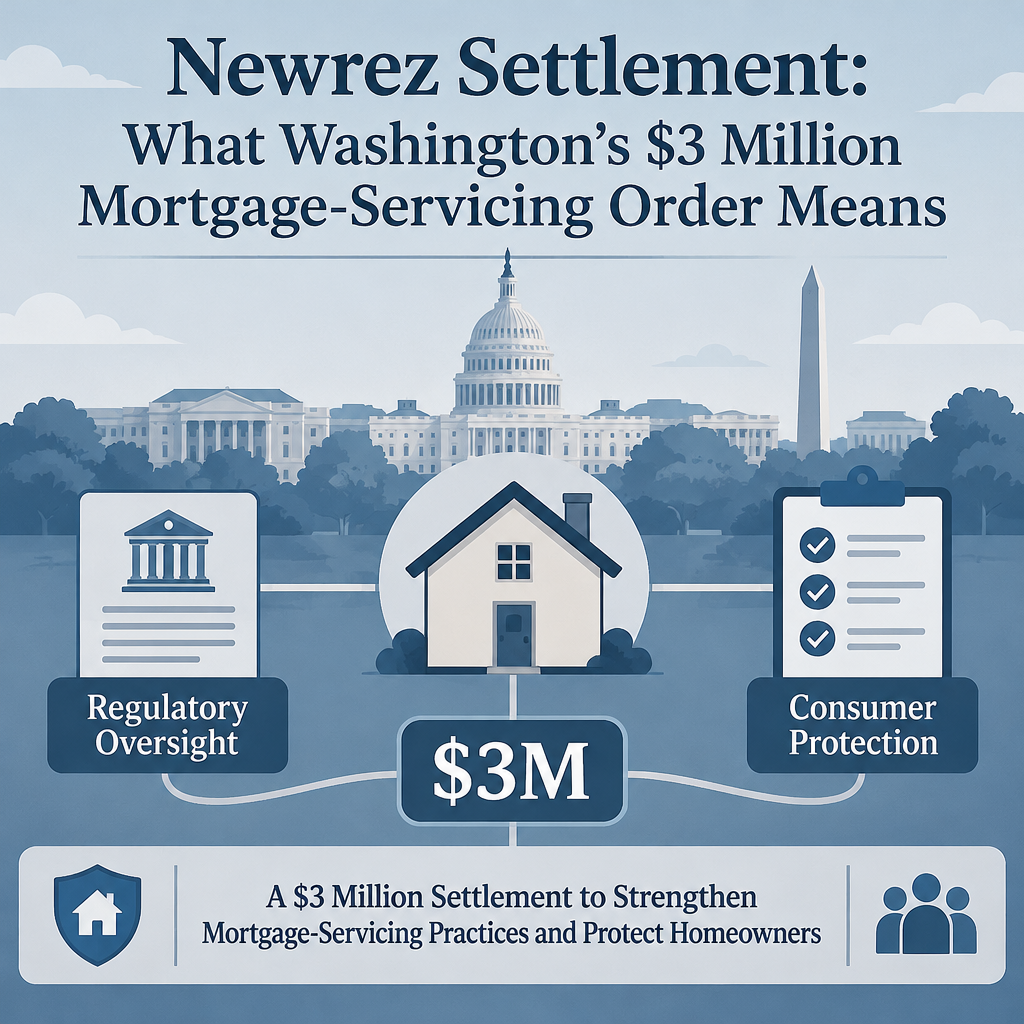
Washington’s mortgage regulator has secured a $3 million settlement with Newrez LLC. Announced by the Department of Financial Institutions on Nov. 17, the agreement requires a $2.5 million payment to the agency and $500,000 in system enhancements, alongside controls addressing escrow, insurance, data security and employee involvement in nonjudicial foreclosures. The allegations remain allegations.
The agreement matters because mortgage servicing touches recurring payments, insurance coverage, account records and, in some cases, the steps preceding foreclosure. A missed escrow adjustment or an unclear record can create real consequences for a household, even when the underlying loan remains current. That is why regulators examine the machinery behind a monthly bill, not just the amount due.
When I reviewed the announced terms, the clearest finding was also the most limited: DFI described the problems it sought to correct, but did not publish case-by-case evidence or say how many borrowers experienced each issue. That distinction should stay visible. A consent order is a concrete regulatory action, but the public announcement is not a full audit of every complaint.
What Is the Newrez Settlement?
The Newrez settlement is an agreement between Washington’s DFI and Newrez LLC, a mortgage servicer operating across the country. DFI said its charges followed an investigation of more than 125 consumer complaints and alleged that Newrez had deficient business practices. Under the consent order, the company must take what the agency called “substantial affirmative actions” to improve consumer protections.
A mortgage servicer is the company that handles the day-to-day administration of a home loan. Depending on the loan arrangement, that can include collecting monthly payments, maintaining records, managing escrow funds for property taxes and insurance, answering borrower questions, and sending required notices. A servicer may not be the same company that originally issued the loan. For an explanation of the basic role, see the Consumer Financial Protection Bureau’s guide to mortgage servicers.
Servicing errors can be hard for customers to spot. A borrower may see an unexpected payment change without knowing whether it reflects taxes, insurance premiums, an escrow adjustment or a processing problem. If a payment is misapplied, even a short-lived bookkeeping mistake can prompt calls, letters and anxiety. The practical standard is not merely that a company has a policy on paper; its systems and staff must carry that policy out consistently.
The settlement addresses three areas named by DFI: controls for insurance and escrow accounts, protection of Washington borrowers’ private information, and employee involvement in nonjudicial foreclosure processes. Those categories are specific enough to show the regulator’s priorities, but they do not describe every alleged incident. DFI’s announcement does not identify individual borrowers or explain the facts behind each complaint.
Frankly, that limit matters. More than 125 complaints were part of the investigation, but the number alone does not establish that every complaint was substantiated, involved the same problem, or resulted in financial harm. It does show why complaint systems can matter: repeated reports may give regulators a reason to look for patterns that a single customer cannot see.
The public terms also distinguish between financial remediation and direct consumer restitution. DFI said $2.5 million would go to the agency and $500,000 would fund system enhancements connected to the required actions. The announcement does not say that borrowers will receive individual checks, nor does it provide a formula for calculating customer-specific payments. Readers should not assume that the headline figure will be divided among complainants.
The consent order is an enforceable regulatory agreement, not a public accounting of every operational failure. The distinction is useful, not evasive: it separates what the agency announced from what remains unreported. A careful account of the settlement should do the same.
Core Details and Consumer Context
The first required change concerns insurance and escrow accounts. Escrow is money collected from a borrower, often as part of the monthly mortgage payment, and held to pay certain property costs when they come due. A servicer’s records and payment procedures need to track deposits, bills, disbursements and account balances. Federal mortgage-servicing rules address escrow account administration; the CFPB’s Regulation X provisions on escrow accounts provide the relevant regulatory framework.
That background does not prove that every Newrez escrow account was mishandled. The DFI release says the company must enhance controls, but does not spell out the transactions that prompted the order. The public should resist filling that gap with guesses. What can be said is that an escrow-control problem, if it occurs, may affect whether an insurance premium is paid on time, whether a balance is calculated correctly, or whether a borrower receives a clear explanation of a payment change.
Insurance is not a minor line item. A gap in coverage can expose a household and a lender to avoidable risk, while an incorrect insurance charge can make monthly housing costs harder to manage. The order’s focus on insurance and escrow therefore reaches beyond bookkeeping. It concerns stewardship of funds entrusted to a servicer and the basic expectation that customers can understand how their payments are handled.
The second area is private information. Mortgage accounts can contain personal and financial details, including contact information, loan balances and payment histories. DFI said Newrez must enhance controls to ensure Washington borrowers’ private information is secured. The announcement does not describe a data breach, identify information that was exposed, or say that any specific security incident occurred. It would be wrong to present the order as proof of one.
The third area concerns employees involved in nonjudicial foreclosure processes. In Washington, a nonjudicial foreclosure proceeds through a statutory process rather than a lawsuit seeking a foreclosure judgment. The state’s Revised Code chapter on deeds of trust and foreclosure sets out legal requirements for that process. DFI’s order requires proper employee involvement, but the release does not explain which roles were inadequate or identify a specific foreclosure file.
Here’s the kicker: policy language alone does not protect a borrower if the right information never reaches the person making a decision. Foreclosure work can involve notices, account histories, review steps and deadlines. The order’s emphasis on employee involvement points to a basic operational issue—systems must route work to people with the authority and information to handle it appropriately. The announcement does not, however, establish that a particular foreclosure was improper.
These controls also connect to the dignity of work and the common good. Employees need clear responsibilities and reliable information; borrowers need accurate records and fair treatment. Neither aim is served by a process that depends on an undocumented handoff or a customer repeatedly chasing answers. That is a practical consumer-protection point, not a claim about facts the agency has not published.
Timeline: How the Case Reached a Settlement
- Consumers submitted complaints. DFI said its investigation involved more than 125 consumer complaints about Newrez. The agency did not publish a complaint-by-complaint chronology, so the public cannot tell from the announcement when each report was received or what each one alleged.
- DFI investigated the company’s practices. The regulator reviewed the complaints and brought charges alleging deficient business practices. A complaint is a report that warrants attention; it is not, by itself, a finding that every allegation is true. The agency’s investigation is the step that gives regulators a chance to examine whether reports point to a broader pattern.
- The parties entered a consent order. The agreement sets out corrective measures, including stronger insurance and escrow controls, better protection for private information, and appropriate employee involvement in nonjudicial foreclosure processes. DFI described the required work as substantial affirmative action. The release does not provide a detailed implementation schedule or list every technical control.
- DFI announced the settlement on Nov. 17. The agency said the financial remediation totals $3 million: $2.5 million to DFI and $500,000 for system enhancements tied to the ordered actions. The announcement does not specify whether the $2.5 million is allocated to a state fund, how it will be used, or whether any portion will reach individual borrowers.
When I look at that sequence, the public record supports a clear but bounded conclusion: complaints led to an investigation, the investigation led to charges, and the consent order imposed financial and operational terms. The sequence does not supply details about internal negotiations, the evidence supporting each charge, or the company’s account of the matter. Those omissions should not be replaced with invented explanations.
The order’s practical effect will depend on implementation. Better written procedures are one thing; reliable account records, tested system changes and staff who follow the rules are another. The release says system enhancements are part of the settlement, but does not report completion dates, testing results, monitoring arrangements or penalties for missing milestones. Until those details are available, claims that the controls are already in place would run ahead of the record.
Consumers who believe their mortgage account contains an error should keep payment records, account statements and written communications, and should contact the servicer through its documented channels. Federal rules include procedures for certain notices of error and requests for information, but the steps and deadlines depend on the circumstances. The CFPB’s mortgage servicing resources explain the broader framework; they do not replace advice about an individual loan.
Comparison Table: Newrez and the Available Competitor Benchmark
The announcement provides no named competitor, market-share comparison or parallel enforcement case. So a head-to-head claim about which company performs better would be guesswork. The most honest comparison is between what the Newrez order specifically requires and what the available information says about other servicers—which, here, is nothing case-specific.
| Measure | Newrez settlement | Other servicers / competitor benchmark |
|---|
| Regulator action | Washington DFI announced a consent order with Newrez LLC. | No competitor or comparable order is identified in the announcement. |
| Complaint basis | Investigation involved more than 125 consumer complaints. | No comparable complaint count is provided. |
| Financial terms | $3 million total: $2.5 million to DFI and $500,000 for system enhancements. | No competitor payment or remediation figure is provided. |
| Required controls | Insurance and escrow handling, borrower data security, and employee involvement in nonjudicial foreclosure. | No competitor control requirements are described. |
| Borrower payments | The announcement does not specify direct payments to individual borrowers. | No comparable borrower payment information is available. |
| Completion details | No public deadline or completed-system report is identified in the announcement. | No competitor timeline is identified. |
The table is intentionally narrow. It does not rank Newrez against another servicer, because no comparable evidence is available here. A fair comparison would need the same measures for each company: complaint volume over a defined period, substantiated findings, account-level outcomes, the type of remedy, and whether corrective actions were independently verified.
Big dollar figures can create a false sense of precision. The $3 million figure is exact, but it combines a payment to DFI with money for system enhancements. It is not a published estimate of individual borrower losses, and it should not be treated as a refund pool. Likewise, the 125-plus complaints are a defined count in the announcement, not a rate; without the number of relevant Washington accounts and the time period, there is no sound denominator for calculating prevalence.
The truth is that a useful competitor comparison requires more than a familiar brand name. Mortgage companies may differ in loan volume, servicing portfolios, complaint reporting and enforcement history. Naming the “biggest competitor” without a source for market position would make the table look decisive while making it less accurate. The available facts support comparison of the order’s terms, not a market-wide verdict.

Common Misconceptions and What to Know
Misconception: The settlement proves that every allegation was established. It does not. DFI said it brought charges alleging deficient business practices after investigating complaints, and the parties entered a consent order. The public announcement does not provide findings for each complaint or describe a trial. Readers should report the allegations and the settlement terms accurately, without converting them into a verdict on every account.
Misconception: The $3 million goes directly to borrowers. The stated breakdown says otherwise: $2.5 million goes to DFI, while $500,000 is for system enhancements related to the ordered actions. The release does not describe individual restitution, a claims process or a payment schedule for customers. A borrower with a specific loss should not assume that this settlement automatically creates an individual payment.
Misconception: More than 125 complaints means more than 125 proven violations. A complaint is a signal, not a final adjudication. DFI’s investigation may have considered the reports as a group, but the announcement does not say how many were substantiated, whether they concerned the same conduct, or how many borrowers were affected. Complaint counts can flag a pattern; they need context before they can measure its scale.
Misconception: The settlement means Newrez has already completed every change. The terms require affirmative actions and system enhancements. The public release does not say that all enhancements are finished, when they must be completed, or who will verify them. A requirement is not the same thing as a completed control. The meaningful follow-up is whether the company can show that new procedures work in ordinary account handling, not merely that they were written down.
Misconception: A problem with servicing automatically means a foreclosure was unlawful. The order calls for proper employee involvement in nonjudicial foreclosure processes, but it does not identify a specific foreclosure or state that one was invalid. Washington law governs those proceedings, and the effect of a servicing error depends on the facts and applicable law. People facing foreclosure should seek qualified legal help promptly rather than infer a case outcome from a companywide settlement announcement.
Misconception: The agency has published the full evidence. It has not, at least in the announcement described here. The release identifies the investigation, the allegations, the required control areas and the financial terms. It does not publish complaint files, individual account records, engineering plans or a detailed explanation of each alleged failure. That does not make the action meaningless; it means the public should distinguish the announced remedy from the underlying case record.
Frankly, the most responsible reading avoids both extremes. The order should not be dismissed as a bookkeeping matter, because escrow, insurance, privacy and foreclosure procedures can affect households directly. But it should not be inflated into a detailed account of harms that DFI has not described. Precision is not timid; it is how public reporting stays useful.
Borrowers who have concerns can first document the issue: dates, payment confirmations, letters, account statements and the names of people contacted. A written request can help create a clear record, and consumers can consult the CFPB’s complaint portal when they want to report a problem involving a financial product or service. The portal is not a substitute for an attorney, and submitting a complaint does not guarantee a particular outcome.
Frequently Asked Questions
What did Newrez agree to pay?
The settlement totals $3 million. DFI said $2.5 million will be paid to the agency and $500,000 will fund system enhancements connected to the required corrective actions. The announcement does not describe a direct payment program for individual borrowers or state how the agency will use the $2.5 million.
What prompted Washington DFI’s investigation?
DFI said the investigation involved more than 125 consumer complaints and led to charges alleging deficient business practices. The public announcement does not list each complaint, identify every allegation or say how many reports the agency substantiated. The complaint count should not be treated as a count of proven violations.
Which Newrez practices must change?
The consent order requires stronger controls for insurance and escrow accounts, improved safeguards for Washington borrowers’ private information, and proper employee involvement during nonjudicial foreclosure processes. DFI did not publish a detailed technical plan, a completion deadline or a list of specific borrower accounts affected.
Does the settlement mean borrowers will receive refunds?
Not based on the terms described in DFI’s announcement. The stated $3 million is divided between a payment to DFI and system enhancements; the release does not announce individual refunds, eligibility rules or a claims process. Anyone who believes they suffered a specific loss should preserve records and seek guidance about that individual account.
Final Thought
This settlement is significant because it targets the systems that sit between a homeowner and a mortgage account: escrow calculations, insurance payments, private data and foreclosure work. Those functions can look routine from the outside, yet a small error can turn into a confusing bill, an unpaid premium or a dispute that consumes weeks. The value of the order will depend on whether Newrez’s required changes make those processes dependable in practice.
The public record also has limits. DFI has reported the complaint count, the allegations, the broad corrective areas and the financial breakdown. It has not supplied an account-level list of harms, a direct restitution plan, or a public scorecard showing that each change is complete. Those gaps are reasons to ask careful follow-up questions, not reasons to invent answers or dismiss the agency’s action.
When I weigh the published terms, the strongest measure of success will not be the headline payment alone. It will be whether borrowers can get accurate information, whether payments and insurance records are handled correctly, whether sensitive details stay protected, and whether staff take the right steps when a loan approaches foreclosure. That is a plain standard: competent administration, fair treatment and respect for the people whose homes are at stake.
Regulatory settlements are most useful when they lead to lasting changes and clear accountability. DFI’s order sets out the required direction; the next evidence should come from implementation and any later public reporting. Until then, the facts warrant attention, but not embellishment.
FAQPage JSON-LD