Childcare workers at KinderCare’s Capitol Childcare Center in Olympia have filed a petition with the National Labor Relations Board, seeking union...
Olympia KinderCare Workers Seek Union Representation: What the NLRB Petition Means
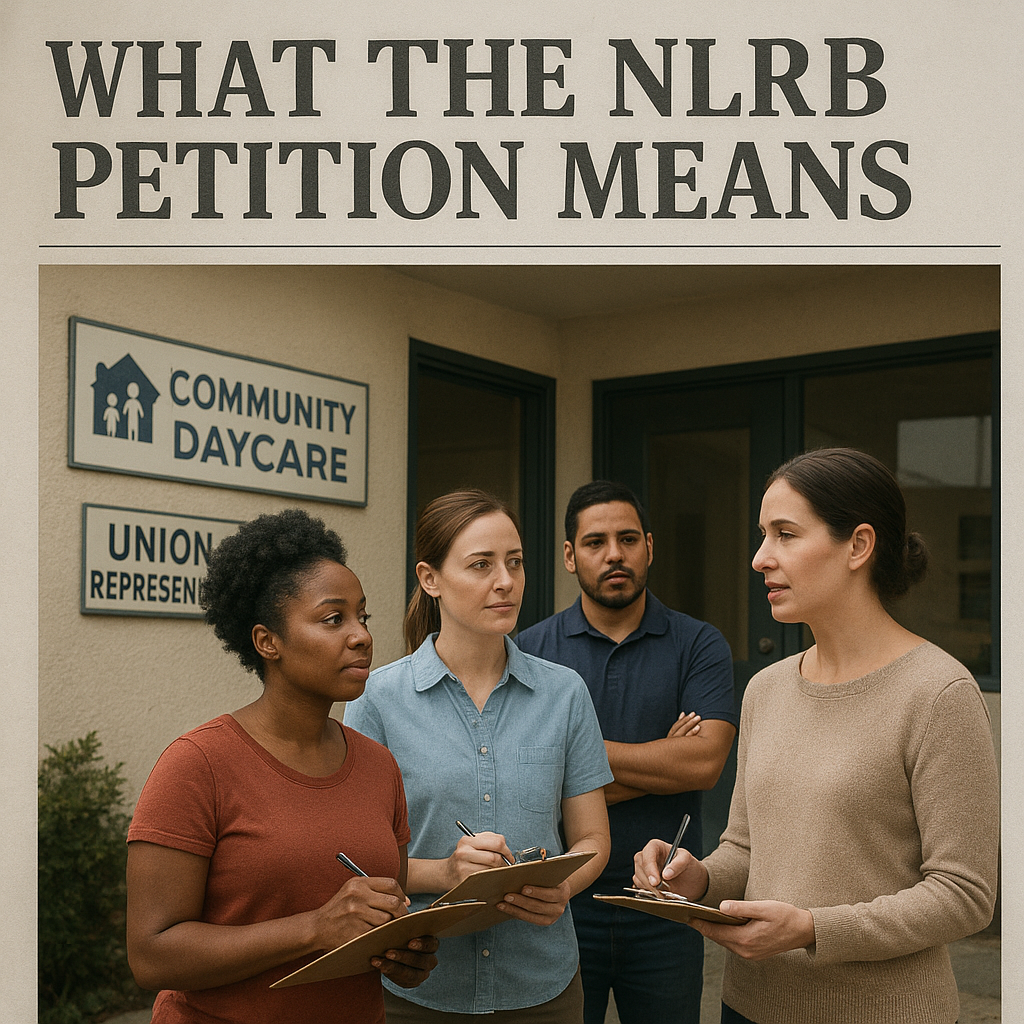
Childcare workers at KinderCare’s Capitol Childcare Center in Olympia have filed a petition with the National Labor Relations Board, seeking union representation in what SEIU Local 925 describes as a first for KinderCare educators in the United States. The workers cite low pay, staffing shortages, limited benefits and disrespectful treatment; the petition begins a formal process, but it does not itself certify a union.
Key Takeaways- SEIU Local 925 says workers at the Olympia center submitted an NLRB petition on Monday, Nov. 9.
- The union says about 20 educators serve more than 80 children at the center, which opened in 2023.
- Workers identify pay, staffing, benefits and workplace treatment as key concerns.
- KinderCare says it aims to offer competitive pay, benefits and professional development, and is committed to listening.
- A petition is not a vote result. No election outcome or union certification has been reported.
The immediate question is procedural: what happens next, and what can the filing establish? The filing puts workplace representation before the federal labor agency, but the details of the petition, the next procedural steps and any election date have not been reported. There is also a historical wrinkle. SEIU calls this the first KinderCare group in the country to opt for representation, while Capital & Main previously reported that employees at a California KinderCare location voted to unionize in 2016 before that location reportedly closed. Those accounts should be read together, not flattened into a simple first-ever claim.
What Is the Olympia KinderCare Union Petition?
A union petition is a formal request for representation proceedings, not a completed labor agreement and not, by itself, proof that employees have won an election. The National Labor Relations Board, or NLRB, administers federal labor law for many private-sector workers. Its materials explain how employees may seek an election and how the agency oversees that process. The exact filing and requested next step in this case have not been reported beyond SEIU Local 925’s statement that workers submitted a formal petition.
In general, a petition prompts an NLRB review of questions such as which employees belong in the proposed bargaining unit and whether the matter can proceed to an election. If an election is held, eligible workers decide by secret ballot whether they want union representation. The rules and circumstances can vary; a petition alone does not tell the public whether an election will happen, when it might happen or how employees will vote. The NLRB’s overview of representation elections sets out the basic federal process.
That distinction matters in Olympia. The workers have asked to pursue representation; there is no reported vote count, certification or collective bargaining agreement. For now, the filing is a meaningful step in a workplace dispute, not its final chapter. Frankly, headlines that treat a petition as a settled victory skip the point at which the process is actually decided: employees must be able to make their choice under the applicable rules.
SEIU Local 925 says it represents more than 5,500 childcare workers statewide. It describes the Olympia educators as the first KinderCare educators in America to opt to have union representation. That is the union’s characterization of the current campaign. It needs a historical qualification, because Capital & Main reported that KinderCare employees at a California center voted to unionize in 2016. The same publication reported that the location closed soon afterward. The information provided does not establish why it closed or whether that earlier group retained representation after the closure.
The Capitol center itself opened in 2023 at 106 Maple Park Ave. SE. KinderCare spokesperson Colleen Moran said it serves state employees as well as the broader Olympia community. According to SEIU’s release, about 20 educators care for more than 80 young children there. Those numbers sketch the scale of the workplace, but they do not explain how shifts are organized, what the center’s staffing levels are at different times of day, or what its current compensation and benefit plans include.
Core Details and Context
The workers say several conditions brought them to the point of seeking representation. SEIU’s news release lists low pay, insufficient staffing, lack of benefits and disrespectful treatment. These are employees’ stated reasons for organizing; they are not, by themselves, findings by a government investigator or proof that every worker shares every complaint. That distinction is important. It keeps reported grievances visible without presenting allegations as adjudicated facts.
Kayla Gertje, a cook at the Capitol center who served as its director until June, focused on turnover and the effect of changing caregivers on young children. In a call, she said continuity helps children feel secure and build bonds with the adults who care for them. Her point is practical as well as personal: early-childhood care depends on repeated interactions. When familiar adults leave and replacements arrive, children have to adjust, while the remaining staff may have to absorb new tasks and relationships.
Gertje described safety as a basic need. If children encounter a constant stream of unfamiliar faces, she said, they may struggle to feel secure. The report does not provide turnover rates for the Capitol center, so it is not possible to measure how often staff change there or compare its experience with another location. Still, the workers’ focus on stable staffing makes the issue more than a question of employee convenience. Care depends on dependable relationships, and the dignity of the work includes the conditions required to do it well.
The workers’ claims sit within a broader set of concerns reported by early educators in Washington. A 2025 survey of 351 nonunion early educators, conducted by PowerHouse Strategic on behalf of Early Educators Rising SEIU 925, found respondents reporting pressure to skip breaks or work while sick. The survey also identified low pay and difficulty obtaining affordable health insurance. Those findings offer context, but the information reported here does not include the survey’s question wording, response rate, sampling method or percentages. It therefore cannot establish how widespread each experience is among all Washington childcare workers.
Mary Yocom, an educator at the Olympia center, said in the Nov. 9 union release that some early educators struggle to afford medication or formula for their own families. That is a pointed account of how low wages can collide with ordinary household needs. It is not a published wage comparison, and the reported information does not specify Yocom’s pay or the number of colleagues facing the same difficulty. Those details should not be guessed at.
KinderCare gave a different, though not directly numerical, account of its approach. Moran said educators are at the heart of the company and that it strives to provide competitive wages, benefits and professional development. She added that KinderCare remains committed to listening and improving support for teams and families. The statement does not give Olympia-specific pay scales, benefit enrollment figures, staffing levels or a response to each union concern. The company’s position is therefore clear in principle, but the figures needed to assess it against workers’ experiences have not been reported.
KinderCare is a large operator. SEIU’s release says the company runs about 70 childcare locations in Washington and is the largest company of its kind in the United States. The union release also says the company became publicly traded two years ago. Those facts help explain why a small center’s labor dispute may attract attention beyond Olympia: a decision involving one workplace can raise questions about representation across a much larger organization. But no broader companywide organizing result is reported here.
Timeline: What Has Happened So Far?
- The Capitol center opens in 2023. KinderCare says the site at 106 Maple Park Ave. SE serves state employees and the wider Olympia community. The reported account does not give enrollment figures at opening or changes in enrollment since then.
- Workers describe workplace concerns. Educators at the center cite low pay, insufficient staffing, benefits and treatment as reasons for seeking representation. Gertje, who worked as the center’s director until June and is now identified as its cook, raises the importance of continuity for young children. The date and details of each concern have not been reported, so there is no basis for assigning a single event as the trigger.
- Workers file a petition on Monday, Nov. 9. SEIU Local 925 says the educators submitted a formal petition to the NLRB. This is the clearest procedural milestone reported so far. I would treat it as the start of a formal process, not as evidence that the agency has already scheduled an election or that the workers have voted.
- The union and company state their positions. SEIU presents the filing as a first for KinderCare educators in the nation and points to workplace concerns. KinderCare responds that it seeks to support educators through wages, benefits and professional development, and says it will keep listening. The two statements speak to different parts of the dispute; neither supplies a full account of the center’s employment terms.
- The next step remains unreported. The reported information does not say whether the NLRB has reviewed the petition, whether KinderCare has responded in the agency process, whether an election has been scheduled or how many employees are eligible to vote. Until those facts are public, claims about the likely outcome are speculation.
There is an earlier point in the history, too. In 2016, KinderCare employees at a California location voted to unionize, according to Capital & Main. The publication reported that the location closed soon after. The available account does not establish the cause of closure, so it would be wrong to treat timing alone as proof that the union vote caused it. Still, that precedent complicates any claim that no KinderCare employees had ever voted for union representation. The Olympia campaign may be a first in a narrower sense, but the exact distinction has not been explained in the reported statement.
The next public milestones could include an NLRB determination about the petition and bargaining unit, a scheduled election, or another resolution permitted by labor law. Those are possibilities, not confirmed events in this case. The agency’s employee rights information explains general protections under federal law. The actual path depends on the filing and what the parties do next.
Comparison: Workers’ Campaign and KinderCare’s Response
The reported facts do not identify KinderCare’s biggest business competitor, provide competitor-specific staffing or wage figures, or offer an apples-to-apples comparison of childcare providers. Naming a rival as the largest competitor without evidence would create a false comparison. The useful comparison here is between the workers’ stated case for representation and the company’s stated approach to supporting employees.
| Issue | Workers’ campaign | KinderCare’s stated position |
|---|
| Representation | SEIU Local 925 says educators submitted an NLRB petition on Monday, Nov. 9. | The company statement does not address the petition’s procedural details. |
| Pay and benefits | Workers cite low pay and lack of benefits. | KinderCare says it strives to provide competitive wages and benefits; no Olympia-specific figures were reported. |
| Staffing and continuity | Workers cite insufficient staffing; Gertje says stable caregivers matter to children’s sense of security. | KinderCare says it is committed to listening and improving support; the statement gives no staffing numbers. |
| Professional growth | The reported union account does not set out a professional-development plan. | KinderCare says it offers professional development. No details about participation or outcomes were reported. |
| Current status | A petition has been submitted, according to SEIU; no vote result is reported. | The company says it will listen and improve; its response to each specific allegation is not reported. |
The table shows why the dispute cannot be settled by comparing a slogan with a counter-slogan. Workers describe what they say they experience. The company describes the support it says it aims to provide. Neither account, as reported, contains the local data needed to test the gap between intention and daily practice. Pay ranges, the cost and scope of benefits, staffing by classroom and shift, turnover, break coverage and professional-development access would make that comparison more concrete.
The NLRB process answers a narrower question: whether workers want a union to represent them, under the rules that apply. It does not automatically resolve staffing levels, wages or benefit design. If workers choose representation and the union is certified, the union and employer may bargain over terms and conditions of employment. That does not guarantee agreement on every issue, nor does it show in advance what any contract would contain.
Here’s the kicker: representation is a mechanism, not a promise of a particular outcome. Employees may see collective bargaining as a way to negotiate over matters they cannot change individually. The company may maintain that its existing programs support educators, or it may change its approach in response to employees. The reported statements do not tell us which path will follow, and neither should be presented as inevitable.

Common Misconceptions and What to Know
A petition does not mean the union has already won. The filing starts a process. No election result, certification or contract has been reported. If a vote is held, the outcome depends on eligible employees and the applicable NLRB procedures. Calling the Olympia workers unionized before that status is established would overstate what is known.
The phrase “first in the nation” needs a qualification. SEIU says these are the first KinderCare educators in America to opt for union representation. But Capital & Main reported an earlier 2016 union vote at a California KinderCare location. The earlier site reportedly closed soon afterward, but the cause is not established in the account. The most careful wording is to attribute the current first claim to SEIU and note the earlier report, rather than erase one of them.
A union’s press release and an employer’s statement are not neutral audits. Each gives a party’s perspective. Workers’ accounts help identify the practical problems they want addressed; the employer’s response describes its stated commitments. Independent wage records, staffing data, benefit documents, a detailed survey methodology and agency filings would help answer questions that the two public statements do not.
The 2025 survey does not tell us the exact conditions at this center. It covered 351 nonunion early educators in Washington and was conducted by PowerHouse Strategic on behalf of Early Educators Rising SEIU 925. Respondents reported concerns including skipped breaks, working while sick, low pay and unaffordable health coverage. Without the full methods and percentages, readers should not treat those findings as a precise statewide rate, much less as a direct measure of conditions at the Olympia site.
The California closure is not proof of retaliation. The reported sequence—a union vote followed by a reported closure—may prompt scrutiny, but timing alone does not establish cause. The available report does not provide a finding that the center closed because employees organized. That distinction protects accuracy and fairness. If later reporting or public records establish additional facts, the account can be updated; for now, the reason is not reported.
A large company does not make one workplace’s conditions uniform. KinderCare operates many locations, but the facts here concern one Olympia center. The union’s estimate of roughly 70 Washington locations and its description of KinderCare as the country’s largest company of its kind do not reveal whether wages, staffing or benefits are identical at every site. Companywide conclusions require companywide data.
Most coverage will focus on the word “union.” The harder question is whether the process gives educators a credible way to raise concerns while keeping children’s care steady. That question needs more than a filing date. It needs facts about staffing, turnover, compensation and the next NLRB steps.
Frequently Asked Questions
Have Olympia KinderCare workers officially unionized?
Not on the facts reported so far. SEIU Local 925 says workers filed a petition with the NLRB seeking union representation. No election result or certification has been reported. A petition marks a formal step, not a final decision by employees or the agency.
What concerns did the workers cite?
SEIU’s release lists low pay, insufficient staffing, lack of benefits and disrespectful treatment. Gertje also described high turnover in the childcare industry and said consistency in caregivers helps children feel safe and build bonds. The report does not include center-specific turnover or wage figures.
What did KinderCare say?
Spokesperson Colleen Moran said KinderCare strives to provide competitive wages, benefits and professional development. She said the company remains committed to listening and improving support for employees and families. The statement did not provide Olympia-specific figures or address each worker concern separately.
Why is the claim that this is a first qualified?
SEIU calls the Olympia educators the first KinderCare group in the country to opt for representation. But Capital & Main reported that KinderCare workers at a California location voted to unionize in 2016. The site reportedly closed soon after; the available information does not establish why. The current “first” claim should therefore remain attributed to the union and explained alongside that history.
Final Thought
This filing matters because early-childhood care is built from repeated human contact, not just a schedule or a room full of equipment. Gertje’s point about familiar caregivers is easy to understand: children need adults they can recognize and trust. Workers, meanwhile, need conditions that let them show up consistently and do demanding work without being pushed to choose between basic household costs and a job that serves other families.
That does not settle the merits of every claim. The reported account contains no Olympia pay table, no staffing roster, no NLRB decision and no election result. KinderCare’s statement describes its intentions, but does not supply the center-level figures that could answer workers’ concerns. SEIU’s statement describes those concerns, but it is not an independent investigation. Plainly, the missing evidence matters.
The next useful test is concrete: what does the NLRB do with the petition, what do the employees decide if a vote takes place, and can the parties produce verifiable information about pay, benefits, staffing and turnover? Those facts would let families and workers judge whether promises match practice. The common good in childcare depends on both the dignity of the people doing the work and the security of the children in their care. For now, Olympia has reached a consequential procedural moment—not a verdict.