The Olympia School District board voted 4-1 on Nov. 12, 2026, to close Madison, McKenny and LP Brown elementary schools. The decision advances a consolidation...
Olympia School Closures: Board Approves Madison, McKenny and LP Brown Shutdowns
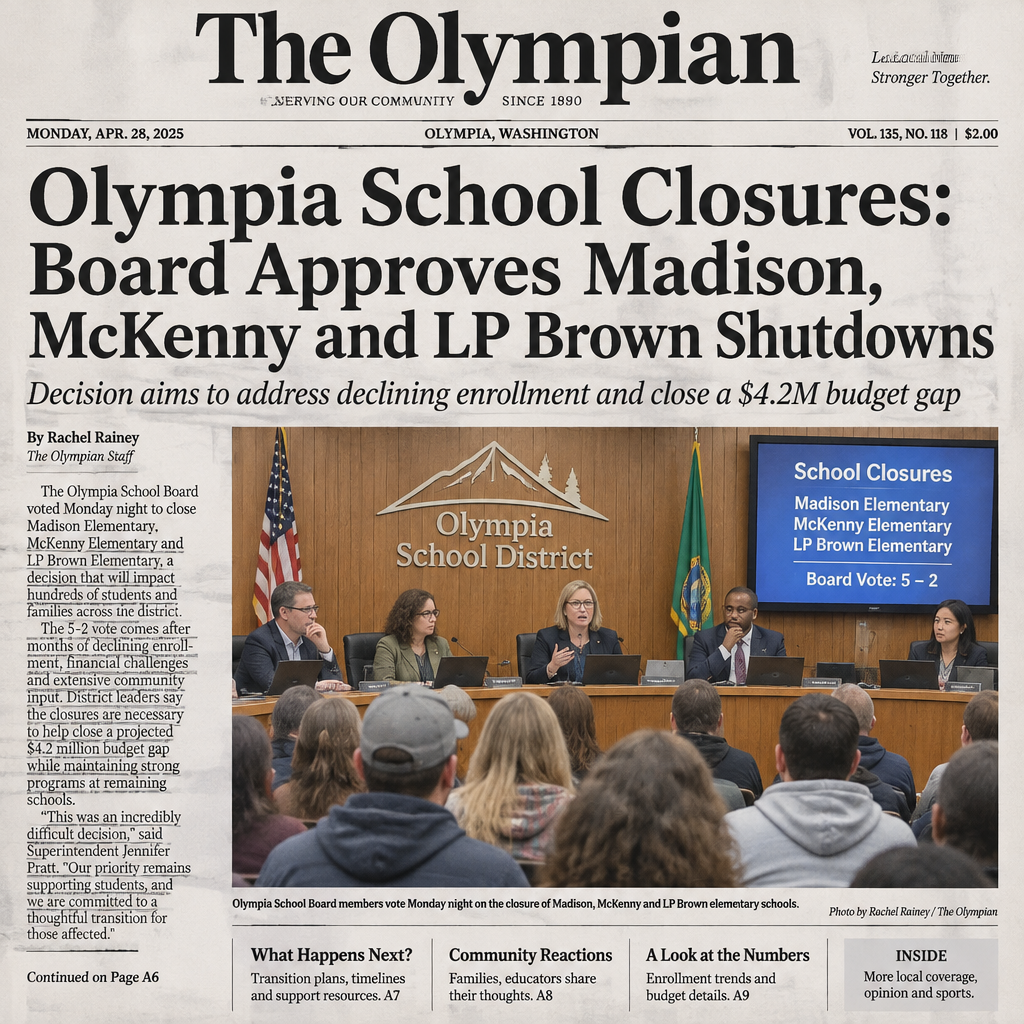
The Olympia School District board voted 4-1 on Nov. 12, 2026, to close Madison, McKenny and LP Brown elementary schools. The decision advances a consolidation plan tied to declining enrollment and budget pressure, but leaves families facing school moves, a lengthy transition and a parent’s stated plan to sue the district.
This was not a routine facilities vote. Families rallied at Madison before the meeting, marched to the district office with a police escort and asked directors to reconsider, while the board weighed a large, recurring budget problem against the disruption caused by closing three neighborhood schools. The public disagreement was plain. The figures behind the choice are less complete in the available reporting.
The vote also leaves important work ahead. Boundaries, transportation, staffing and transition support must be worked out, and the district’s published timeline stretches into the months before the 2027-28 school year. The Olympian has reported the vote and proposal in its education coverage. The practical question now is whether the district can carry out the plan without turning a budget decision into a preventable failure of communication and care.
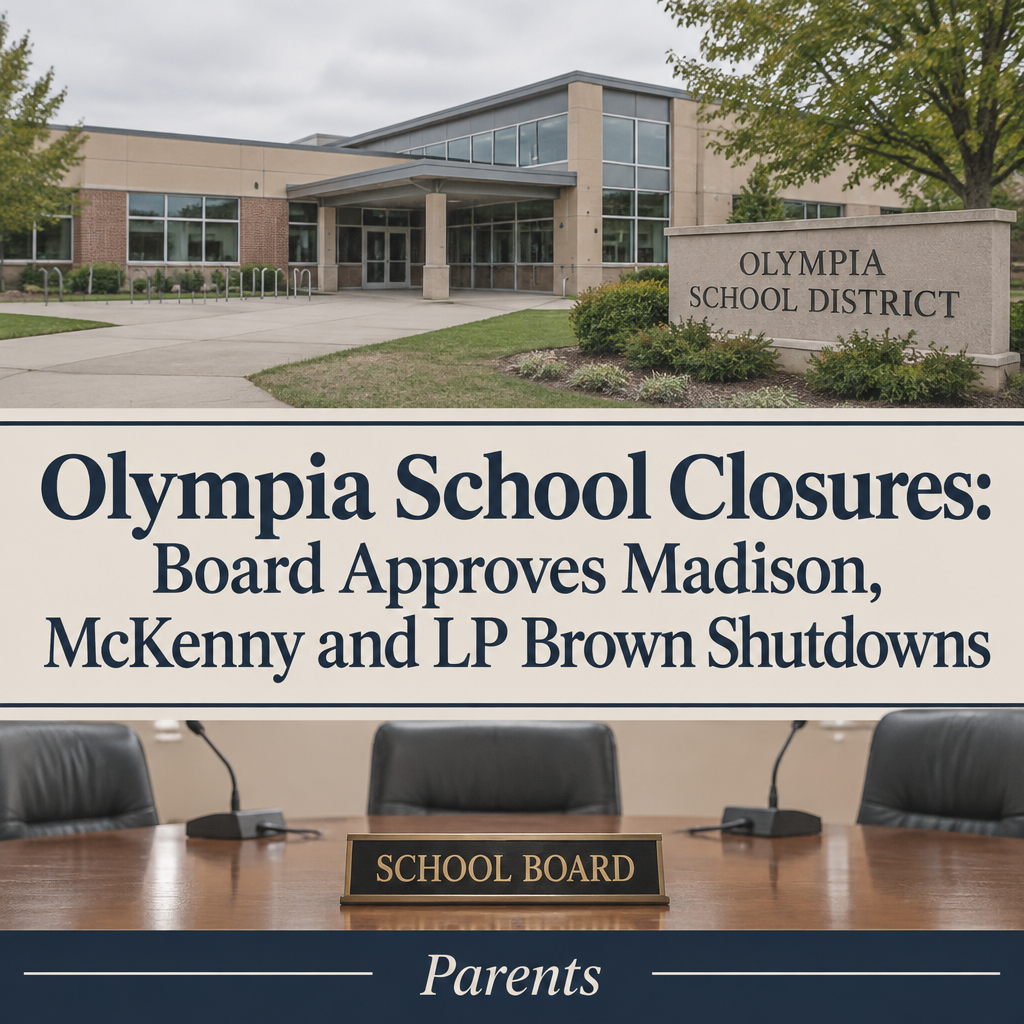
What Are the Olympia School Closures?
The Olympia school closures are a proposed consolidation of three elementary campuses: Madison, McKenny and LP Brown. In plain terms, the district will stop operating those schools as separate elementary sites and transfer their students to other schools. Superintendent Patrick Murphy presented the plan as a response to declining enrollment and financial challenges facing the district, according to The Olympian’s reporting.
A closure and a consolidation are related, but they are not identical descriptions. Closure names what happens to the campuses; consolidation describes the district’s plan to distribute students and operations among the remaining schools. That distinction matters because the financial case is only one part of the decision. Families also need to know where students will attend, how they will get there, how staffing will change and what support will be available during the move.
The proposed assignments are specific. McKenny students would move to Pioneer and Centennial elementary schools. Madison students would go to Roosevelt. LP Brown students would be assigned to Hansen and Garfield. The reported plan does not give the number of students in each receiving school, the capacity available at each site or the final transportation routes. Those details belong in the implementation work, not in guesswork.
The board’s vote was 4-1. Director Maria Flores was the only director to vote against Murphy’s proposal. Director Renee Fullerton had planned to propose postponing the decision until Dec. 14, but withdrew that proposal after Murphy responded to her request for information about alternatives that could address the same financial deficit. Fullerton said the response eased some of her concerns; she concluded there was little point in delaying the vote if delay risked deeper cuts elsewhere and voted for closure.
Frankly, that sequence matters as much as the final tally. It shows that at least one director’s position turned on whether the district had examined alternatives, yet the available account does not describe those alternatives in enough detail to compare their price tags. The Olympia School District’s public site is the place to look for district materials and updates as implementation proceeds. A public decision is stronger when residents can inspect the assumptions behind it, not merely the final vote.
Core Details and Context
The district’s case rests on a financial problem and a facilities calculation. Murphy’s proposal estimates recurring annual savings of about $3.1 million from closing the three schools. The listed figures add up to $3,028,842: $829,368 associated with McKenny, $1,122,856 with Madison and $1,076,618 with LP Brown. The headline figure is rounded, and the difference is ordinary rounding, not a separate pot of money.
The proposal also says closure would help the district avoid $136 million in modernization costs that would be needed to best serve students if the schools remained open. That number should not be casually added to the annual savings. One is described as recurring yearly savings; the other is a large future facilities cost the district says it can avoid. The information reported so far does not spell out the timing, project scope, financing assumptions or how the modernization estimate was calculated.
Here’s the kicker: neither figure alone proves that closing schools is the best available policy. The annual savings matter, especially if a district faces continuing deficits, but the public also needs to understand what costs remain after students move. Transportation, staffing adjustments, building maintenance and receiving-school readiness can affect the net result. The reported proposal gives the savings estimates, but those specific implementation costs are not reported in the account summarized here.
The community response was substantial. Nearly 200 people attended a rally at Madison Elementary before the board meeting. Participants marched around the block and through the streets with a police escort, then gathered outside the district office. The rally included songs, among them “Revolting Children” from Matilda The Musical. The emotion was visible, but it should not be mistaken for a substitute for analysis—or dismissed as noise. Families were reacting to the loss of schools that anchor daily routines and neighborhood ties.
After the vote, parent Marissa Smith told The Olympian that her family was already planning to file a lawsuit against the district. That is a stated intention, not confirmation that legal papers have been filed. The grounds for a potential lawsuit, its timing and the parties involved beyond the family and district are not described in the report. It would be irresponsible to predict a legal outcome from that limited information.
Enrollment is central to the district’s justification, but the specific enrollment counts and projections are not included in the details reported here. Residents assessing that part of the case can consult the state’s OSPI data portal and the federal NCES district search, while checking whether the datasets match the district’s time period and definitions. Numbers need context: a districtwide decline does not by itself show how each school is being used, or whether alternatives would work.
A school consolidation is therefore more than a budget line. It affects public services, staff assignments and students’ daily lives. The district has a duty to manage public money as a trust, while keeping students’ dignity and access to a stable education in view. Those responsibilities are not opposites. The board’s job is to show how the plan meets both, with clear evidence and careful execution.
Timeline: What Happens Next?
The district’s reported plan has four phases. The timeline is intended to move from planning to school transfers and then to continued monitoring; it does not mean every detail is already settled. The district was reported to be halfway through phase two at the time of the coverage.
- Framework and community input. The first phase involved developing the consolidation framework, gathering community feedback and beginning to form transition teams for students and staff. That work set up the process; it did not settle every family’s questions. Feedback is useful only if the district explains how it shaped decisions or why a request could not be adopted.
- Boundaries, transportation and staffing. Phase two runs through January, according to the reported timeline. It covers new school boundaries, transportation plans and staffing. These decisions will determine much of the practical experience for students and families. The district should make clear how it will communicate assignments, address route questions and handle circumstances that do not fit neatly into a map.
- Transition preparation. The third phase is scheduled from January through September 2027, ahead of the 2027-28 school year. It involves implementing transition-team plans for students, staff and families. The timeline calls for student, family and staff orientations in spring. Those meetings are an opportunity to explain where students will go and what support is available—not a box to tick after the consequential choices have already been made.
- Closures and continued support. In phase four, the three schools would officially close ahead of the 2027-28 school year. The district’s plan also calls for continued assistance for students and staff who need to move, followed by monitoring enrollment and the effects of consolidation. That final step matters: a policy should be judged by what happens after it takes effect, not only by the savings projected beforehand.
Let’s be real: a timeline is not proof that a transition will go smoothly. A plan can show dates and still leave families uncertain about transport, staffing or how to ask for help. The district should publish updates as boundaries and routes are set, identify who is responsible for responding to questions and report problems early enough to correct them. Staff members also need clear information about assignments and support, because the work of moving children depends on adults who know what is expected.
The board’s vote ends one phase of the debate, not the public’s right to scrutinize the decision. The district can reduce confusion by keeping meeting materials, transition updates and relevant financial explanations accessible through its official site. Residents, in turn, should distinguish between an announced plan and a completed action. Until the transition dates arrive, there is still implementation work to do—and the details will matter.
Comparison: Closure Plan Versus Keeping All Three Schools Open
The strongest competing option in this debate is keeping Madison, McKenny and LP Brown open while seeking other ways to address the same financial shortfall. The reported material gives a financial estimate for Murphy’s closure proposal, but it does not provide a corresponding cost or savings estimate for a specific keep-open alternative. That gap deserves attention; it does not automatically prove either option is better.
| Decision path | What it means | Financial figures reported | Main unresolved questions |
|---|
| Close and consolidate | Move students from the three schools to five receiving schools | About $3.1 million in recurring annual savings; $136 million in modernization costs the proposal says would be avoided | What are the net implementation costs, final routes, staffing changes and receiving-school capacities? |
| Keep all three open | Retain the campuses and seek other measures to address the deficit | No comparable savings or cost estimate is reported | Which specific alternatives would close the same financial gap, and what services or programs would they affect? |
| Delay the vote | Postpone the decision while examining alternatives | No distinct dollar figure for delay is reported | Would more analysis change the plan, and what cuts or costs would arise during the delay? |
The closure option has one clear advantage in the reported figures: it comes with estimated savings and a modernization estimate. It also has direct consequences for families and staff, and its final net savings cannot be evaluated without knowing the costs of transition and the demands placed on receiving schools. The keep-open alternative avoids immediate school moves, but without a costed plan, it is not yet a fully comparable budget proposal.
Fairly put, the board faced an asymmetry of detail. Murphy’s proposal gave the public figures; the account of Fullerton’s request says she sought information about alternatives but does not list each option or its estimated impact. That makes it harder for residents to assess whether closure was necessary, merely preferable to the alternatives studied, or chosen because other possibilities would cut services more sharply. The distinctions should be made with documents, not insinuation.
The best comparison would put each option on the same page: annual savings, one-time costs, facility needs, staffing effects, transportation changes, student impacts and assumptions about future enrollment. It should also identify what is known and what remains uncertain. A single large modernization estimate can loom over the debate, but decision-makers should explain the work it covers and the time horizon involved. Precision is not a luxury when the decision moves children and changes public assets.
Common Misconceptions and What to Know
Misconception: The $3.1 million and $136 million figures are the same kind of savings. They are not. The first is presented as recurring annual savings; the second is a modernization cost the district says it can avoid if the schools close. One is a yearly estimate, the other a future capital expense. Treating them as one total would distort the financial case.
Misconception: All students from each closing school will attend one new school. The assignments are split across receiving campuses. McKenny students are slated for Pioneer and Centennial; Madison students for Roosevelt; LP Brown students for Hansen and Garfield. The reported plan does not state the final student counts at each site, so it is too early to assume how large each receiving group will be.
Misconception: A parent’s lawsuit plan means a lawsuit is already underway. The report says Smith’s family is planning to file suit. It does not say a complaint has been filed or provide legal claims. The distinction is basic, but it matters: intentions can change, and claims must be tested through the legal process rather than treated as established findings.
Misconception: A 4-1 vote means the community reached agreement. It means four directors approved the proposal and one opposed it. The rally of nearly 200 people and the public response show substantial concern, but attendance is not a districtwide poll. Nor does the vote erase the duty to respond to families who will bear the effects of the plan.
The truth is that a school-board decision can be lawful, financially defensible and still poorly implemented if communication fails. The reverse is also true: a painful change does not, by itself, establish that the budget analysis is wrong. Those questions require evidence. Residents should watch for the underlying assumptions, the final transition plans and the measures the district will use to judge whether the consolidation is working.
There is another point worth keeping straight. A falling district enrollment figure, if documented, does not automatically tell the public which buildings should close or how services should be distributed. Decision-makers need school-level information, facility condition, enrollment forecasts and a clear account of alternatives. The OSPI and NCES portals can help provide context, but district-specific planning documents are needed to explain how those broad figures connect to this particular proposal.
Frequently Asked Questions
Which schools did the Olympia School District vote to close?
On Nov. 12, 2026, the board voted 4-1 to close Madison, McKenny and LP Brown elementary schools under Superintendent Patrick Murphy’s consolidation proposal. Director Maria Flores cast the only vote against it. The district’s reported plan places the closures ahead of the 2027-28 school year.
Where will students from the three schools go?
McKenny students are slated to move to Pioneer and Centennial elementary schools. Madison students would attend Roosevelt, while LP Brown students would be split between Hansen and Garfield. The final boundaries, transportation arrangements and staffing plans are part of the district’s transition work.
How much money does the district expect to save?
The proposal estimates about $3.1 million in recurring annual savings. Its listed school figures total $3,028,842: $829,368 for McKenny, $1,122,856 for Madison and $1,076,618 for LP Brown. The plan separately says closure would help avoid $136 million in modernization costs; that is not an annual savings figure.
Has the family filed a lawsuit against the district?
The report says parent Marissa Smith told The Olympian that her family is planning to file a lawsuit. It does not confirm that a case has been filed, identify the legal claims or report a court decision. A stated plan to sue should not be described as an active lawsuit unless a filing is confirmed.
Final Thought
The board has made its decision, but the case for that decision is not finished. It now rests on what the district does with the money, how it handles the transition and whether its public explanations stand up to scrutiny. Families need specific answers, not assurances: where students will go, how they will get there, who will support them and how the district will respond when a plan meets real life.
When I examine the reported numbers, I see a financial rationale that deserves serious consideration and important gaps that should be filled before anyone declares the matter settled. Annual savings are not the whole cost calculation, and an avoided capital expense is not the same as cash immediately available for classrooms. The district should show its work, publish progress and revisit assumptions if enrollment or transition outcomes differ from projections.
Public schools serve children, but they also hold public resources in trust. Stewardship means using those resources carefully; justice means not making students and staff carry unexplained burdens; and respect for human dignity means listening to families even when leaders have already voted. Those duties can coexist with hard budget choices. They become harder to honor when information is thin or communication arrives late.
A closed building is difficult to reopen. That is why the district’s next steps matter as much as the vote. If the plan is sound, transparent implementation will make that case more convincingly than any slogan. If it falls short, monitoring must lead to correction—not a polished explanation of why the problems were inevitable.
FAQPage Schema
{"@context":"https://schema.org","@type":"FAQPage","mainEntity":[{"@type":"Question","name":"Which schools did the Olympia School District vote to close?","acceptedAnswer":{"@type":"Answer","text":"On Nov. 12, 2026, the board voted 4-1 to close Madison, McKenny and LP Brown elementary schools under Superintendent Patrick Murphy’s consolidation proposal. Director Maria Flores cast the only vote against it. The district’s reported plan places the closures ahead of the 2027-28 school year."}},{"@type":"Question","name":"Where will students from the three schools go?","acceptedAnswer":{"@type":"Answer","text":"McKenny students are slated to move to Pioneer and Centennial elementary schools. Madison students would attend Roosevelt, while LP Brown students would be split between Hansen and Garfield. The final boundaries, transportation arrangements and staffing plans are part of the district’s transition work."}},{"@type":"Question","name":"How much money does the district expect to save?","acceptedAnswer":{"@type":"Answer","text":"The proposal estimates about $3.1 million in recurring annual savings. Its listed school figures total $3,028,842: $829,368 for McKenny, $1,122,856 for Madison and $1,076,618 for LP Brown. The plan separately says closure would help avoid $136 million in modernization costs; that is not an annual savings figure."}},{"@type":"Question","name":"Has the family filed a lawsuit against the district?","acceptedAnswer":{"@type":"Answer","text":"The report says parent Marissa Smith told The Olympian that her family is planning to file a lawsuit. It does not confirm that a case has been filed, identify the legal claims or report a court decision. A stated plan to sue should not be described as an active lawsuit unless a filing is confirmed."}}]}