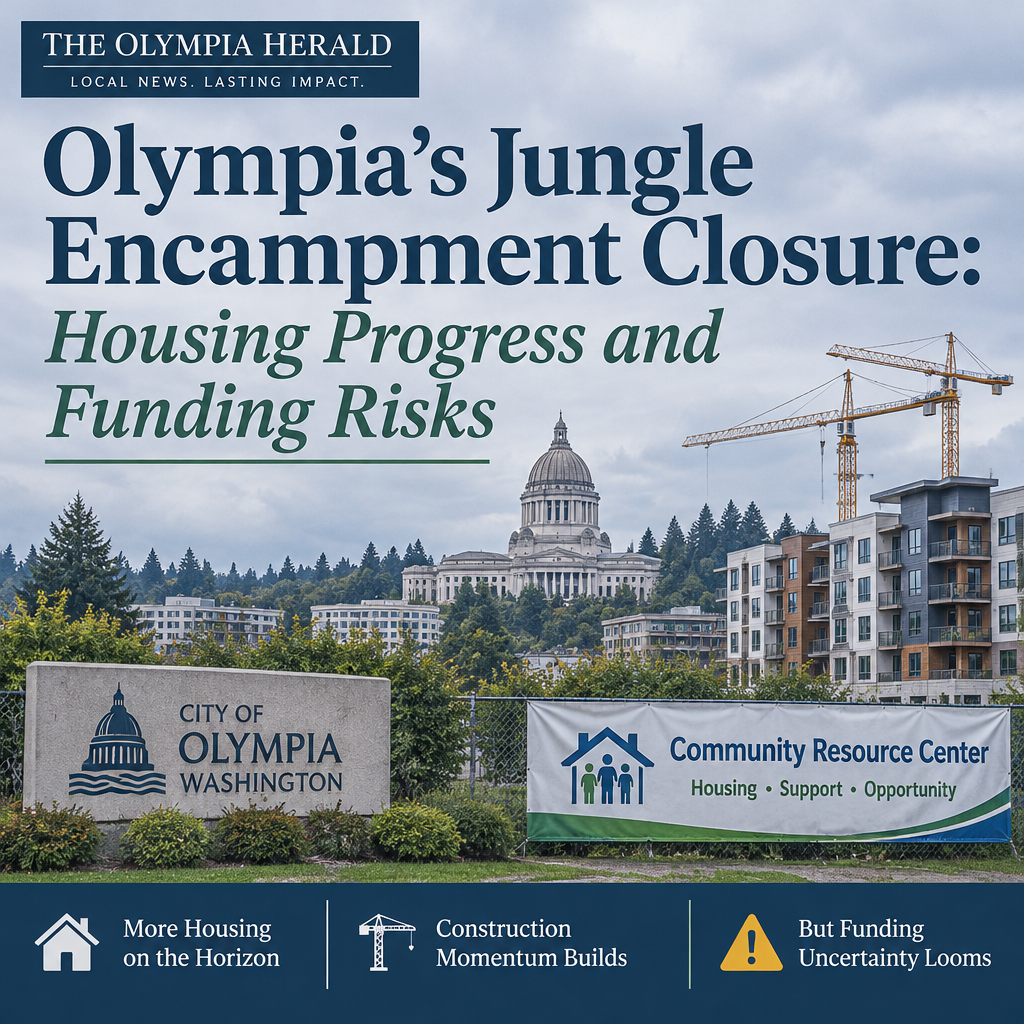
Olympia’s Jungle Encampment Closure: Housing Progress and Funding Risks
Olympia plans to close the north section of the Jungle encampment by the end of November, while continuing phased work to move listed residents into housing; city figures reported by The Olympian say 39 people had been housed by Nov. 1, but 246 remained on the list, making the deadline a start, not an endpoint.
Key Takeaways- Olympia expects to close the Jungle’s northern section near Martin Way and Fatso’s Bar & Grill by the end of November.
- The city reported 39 people housed by Nov. 1; 246 remained on its by-name list after one person died.
- The City Council extended its homelessness emergency declaration for 12 months on Nov. 10.
- The city’s housing response faces funding uncertainty after June 2027, with Home Fund money described as a possible short-term backstop.
The city’s immediate target is limited: one section, not a declared end to every service or housing need connected to the encampment. The north section is near the Martin Way entrance by Fatso’s Bar & Grill. The city says cleanup work began in the southern part first, with crews expected to focus on the north section the following week. Cleanup, closure and housing placement are related steps, but they are not interchangeable.
The numbers put the scale in plain view. Olympia began with a list of 286 people, according to spokesperson Brandon Chapman. By Nov. 1, 39 had been housed; Chapman also reported one death and 246 people still on the list. City staff were working to house seven more people soon, but that was a goal, not a confirmed placement. The Olympian’s local reporting and the City of Olympia website are the public reference points for the city’s reported progress and updates.
What Is the Jungle Encampment?
The Jungle is a longstanding encampment on Olympia’s east side. In this report, the name refers to the area where people have been living and where the city is carrying out a phased encampment-resolution effort. Olympia’s stated plan is not simply to clear a site and leave the next steps unspoken: the city says it is working to place people on its list into housing, then restrict access to sections as they are closed.
That distinction matters. A cleanup removes accumulated waste or addresses site conditions; a closure makes an area inaccessible; housing placement provides somewhere else to live. One action does not automatically accomplish the others. The city’s announcement concerns all three, but progress in one category cannot be used as proof that the rest is complete.
The city began a by-name list in May to track the encampment’s permanent residents and offer them housing, according to previous reporting by The Olympian. Chapman said the list began with 286 people. As of the figures reported in November, 39 had been housed and 246 remained, with one person having died. Those counts reconcile arithmetically, but they do not tell readers how many people are currently physically present at the site, how many have moved elsewhere without a city placement, or whether each person’s housing is permanent. Those details were not reported.
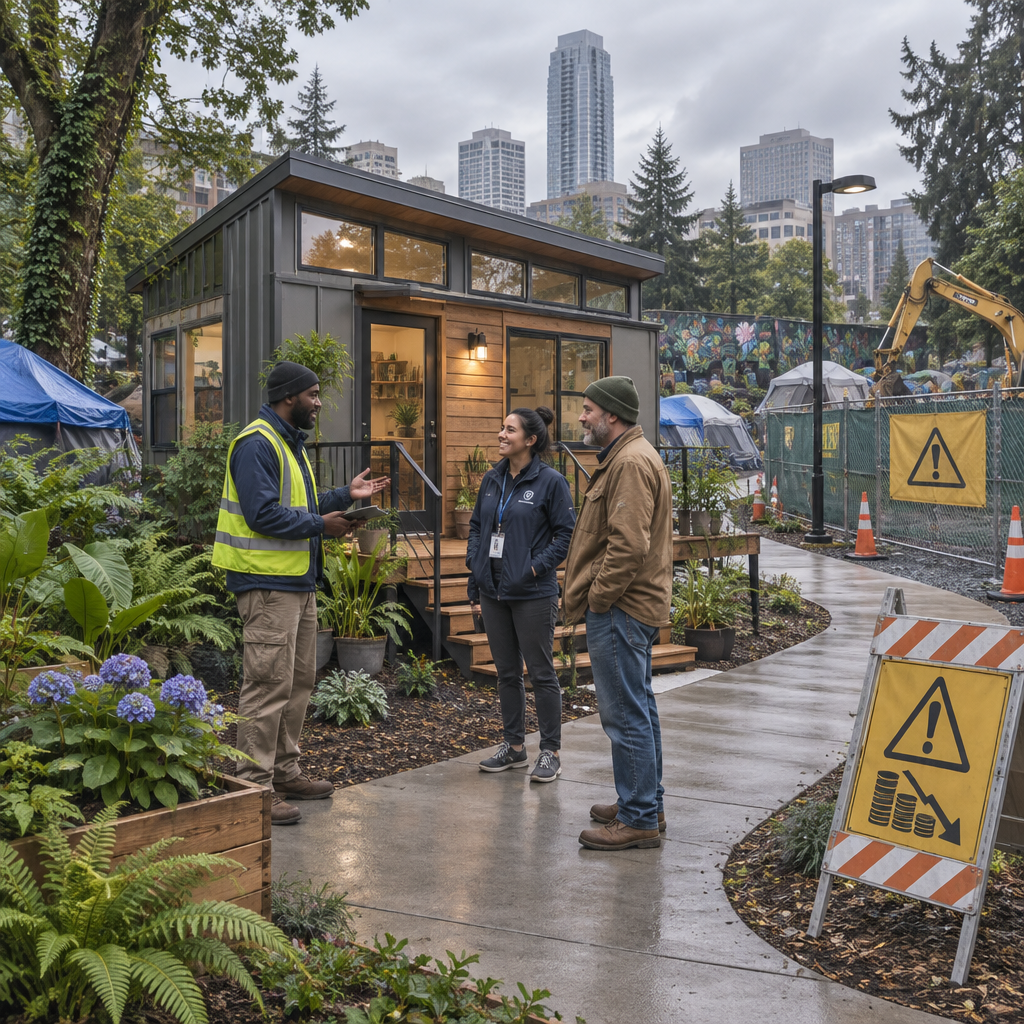
Olympia sought approval from the Washington State Department of Commerce to designate the Jungle as an Encampment Resolution Program site. The program, commonly shortened to ERP, gives the city access to state-funded beds or housing units, according to the reporting. Placements are mostly at Franz Anderson Tiny Home Village and Maple Court in Lacey. The state describes the program on its Encampment Resolution Program page.
The city’s policy is phased. Assistant City Manager Stacey Ray told the City Council on Aug. 25 that Olympia can access the extra beds while demonstrating active work to close the encampment. The city has said people will move out in phases, portions of the site will then be cordoned off, and police will monitor those areas. That sequence makes housing access and closure activity closely linked. It also creates a practical test: whether the city can secure suitable placements quickly enough to keep the next phase from becoming a move-out without a viable destination.
Core Details and Context
Several facts define the immediate decision. None should be read as a full accounting of homelessness in Olympia; they describe a particular encampment, a specific list and a funding plan whose later years are uncertain.
- The first closure target is the north section. Chapman said the city anticipated closing the area off Martin Way near the entrance of Fatso’s Bar & Grill by the end of November. That is a stated expectation, not a report that the section has already been closed.
- Cleanup began in the south. Chapman said on Nov. 13 that an additional cleanup had started that week in the southern part of the Jungle, with work focused on the northern part the following week. The sequence places cleanup activity ahead of the expected northern closure, but the city had not reported that the entire site was cleared.
- The list remains substantial. The city began with 286 names. By Nov. 1, 39 people had been housed, one had died, and 246 remained. Staff were working to house seven more soon; until a placement is confirmed, those seven should not be counted as housed.
- People not on the list are not described as ignored. Ray said the city was not adding names to the list. She said people who continue to arrive and are not listed are still connected to resources, while those on the list receive priority for the housing access tied to the program.
- ERP access depends on active closure work. The city said it must demonstrate that it is actively closing the site to access the additional beds. That requirement makes timing and coordination central, not administrative footnotes.
- The emergency declaration is not the same as a funding award. The council extended the declaration for another 12 months on Nov. 10. Housing Director Ashley Chambers said the extension lets the city continue prioritizing the Jungle closure and work with regional partners. It does not, by itself, guarantee replacement funding after current allocations end.
The awkward part is the overlap between a public deadline and a housing system that depends on available units. A closure date can be announced in advance; a suitable housing placement depends on capacity and coordination. The city has identified the two main placement sites, but the reported information does not state how many beds are available, what eligibility rules apply to each person, or what happens when a resident declines an offer. Those gaps are not proof of failure. They are unanswered operational questions.
The funding issue adds another layer. Finance Director Burney told the council that Olympia’s current ERP allocation is funded through the end of June 2027. He said the city could lose $800,000 in budgeted revenue for half of 2027 and $1.6 million in 2028 if Thurston County does not receive ERP funding. He also said county ERP funding had fallen from $13 million to $8 million and then to $5.5 million, which he described as the minimum needed to maintain all county sites serving unhoused people.
Thurston County mayors have written to the Regional Housing Council seeking renewed funding, Burney said, while an RHC member works on an alternative plan in case ERP money is cut or reduced. If neither route provides enough support, the city could draw on its Home Fund balance. Olympia says the fund has provided more than $2 million each year for affordable housing development and programs benefiting people and families experiencing homelessness. Burney characterized using its balance as a short-term bridge, not a durable replacement. The Thurston County housing and homelessness information provides regional context for that funding discussion.
Timeline: From Housing List to Section Closure
May: Olympia starts tracking residents. The city began its by-name list to identify permanent residents of the Jungle and offer housing. The list is an administrative tool for directing placements, not a complete count of every person experiencing homelessness in the city. That distinction is easy to miss, and it matters when comparing the list with broader estimates.
Before the August council meeting: the city secures program access. Olympia sought and received approval from the state Department of Commerce to designate the encampment as an ERP site. The approval allowed access to state-funded beds or housing units, mainly at Franz Anderson Tiny Home Village and Maple Court in Lacey. The city said that access depends on showing active progress toward closing the encampment.
Aug. 25: the city explains its phased approach. Assistant City Manager Stacey Ray told the council that people would move out in phases, followed by sections being cordoned off and monitored by police. Ray also said the city was not adding names to the list. People who arrived later and were not on it would still be connected with resources, but listed residents would be prioritized for the program’s housing placements. When I follow the sequence described in the meeting, the central operational issue is clear: placements and closure phases have to move together.
Nov. 1: the city reports housing counts. The city’s website said 39 people had been housed. Chapman said the original list contained 286 people, one person had died and 246 remained. Staff were working to house seven more soon. That last figure signals anticipated work, not a completed outcome.
Nov. 10: the council extends the emergency declaration. The council voted to extend the homelessness-related declaration for another 12 months. Chambers said the extension allows Olympia to keep prioritizing the Jungle closure and coordinate with regional partners. Burney described the financing risk if county ERP funds are reduced or discontinued.
Nov. 13: the city describes cleanup and its November target. Chapman said work had started in the southern section that week, with the northern part next. He said Olympia anticipated closing the north section near Martin Way by the end of November. As of the information reported, that remained a deadline the city expected to meet—not a verified completed closure.
After the immediate deadline: funding decisions remain. The current city ERP allocation is funded through June 2027, according to Burney. County and regional officials are seeking renewed or alternative funding. If those efforts fall short, the city could use Home Fund reserves for a limited period while it looks for another source. The account provided no confirmed long-term replacement plan.
The order is worth watching. A section may be cleaned before it is closed, but neither milestone proves every resident has obtained housing. A resident may receive an offer without the city having reported the placement as complete. And a funded bed through June 2027 does not settle what happens in 2028. The dates describe separate decisions, not one tidy finish line.
Comparison: ERP Housing Support and the Home Fund Backstop
The closest comparison in the reported figures is not a rival encampment plan. It is the difference between ERP funding, which supports the immediate placement-and-closure work, and Olympia’s Home Fund, which could serve as a temporary financial backstop. These tools are not direct substitutes: they have different stated purposes, and the city has not said that every Home Fund dollar could be redirected to this effort.
| Measure | ERP-funded response | Home Fund fallback |
|---|
| Main role described | Supports access to state-funded beds or housing units connected to active encampment resolution | Supports affordable housing development and programs benefiting unhoused people and families |
| Reported funding position | Olympia’s current allocation is funded through the end of June 2027; county funding was reported at $5.5 million after earlier amounts of $13 million and $8 million | The city says the fund has provided more than $2 million each year; Burney said its balance could be used temporarily if other funding fails |
| Connection to closure | The city says access to extra beds depends on showing active work to close the Jungle | A possible bridge for broader housing-related work, not described as a replacement ERP program |
| Main risk | County or regional reductions could leave a gap, including projected city budget revenue losses of $800,000 for half of 2027 and $1.6 million in 2028 | Drawing down reserves would buy time but would not solve the longer-term funding problem |
| What the figures do not show | The number of beds available, total cost per placement or future award amount | The fund’s current balance, amount that could be used, or how long it would last |
The numbers need careful handling. The $5.5 million figure refers to county ERP funding, while the $2 million-plus figure describes annual support provided through Olympia’s Home Fund. They are not equivalent pots of money, and the reporting does not establish that their amounts can be added together or swapped freely. The projected $800,000 and $1.6 million losses are city budget revenue figures Burney cited under a scenario in which the county does not receive ERP funds; they are not a statement that the city has already lost that money.
The comparison points to a real policy choice. Using reserves can keep services operating while officials negotiate, but reserves are finite and may also support affordable housing production and programs for families. Stewardship of public money means being plain about what a temporary transfer buys and what it puts at risk. The city has said the Home Fund could help get through 2027 and buy time to identify another source. That is a contingency plan, not evidence that the gap is solved.
Common Misconceptions and What to Know
Misconception: Olympia is closing the entire Jungle by the end of November. The reported deadline applies to the first section, the north part near Martin Way and Fatso’s Bar & Grill. The city described phased moves and closures. The announcement does not say that every portion of the encampment will be closed by that date.
Misconception: 39 housed means the city has nearly finished. It means 39 people on the original list had been housed by Nov. 1. Against the initial 286 names, that is about 14 percent. The remaining list stood at 246, while one person had died. The percentage is useful as a rough measure of progress, but it does not tell us whether placements are stable, whether more people have moved away independently, or how many people are currently living at the site.
Misconception: the seven people staff hoped to house were already housed. Chapman said staff were working to get seven more people housed “soon.” That wording describes work in progress. It should not be turned into a completed placement count until the city confirms the outcome.
Misconception: residents who are not on the list receive no help. Ray said people who continue to come to the encampment and are not on the list are still being connected to resources. But the city also said listed residents have priority for the additional beds. That creates a clear difference in priority, not proof that everyone outside the list is receiving equivalent assistance. The city has not reported the scale or results of those referrals.
Misconception: extending the emergency declaration guarantees the money. The Nov. 10 council action extended the declaration for 12 months. Chambers described it as a way to keep the closure and regional response prioritized. Burney separately warned about funding reductions and possible budget losses. A policy declaration and a funding commitment are different things.
Misconception: the Home Fund can simply replace ERP. The city’s fund supports affordable housing development and programs for people experiencing homelessness. Burney described using its balance as a short-term measure if ERP or regional funding cannot be secured. No reported detail establishes that the fund can cover the same costs, support the same number of placements or do so beyond the short term.
Frankly, the most important missing information is not a slogan about clearing or keeping an encampment. It is a public account of completed housing placements, the conditions attached to those placements, what support continues after move-in and what happens when funding runs short. Those answers would let residents judge both the city’s performance and its obligations to people facing displacement. The dignity of the people affected is not an optional detail in a budget table; it is part of whether the plan serves the common good.
Frequently Asked Questions
When does Olympia plan to close the first section of the Jungle?
The city said it anticipated closing the northern section by the end of November. The area is off Martin Way near the entrance of Fatso’s Bar & Grill. The announcement is a target for the first section, not confirmation that the closure has already happened or that the entire encampment will close at once.
How many people from the Jungle had been housed?
The city’s website reported 39 people housed as of Nov. 1. Chapman said the original list contained 286 people, one person had died and 246 remained. Staff were working to house seven more soon, but that figure was not reported as a completed placement.
What is the Encampment Resolution Program?
The ERP is a Washington State Department of Commerce program through which Olympia can access state-funded beds or housing units for the Jungle response. The city said continued access depends on demonstrating active work to close the encampment. Most placements were reported to be at Franz Anderson Tiny Home Village and Maple Court in Lacey.
What happens if ERP funding is reduced or ends?
City officials said they are seeking renewed or alternative regional funding. If those sources are unavailable, Olympia could draw on its Home Fund balance as a short-term bridge. Burney said that option would buy time, not provide a lasting solution; the city has not reported a confirmed replacement funding plan.
Final Thought
The end-of-month target will be easy to measure: did the city close the north section on schedule? The harder measures take longer. How many people actually moved into housing? Were the placements appropriate and stable? What support remained available to residents whose names were not on the list? And can the city keep its commitments when regional funding changes?
Those questions should not be used to dismiss the work already reported. Thirty-nine housing placements are consequential for the people who obtained them. Cleanup and phased access controls may also address immediate site conditions. But neither accomplishment removes the city’s duty to explain the next steps, particularly when its own figures show 246 people still on the list and officials describe a future budget gap.
A sound public response needs more than a date and a fence line. It needs enough housing options to make relocation real, clear reporting that distinguishes a planned placement from a completed one, and a funding plan that does not quietly shift costs onto programs meant to create affordable homes. Public resources are held in trust; so is the responsibility to treat each resident as a person, not a line item. Olympia has set a first deadline. The measure of the plan will be what happens to people after that date—and whether the city can keep helping when the current money runs out.
FAQPage JSON-LD