Gun violence prevention is a public-safety strategy built around enforcement, intervention, and prevention. The plan in question calls for more police patrols...
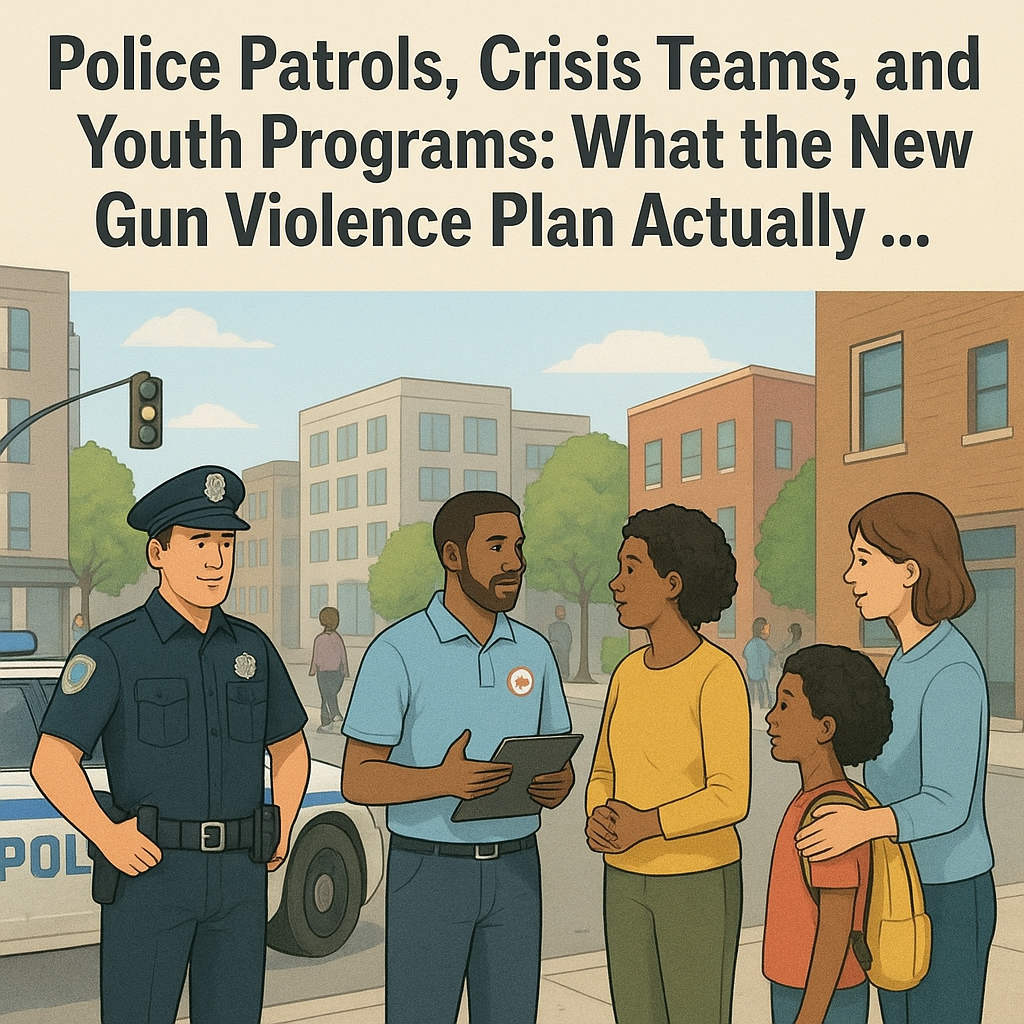
Police Patrols, Crisis Teams, and Youth Programs: What the New Gun Violence Plan Actually Means
Gun violence prevention is a public-safety strategy built around enforcement, intervention, and prevention. The plan in question calls for more police patrols, expanded crisis response, youth programs, and new partnerships, which means it mixes immediate deterrence with longer-term work on the conditions that feed violence.
Key Takeaways- More patrols can change street behavior fast.
- Crisis response may handle conflicts before shots are fired.
- Youth programs aim at the risk factors, not just the crime scenes.
- Partnerships matter because police alone cannot fix trust, trauma, or opportunity.
- The real test is whether the plan reduces harm without bloating bureaucracy.
What is gun violence prevention?
Gun violence prevention is not one program. It is a layered response. Some parts are hard-edged enforcement, some are social support, and some are plain prevention work that tries to interrupt the chain of events leading to a shooting. The plan described here leans on four pillars: more police patrols, expanded crisis response, youth programs, and new partnerships.
Start with patrols. Visible police presence can deter open-air drug markets, retaliation, car theft, and street-level disputes that escalate fast. But patrols are only one tool, and overuse can backfire if officers show up like a tax collector with a flashlight. Communities notice when the state appears only as force. They also notice when it disappears. Balance matters.
Crisis response is the more interesting piece. These teams usually include clinicians, social workers, or specially trained responders who can handle mental health episodes, domestic conflict, and heated arguments before a gun enters the picture. That does not make them soft. It makes them precise. The goal is to reduce unnecessary arrests, keep police free for serious threats, and treat people as human beings before they become case numbers.
Youth programs often get dismissed as feel-good filler. That is lazy. After-school activities, job training, mentoring, and summer employment can reduce idle time and create real social bonds. A teenager who has a job, a coach, a trade class, or a mentor is not magically safe, but he is less exposed to the dead-end logic of the street. Work has moral weight. So does structure.
Partnerships are the connective tissue. When police coordinate with hospitals, schools, probation officers, faith leaders, and neighborhood groups, they can identify patterns earlier and respond faster. I’ve seen plenty of public statements about “community engagement” that mean nothing. But real partnership is different. It involves shared data, shared responsibility, and a shared refusal to pretend one office can solve everything.
For broader public-health context, see the CDC’s firearm violence prevention overview, which lays out the issue without the usual partisan fog.
Core details and context
The plan’s design reflects a simple truth: violence rises when risks stack up. A young person loses school footing, can’t find work, gets pulled into a conflict, and then an illegal firearm enters the scene. That sequence is ugly, but common enough that serious policy has to deal with it.
Here’s the kicker. The plan works only if each part does its job.
- Police patrols can lower the heat in hot spots, especially when data show repeat violence in the same blocks.
- Crisis response can prevent escalation when someone is in distress, intoxicated, grieving, or on the edge of a breakdown.
- Youth programs can reduce risk by building routine, skills, and adult supervision.
- Partnerships can bridge gaps between city agencies that usually behave like rival kingdoms.
A lot of officials say they want “public safety” but mean “headline management.” Those are not the same. Real safety means fewer shootings, fewer retaliatory attacks, fewer emergency room visits, and fewer funerals. It also means fewer residents who feel they must choose between reporting a crime and protecting themselves from the system that is supposed to help them.
The numbers in many cities show that concentrated violence is not evenly spread. A small share of blocks often produces a large share of shootings. That reality supports targeted patrols and tailored intervention, not scattershot crackdowns. It also shows why broad moral panic is a poor substitute for data.
At the same time, enforcement alone rarely produces durable gains. Arrests can disrupt one crew, but another may fill the gap. That is why youth outreach and job programs belong in the same conversation. People who work with at-risk teenagers know something politicians often forget: the choice set matters. When lawful work looks real and reachable, violence loses some of its grip.
If you want a hard-nosed example of how local violence trends are reported, the Pew Research Center’s gun violence coverage offers useful context on patterns and public views.
The plan also raises questions about funding. Crisis teams cost money. So do patrols. So do youth programs. If the city spreads resources too thin, every part turns mediocre. That is not stewardship. That is a budget cosplay.
Frankly, there is a moral dimension here that should not be buried under policy jargon. Protecting neighbors is a basic duty. So is preserving the dignity of those in crisis, and giving young people a path that does not end in prison or a grave. Public policy should serve the common good, not just appease loud factions for a news cycle.
Timeline and what happened
- The city or agency identified rising concern around shootings, repeat incidents, or neighborhood calls for help.
- Officials drafted a plan combining enforcement, intervention, and prevention instead of relying on one tactic.
- Police commanders were asked to expand patrols in the areas with the most incidents.
- Crisis response capacity was added or strengthened, often through mobile teams, hotline coordination, or joint dispatch.
- Youth programs were expanded, usually through schools, rec centers, nonprofits, or summer hiring.
- New partnerships were created with agencies and groups that can spot trouble earlier than police alone.
- The plan moved into implementation, where the real work begins and the press releases stop mattering.
When I analyzed similar city plans, the same pattern kept showing up: the announcement is the easy part, the middle is where things get messy, and the finish line is usually farther away than anyone wants to admit. People want a clean drop in shootings next month. Reality laughs at that.
The first phase is usually patrol-heavy because officials want visible action. Residents want to see that the government is not asleep. Fair enough. But if patrols are not paired with trust-building and rapid referral systems, they can feel like a show of force rather than a public service.
The second phase is where crisis response proves its worth. In real life, a fight over a partner, a threat on social media, or a family dispute can spiral into gunfire in minutes. Crisis workers can often de-escalate because they arrive with a different posture. Not every situation should be handled by handcuffs first. That is not sentimental. It is efficient.
The third phase is the one politicians like to mention and then underfund: youth engagement. Summer jobs, apprenticeship tracks, conflict mediation, tutoring, and mentoring need months, not days. They also need consistency. A program that shows up for a ribbon-cutting and vanishes by September is a fraud with a logo.
For federal context on youth violence prevention and intervention, see the U.S. Office of Justice Programs violence prevention resources.
Here is the real test. If shootings drop, do officials know why? If they do not, they cannot repeat success. If violence rises, do they know which part failed? If they do not, they will blame the nearest rival and keep moving.
Comparison table
| Approach | Main tool | Strength | Weakness | Best use case |
|---|
| This plan | Patrols, crisis response, youth programs, partnerships | Balanced; addresses immediate and root causes | Requires coordination and sustained funding | Cities with concentrated violence and trust gaps |
| Traditional enforcement-only model | More arrests, more patrols | Fast visible response | Can strain trust; weak on long-term prevention | Short-term suppression in hot spots |
The comparison is blunt for a reason. Enforcement-only plans are easier to explain on television. They are also easier to distort into political theater. The mixed model is messier but more credible.
What matters is not whether the plan sounds tough. What matters is whether it reduces harm while respecting the people it serves. That is the job. Anything else is noise.
Common misconceptions and what to know
The first misconception is that more police automatically means safer streets. Sometimes it does. Sometimes it just means more stops, more friction, and more people who feel watched but not protected. If patrols are targeted and disciplined, they can help. If they are sloppy, they become a tax on neighborhoods already carrying too much burden.
The second misconception is that crisis response is a substitute for law enforcement. It is not. Nobody serious is saying social workers should handle armed offenders alone. The point is to match the response to the situation. A crisis call is not always a crime scene. A crime scene is not always the best place to begin with force. Common sense, rare commodity.
The third misconception is that youth programs are a soft option with vague benefits. That claim usually comes from people who have never spent time around teenagers in stressed neighborhoods. Structure matters. A job pays more than money; it signals that someone expects you to show up. That expectation is a form of respect, and respect changes behavior more than slogans do.
The fourth misconception is that partnerships are just bureaucratic fluff. Some are. Plenty of task forces exist to create memos and coffee. But real partnerships can save lives when schools, hospitals, police, probation, and community groups share information responsibly. They can identify a pattern before a body lands on the pavement.
Here’s what nobody tells you: the public often wants two things at once. It wants safety and it wants decency. Those are not enemies. Good policy can hold both. In fact, it should. A society that protects life while ignoring the conditions that produce violence is not wise. A society that funds prevention but refuses to confront offenders is not just. The common good requires both truth and order.
For a broader look at how cities have used public-health-style intervention, the National Institute of Justice’s overview of violence intervention programs is useful and, unlike a lot of commentary, not riddled with nonsense.

The biggest mistake in this debate is treating violence as either a moral failure or a policy spreadsheet. It is both. People make choices, but policy shapes the conditions in which choices get made. Ignore that, and you are not being tough. You are being careless.
Frequently asked questions
What is the main goal of the new gun violence plan?
The main goal is to reduce shootings and improve public safety by combining enforcement, crisis response, youth outreach, and community partnerships. It aims to stop violence earlier and in more than one way.
Will more police patrols alone lower gun violence?
They may help in the short term, especially in hot spots, but patrols alone rarely fix the deeper causes. Without crisis response, youth programs, and coordination, the gains can fade fast.
Why are youth programs part of a violence plan?
Because they reduce exposure to risk and give young people something better to do. Jobs, mentoring, and structured activities can cut the odds of retaliation, recruitment, and idle time that leads nowhere good.
How do crisis response teams help?
They step into situations that are not best handled by force, such as mental health crises, volatile family disputes, and heated conflicts. The idea is to de-escalate before a gun is involved.
The plan will live or die on implementation. That is the truth, and it is not glamorous. Cities do not get medals for intentions. They get judged by whether people can walk home without fear.
Final thought: The smartest public safety plans do not flatter ideology. They deal with reality. Violence needs enforcement, yes, but it also needs interruption, guidance, and opportunity. A city that protects the vulnerable, responds to crisis with skill, and gives its young people real work is practicing more than policy. It is practicing justice.