Puget Sound Energy customers are staring at another bill increase.
Puget Sound Energy Rate Hike Proposal Explained: What Customers Could Pay Over Three Years
Puget Sound Energy customers are staring at another bill increase.
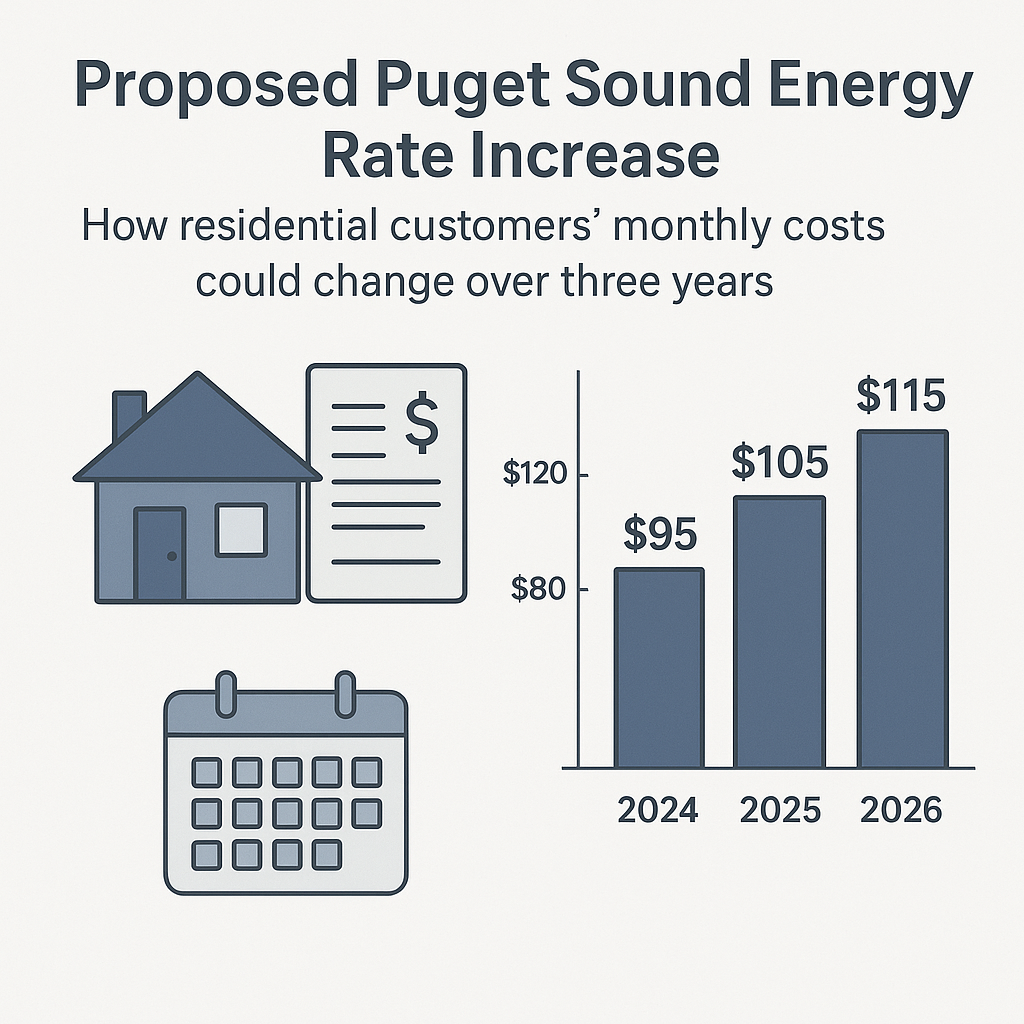
The utility’s latest proposal would raise residential natural gas rates by more than 13% over three years, or roughly $14 a month for a typical household, while electricity customers would also see changes tied to infrastructure, wildfire prevention, and service costs. The public still has a chance to weigh in, and that matters because utility rates are not just accounting lines — they shape household budgets, small-business costs, and the basic cost of keeping the lights on and the furnace running.
Key Takeaways
- PSE has proposed three-year rate hikes affecting gas and electric customers.
- A typical residential natural gas bill could rise by more than 13%, or about $14 per month.
- The plan is tied to fuel costs, grid investments, wildfire risk reduction, and operating expenses.
- Customers can still submit comments and participate in the public process.
- The debate is really about who pays for reliability, and how much burden should fall on households already squeezed by rent, food, and insurance costs.
What is Puget Sound Energy’s proposed rate hike?
Puget Sound Energy’s proposed rate hike is a request to raise the amount customers pay for electricity and natural gas over a three-year period. That sounds dry, but it is not. It is the price of a utility’s promises: poles, wires, pipelines, maintenance crews, storm repairs, wildfire mitigation, and the capital spending needed to keep the system from going sideways when the weather turns ugly.
Frankly, utilities do not ask for rate increases because they enjoy the public mood. They ask because they say they need the money, and regulators then decide what is fair. That is the whole machine. The Washington Utilities and Transportation Commission will review the request, take testimony, and consider whether the proposed rates are justified. Public comment is part of the process, and that gives customers a voice even if the jargon can make your eyes glaze over.
I’ve covered utility fights before, and here’s the kicker: the biggest misunderstanding is thinking a rate case is simply a company asking for more cash. It is also a test of whether the utility has spent prudently, whether customers are being protected, and whether the cost of long-term reliability is being spread in a way that respects human dignity instead of just brute-forcing another bill into the mailbox.
For background on how regulators weigh these requests, the public can review state utility oversight materials from the Washington Utilities and Transportation Commission. The basic idea is simple enough. If a utility wants to charge more, it has to justify the need. If customers think the ask is too rich, they can say so, and regulators have to listen.
This proposal also lands in a broader national pattern. Utilities across the country are seeking more revenue for grid upgrades, storm resilience, and decarbonization work. The Washington context adds its own pressure: population growth, severe weather, and a policy push toward cleaner energy. Those goals may be reasonable, but the bill still arrives in a real household, at a real kitchen table, where budgets are not abstract.
Core details and context
The numbers matter, but so does the shape of the request.
- Residential natural gas rates: more than 13% higher over three years, or about $14 per month for a typical customer.
- Electric rates: also expected to rise, though the exact impact depends on usage and final commission approval.
- Main drivers: infrastructure upgrades, wildfire prevention, labor and maintenance, financing costs, and other operating expenses.
- Public process: customers can comment before regulators issue a final decision.
- Time horizon: this is not a one-month sticker shock; it is a phased-in plan.
Everyone talks about “needed investment,” but few explain what that phrase covers. In utility speak, it can mean everything from replacing aging gas mains to hardening the grid against storms and reducing fire risk in vulnerable areas. It can also mean planning for future demand, which is not silly in a state that keeps growing and electrifying more of daily life.
But the truth is, there is always a tension. On one side, underinvestment creates outages, leaks, and dangerous failures. On the other, overinvestment can push costs onto customers before the benefits are obvious. That is why rate cases become political, even when the paperwork is technical. They are arguments about fairness.
A few parts of this deserve a harder look:
- Wildfire mitigation is expensive, and in the West it is no longer optional. Utilities face real liability if they fail to reduce risk, as other states have shown in brutal fashion.
- Fuel costs can swing rates even when utilities do not control the market. Customers often blame the company, but commodity prices are a different beast.
- Capital spending can be both necessary and swollen. Regulators have to sort genuine need from padded plans.
- Lower-income households feel rate increases first and hardest. A $14 monthly jump may sound modest to some people; to others it is groceries, medication, or part of a rent shortfall.
That last point is where stewardship comes in. In Catholic moral thinking, resources are not just property; they are entrusted goods. A utility has to steward infrastructure carefully, and regulators have to steward the public interest with equal care. Efficiency matters. So does justice.
For readers following the broader energy debate in Washington, this proposal fits alongside state-level clean energy policy and utility oversight. PSE is not the only company facing scrutiny, and utility pricing is increasingly tied to climate resilience and the cost of modernization. If you want the wider policy angle, see our coverage of utility rate hikes in Washington, along with the broader public debate over Washington energy policy and climate risk and infrastructure.
Most news coverage focuses on the headline percentage. That is lazy. The real story is how rate design shifts costs among customer classes, which households get relief, and whether the utility’s spending plan is disciplined enough to deserve approval.
Timeline and what happens next
This is a process, not a verdict.
- PSE files its proposal. The company lays out the requested rate changes, explains the spending plan, and submits support data to regulators.
- Regulators open review. The Washington Utilities and Transportation Commission examines the case, asks questions, and may request more documentation.
- Public comments begin. Customers, cities, advocacy groups, and businesses can file concerns or support. This is where ordinary ratepayers can speak for themselves instead of being spoken for.
- Hearings and testimony follow. Experts may discuss cost recovery, revenue needs, customer impacts, and whether the plan is reasonable.
- Revisions are possible. Utilities often adjust requests during review. A proposal is not a final number; it is the opening bid.
- Final decision arrives later. Regulators approve, reject, or modify the request. The result may differ from the original ask, sometimes by a lot.
I’ve watched enough of these filings to know the public often hears about them late, after the damage is already doing laps around the room. That is why timing matters. A comment filed early can help shape the record. A comment filed after the decision is mostly a complaint, and while complaints are understandable, they are not the same as participation.
Here’s the practical sequence for customers who want to act:
- Read the notice from the utility or the commission.
- Compare your recent bills, not just the headline rate.
- Note whether your usage is seasonal, especially for gas heat.
- File comments on affordability, reliability, or the need for tighter spending controls.
- Ask whether lower-income assistance or rate design changes are available.
If you want to understand how public-comment systems work in local government generally, our reporting on public comment in local government explains the mechanics without the usual bureaucratic fog. The same idea applies here: complaints backed by facts travel farther than shouting.

Comparison table: Puget Sound Energy vs. a typical regulated utility rate case
| Factor | Puget Sound Energy proposal | Typical competitor utility rate case |
|---|
| Customer impact | Residential natural gas bills up more than 13% over three years | Often 5% to 15% depending on fuel, storm costs, and state rules |
| Main drivers | Infrastructure, wildfire mitigation, operations, financing | Infrastructure, debt service, weather recovery, labor, compliance |
| Review body | Washington Utilities and Transportation Commission | State public utility commission or similar regulator |
| Public input | Customers can comment before final approval | Public comments and hearings usually available |
| Risk profile | Exposure to wildfire, aging assets, and growth pressure | Varies by region, but often storm or fuel volatility |
| Customer concern | Affordability for households and small businesses | Similar affordability pressure, especially for fixed-income customers |
| Policy backdrop | Clean energy transition and reliability investments | Usually a mix of grid hardening, fuel volatility, and decarbonization |
The comparison shows the obvious, but it is worth saying plainly: PSE’s proposal is not unusual in the current utility environment. What makes it hard is the scale of the household effect. Even a monthly jump that looks small in conference-room language can hit a family budget like a brick.
If readers want more context on how utilities defend these filings, it helps to compare them with other recent energy stories. Our related coverage of energy prices and household budgets shows how rate increases filter through everyday spending. The same logic applies here. Utilities talk about system resilience; customers talk about what gets cut to make room for the bill.
Common misconceptions and what to know
A rate hike is not automatically a ripoff.
That may annoy people, but it is true. A utility has real costs, and some spending is required to keep power and gas flowing safely. But the opposite mistake is just as bad: assuming every requested dollar is necessary or that regulators always trim excess. They do not, at least not enough for everyone’s taste.
Let’s clear up a few common claims:
- “It’s just corporate greed.” Sometimes companies push too hard, sure. But rate cases are usually more complicated than a cheap villain story. Costs, debt, repairs, and compliance all matter.
- “Regulators will stop it anyway.” Not guaranteed. Regulators can reduce a request, but they often approve some increase if the utility proves a need.
- “A few dollars a month is nothing.” For households with margin, perhaps. For others, no. Small recurring costs add up, especially when stacked with rent, food, transportation, and insurance.
- “This only affects gas customers.” Not necessarily. Utility cost changes often ripple across electric service, infrastructure spending, and long-term rate design.
Here’s what nobody tells you: the real fight is often over whose risk gets socialized. If a utility underinvests and service fails, customers pay through outages, repair costs, or worse. If it overinvests, customers pay through bills that rise before the supposed benefits arrive. That is why oversight exists.
There is also a moral dimension that most coverage misses. In a fair society, essential services should be priced in a way that recognizes the dignity of work and the burden on families. That does not mean free service. It does mean not treating ratepayers as an afterthought while boards, consultants, and contractors all get a seat at the table.
If you want a deeper look at the public policy piece, our analysis of consumer protection and utility regulation goes into how state oversight tries to balance reliability with affordability. That balance is delicate, and when it breaks, people notice fast.
Frequently asked questions
How much more could Puget Sound Energy customers pay?
Residential natural gas customers could see rates rise by more than 13% over three years, which PSE says works out to about $14 a month for a typical household. The final amount depends on the regulator’s decision, actual usage, and whether the request is modified.
Why is PSE asking for higher rates?
The company says it needs revenue for infrastructure upgrades, wildfire mitigation, maintenance, financing, and operating costs. Utilities usually frame these requests as necessary to keep service safe and reliable. Sometimes they are. Sometimes parts of the ask are padded. That is why review matters.
Can customers oppose the rate hike?
Yes. Customers can submit public comments and participate in the review process through Washington’s utility regulator. Those comments become part of the record considered before a final decision is made.
Will electricity rates also go up?
The proposal affects more than gas, though the natural gas increase has drawn the sharpest attention because of the reported 13% figure. Electricity impacts depend on the final regulatory outcome and customer usage patterns.
The public process is not theater if people use it.
If enough customers show up with clear objections, the commission cannot pretend nobody noticed. If the company presents solid evidence, it may still win much of what it wants. Either way, the decision should be made in the open, with numbers that can be checked and assumptions that can be challenged.
That is the plain version. The fancy version is that utility regulation sits at the intersection of stewardship, justice, and public necessity. The bills are real. So are the pipes, wires, and crews that keep the system running. The only honest answer is to look at both and insist that neither the company nor the customer be treated like a rounding error.
When I look at this case, I see the same old tension wearing a fresh suit: reliability costs money, and money comes from people who are already tired of paying more for nearly everything. That does not mean the request should be rejected out of hand. It does mean the utility should prove, line by line, that every dollar asked for serves the common good rather than just the comfort of the balance sheet.
The commission should ask hard questions. Customers should answer them. That’s how this is supposed to work.
FAQPage schema
{
  "@context": "https://schema.org",
  "@type": "FAQPage",
  "mainEntity": [
    {
      "@type": "Question",
      "name": "How much more could Puget Sound Energy customers pay?",
      "acceptedAnswer": {
        "@type": "Answer",
        "text": "Residential natural gas customers could see rates rise by more than 13% over three years, which PSE says works out to about $14 a month for a typical household. The final amount depends on the regulator’s decision, actual usage, and whether the request is modified."
      }
    },
    {
      "@type": "Question",
      "name": "Why is PSE asking for higher rates?",
      "acceptedAnswer": {
        "@type": "Answer",
        "text": "The company says it needs revenue for infrastructure upgrades, wildfire mitigation, maintenance, financing, and operating costs. Utilities usually frame these requests as necessary to keep service safe and reliable."
      }
    },
    {
      "@type": "Question",
      "name": "Can customers oppose the rate hike?",
      "acceptedAnswer": {
        "@type": "Answer",
        "text": "Yes. Customers can submit public comments and participate in the review process through Washington’s utility regulator. Those comments become part of the record considered before a final decision is made."
      }
    },
    {
      "@type": "Question",
      "name": "Will electricity rates also go up?",
      "acceptedAnswer": {
        "@type": "Answer",
        "text": "The proposal affects more than gas, though the natural gas increase has drawn the sharpest attention because of the reported 13% figure. Electricity impacts depend on the final regulatory outcome and customer usage patterns."
      }
    }
  ]
}