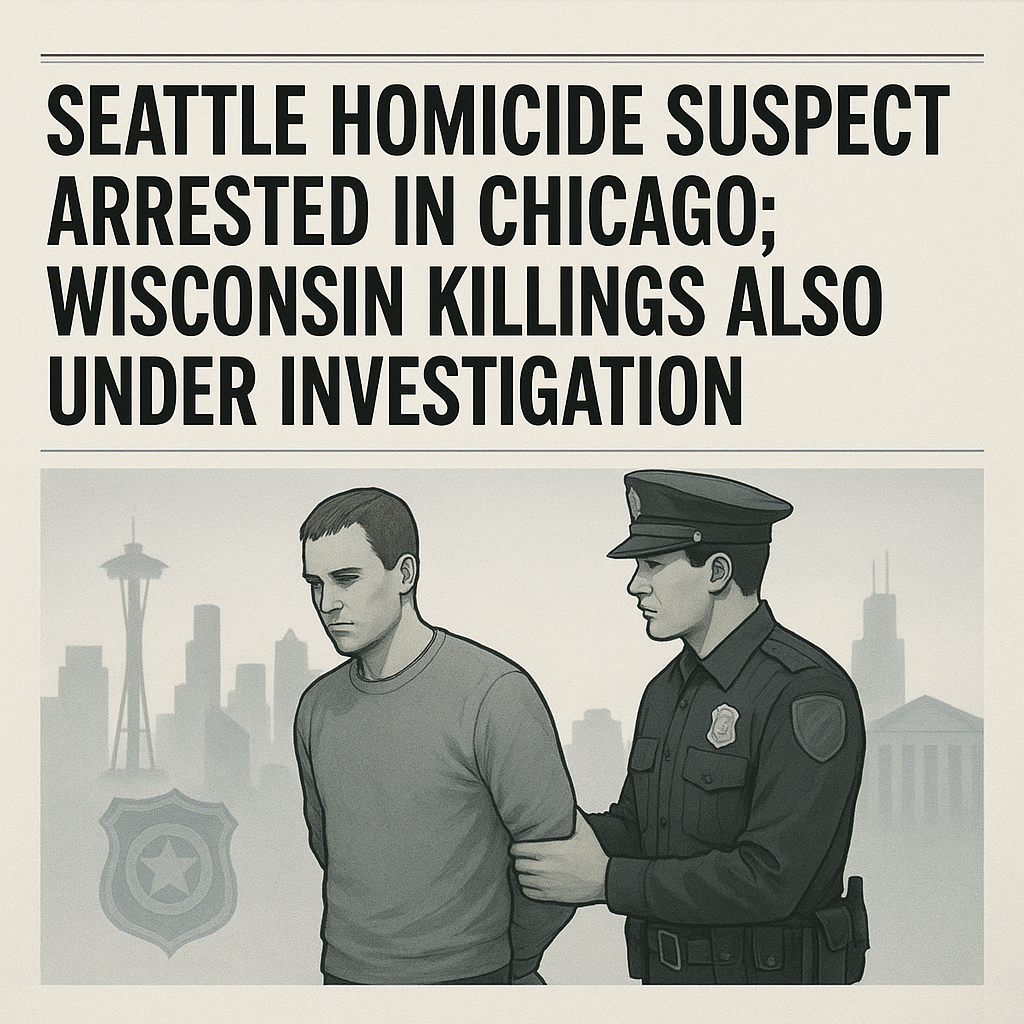
Seattle Homicide Suspect Arrested in Chicago; Wisconsin Killings Also Under Investigation
A 33-year-old man arrested in Chicago on Tuesday is a suspect in a Seattle homicide and two killings in Wisconsin, according to the supplied account of police statements. The arrest brings the investigations into the same reported case, but it does not establish guilt, explain how authorities linked the killings, or indicate what charges have been filed.
What is known about the case?
The available account is brief: police say a 33-year-old suspect tied to a Seattle homicide is also a suspect in two Wisconsin killings, and he was arrested in Chicago on Tuesday. Those are the facts that can be responsibly stated from the supplied material. It gives no name, no victim information, no exact arrest date, and no details about the events under investigation.
A suspect is a person investigators believe may be connected to a crime; the word does not mean that a court has found the person guilty. Saying police are investigating a possible link is not the same as establishing that all three killings had the same motive, were carried out in the same manner, or were planned together.
The geography makes the case notable. The reported investigations span Seattle, Wisconsin, and Chicago, involving authorities in more than one jurisdiction. But the short account does not say which Wisconsin agencies are involved, where in the state the killings occurred, or whether Chicago police made the arrest at another agency’s request. Filling in those blanks with guesses would turn a sparse report into fiction.
I would be cautious about any account that confidently supplies a motive, a detailed timeline, or a narrative of how the suspect moved between cities without citing police statements or court records. The public deserves clear reporting, but victims and their families also deserve not to have speculation presented as fact. The U.S. Department of Justice’s overview of the criminal process explains general stages of a federal case; it is background, not a source confirming this investigation.
Core details and what remains unanswered
The reported facts point to a multi-jurisdiction investigation. Seattle is connected to one homicide; Wisconsin is connected to two more killings; Chicago is where the suspect was reportedly arrested. Beyond that outline, the supplied information leaves important questions unanswered.
- The suspect’s identity: The account provides an age but no name. Naming someone without a reliable source risks misidentification, particularly when proceedings may still be developing.
- The victims: No names, ages, or other identifying details are provided. Their lives should not be reduced to a count, and their identities should not be guessed from unrelated reporting.
- The dates and locations: “Seattle” and “Wisconsin” are broad geographic descriptions. The material does not give neighborhoods, towns, or dates.
- The alleged connection: Police reportedly identify the man as a suspect across the cases, but no evidence, investigative method, or explanation is included.
- The arrest and charges: The report says he was arrested in Chicago on Tuesday. It does not say whether he was formally charged, which jurisdiction may prosecute him, or whether he appeared in court.
- The motive: No motive is stated. It would be premature to infer one from the number of cases or locations.
Frankly, those omissions are not minor. They mark the boundary between what the brief report says and what an article can responsibly claim. Authorities may later release additional information through police statements, court filings, or public proceedings. Until then, the absence of detail is not an invitation to invent a fuller story.
The Seattle Police Department newsroom, the Wisconsin Department of Justice, and the Chicago Police Department publish official information. These agency resources are not incident-specific confirmations; readers should look for a release or court record that directly addresses this case.
Timeline: the reported sequence
The available account supports only a limited timeline. It does not provide calendar dates for the killings or the arrest, so the sequence below separates what was reported from what remains unknown.
- A homicide occurs in Seattle. The supplied summary refers to a Seattle homicide and says the 33-year-old man is tied to it. It gives no date, location, victim identity, or account of the circumstances.
- Two killings in Wisconsin enter the investigation. Police reportedly also consider the man a suspect in two Wisconsin killings. The summary does not establish when those deaths occurred or when investigators first connected them to the Seattle case.
- The suspect is arrested in Chicago on Tuesday. The weekday is stated, but no calendar date or arrest circumstances are provided. The summary does not say which agency made the arrest or whether it was conducted under a warrant from another jurisdiction.
- The legal status remains unclear. No charge, court appearance, transfer, bail decision, or plea is mentioned.
When I assess a short crime report, I keep the timeline narrow. The fact that an arrest followed an investigation does not, by itself, show what evidence prompted it. Nor does the fact that police are examining multiple killings prove that the cases share a single motive or were part of one coordinated plan.
Comparison table: what is reported in each location
The comparison below organizes the claims in the supplied account. It does not add details about the cases or imply that investigators have established a final link among them.
| Location | What the supplied account says | What it does not establish |
|---|
| Seattle | The 33-year-old is a suspect tied to one homicide. | The victim’s identity, date, circumstances, evidence, or charge status. |
| Wisconsin | Police reportedly consider him a suspect in two killings. | The towns, dates, victims, agencies, or whether the cases are connected to each other. |
| Chicago | The suspect was arrested there on Tuesday. | The arrest date, arresting agency, warrant details, court status, or custody arrangements. |
There is no meaningful “competitor” to compare in a developing criminal investigation. The useful comparison is between what has been reported for each location and what remains unverified. Ranking the alleged cases against one another, or treating the three locations as proof of a single criminal scheme, would be misleading.
The public should distinguish between an arrest location and the place where a case will be prosecuted. A person can be arrested in one city while investigators, prosecutors, and courts in another jurisdiction handle allegations. The supplied summary does not identify those arrangements here. The DOJ’s Justice 101 resource is general background, not an answer to case-specific questions.

What to know—and what not to assume
An arrest is not a conviction. Police can identify someone as a suspect while an investigation continues. The presumption of innocence matters because allegations must be tested in court, where prosecutors must meet the applicable burden of proof.
“Suspect” does not tell readers what evidence exists. The supplied account does not describe evidence, witness statements, forensic findings, or investigative steps. Readers should not infer those details from the fact of an arrest.
Three locations do not automatically mean one coordinated crime. The reported cases involve Seattle and Wisconsin, while Chicago is described as the arrest location, not as the site of another killing. The summary does not explain whether investigators believe the deaths share a motive, timing, or method.
A headline is not a case file. Headlines compress information, sometimes leaving out important qualifiers. Here, the account says police consider the man a suspect in multiple killings; it does not provide the underlying police statements or court documents. Until those are available, responsible coverage should preserve that attribution.
Victims’ dignity matters. Reporting should identify victims when authorities have confirmed their identities and when doing so is appropriate, while avoiding intrusive or unsupported details. A careful account recognizes that homicide cases involve real people and families, not merely a mystery for readers to solve. That restraint is part of treating people fairly while the facts are still being established.
The legal process can cross borders. Agencies may coordinate when an investigation spans jurisdictions, and prosecutors may need to address warrants or custody. But the supplied account does not describe that coordination or name a lead agency. General context should not be mistaken for a description of what happened here.
The most important next facts are straightforward: the suspect’s confirmed identity, formal statements from the relevant agencies, any filed charges, and court records. Those records can clarify what is alleged and which court has authority. Until they appear, a confident account of motive or investigative tactics would add noise rather than understanding.
Frequently Asked Questions
What is the suspect accused of?
The supplied account says police consider a 33-year-old man a suspect in one Seattle homicide and two killings in Wisconsin. It does not name specific charges or provide enough information to describe the allegations in greater detail. A suspect designation is not a conviction.
Where was the suspect arrested?
He was reportedly arrested in Chicago on Tuesday. The supplied material does not state the calendar date, the arresting agency, or the legal process that led to the arrest.
Have police explained whether the three killings are connected?
The account says the same man is a suspect in the Seattle homicide and two Wisconsin killings. It does not explain the evidence for the links or establish whether investigators believe the deaths share a motive or plan. More specific claims require direct confirmation from authorities or court records.
Has the suspect been charged or convicted?
The supplied information does not say whether charges have been filed, and it reports no court outcome. An arrest is not a conviction; the status should be checked against official police statements and court records.
Final Thought
A three-state headline can suggest that the whole story is already clear. It is not. The available account establishes a reported arrest in Chicago and says police suspect the 33-year-old man in one Seattle homicide and two Wisconsin killings. It does not identify the man or victims, describe the evidence, state a motive, or explain what charges—if any—have been filed.
That is enough to report the central development, but not enough to write a confident narrative about what happened. The responsible course is to attribute the allegations to police, keep the distinction between suspicion and proof intact, and update the account when verifiable records or statements fill in the gaps. In criminal reporting, restraint is not a failure to inform. It is how the public is spared false certainty while investigators and courts do their work.
The next useful update will not be a more dramatic headline. It will be a precise one: naming the relevant agencies, identifying any filed charges, recording the court’s actions, and stating what authorities have actually confirmed. Until then, the facts are limited—and saying so is part of telling the truth.
Sources and official background
These links provide official agency or general legal information; they do not independently confirm the incident-specific claims in the supplied summary.