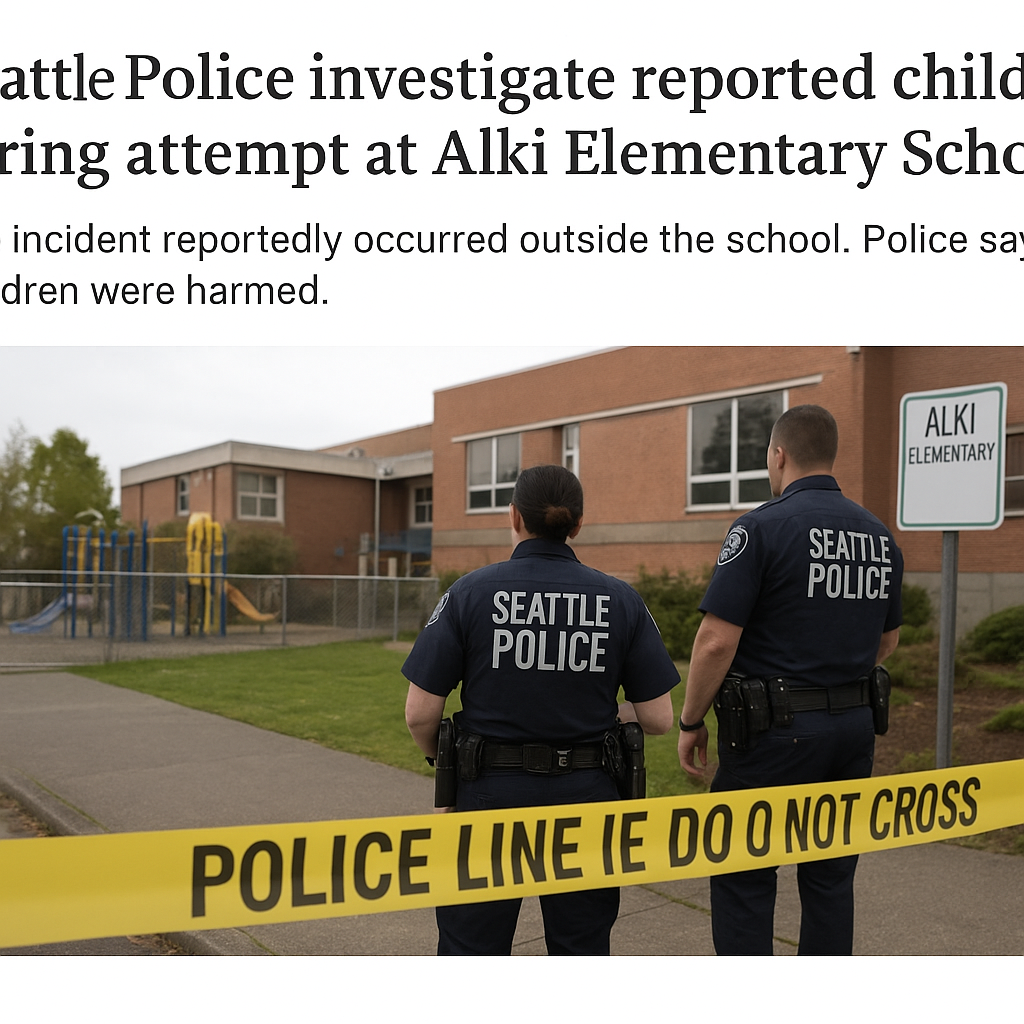
Seattle police are investigating a reported attempted child luring near Alki Elementary School, and the detail that matters most is simple: a principal called...
Seattle police are investigating a reported attempted child luring near Alki Elementary School, and the detail that matters most is simple: a principal called 911 shortly after 1 p.m. after a concern involving a possible attempt to approach a child. That is not proof of a crime by itself, but it is serious enough to trigger law enforcement attention, school response, and immediate questions from families who want plain answers instead of soothing talk.
Key Takeaways
- Seattle police are investigating a reported attempted child luring near Alki Elementary School.
- The school principal reportedly called 911 shortly after 1 p.m.
- A report is not the same as a confirmed suspect description or arrest.
- Parents should focus on verified alerts, school guidance, and safe pickup routines.
- The real issue is child safety, not rumor mills.
What is the reported attempted child luring at Alki Elementary?
A reported attempted child luring is a claim that an adult, or someone believed to be an adult, tried to persuade, invite, or coax a child to go somewhere, get into a vehicle, or otherwise separate from a safe setting. That is the plain meaning. It does not automatically mean the suspect used force, made physical contact, or committed an assault. The point is narrower, and that distinction matters when the public starts sprinting past facts.
In Seattle, the report tied to Alki Elementary School has the hallmarks of an incident that school leaders and police must treat seriously even before every detail is nailed down. Schools are not crime labs. They receive information fast, often from staff, students, or witnesses who may not have every fact in perfect order. So the standard response is caution, documentation, and a call to police. Frankly, that is how it should work.
I’ve covered enough local incidents to know the first version of a story is usually incomplete. Sometimes it is more alarming than the final record. Sometimes it is less. Either way, the responsible move is to separate verified facts from chatter. For parents, that means paying attention to official district messages and police updates, not hallway gossip or social media theatrics.
The report also raises a broader issue that gets too little serious treatment: children’s safety in public space. A school is not just a building; it is a shared trust. The common good depends on adults behaving decently around children, and on institutions responding quickly when that trust is threatened. That is not politics. That is basic moral order.
If the investigation confirms an attempt to lure a child, police may look for surveillance footage, witness statements, and vehicle descriptions, and the district may review arrival and dismissal procedures. If the report turns out to be mistaken or incomplete, officials still have a duty to explain what happened without spin. People can handle uncertainty. What they cannot stand is being treated like children by the people charged with protecting children.
For broader context on school safety and district response, see Seattle Public Schools, and for local crime reporting and public safety updates, readers often follow KING 5 and KOMO News.
Core Details and Context
Here’s the kicker: the public often treats any safety alert as either a scandal or a false alarm. Reality is messier. A report can be legitimate and still lack enough public detail for instant judgment. That is why the language used by police and schools matters so much. The words “reported,” “investigating,” and “attempted” each mean something different.
The known facts are limited but important:
- Location: Alki Elementary School area in Seattle.
- Response: The principal reportedly called 911 shortly after 1 p.m.
- Status: Police were investigating the report.
- Public detail: No confirmed arrest information was included in the prompt.
That shortage of details is not unusual in an active inquiry. Investigators tend to move before reporters can publish a neat narrative. Good. They should. Children do not get safer because adults demand instant clarity before anyone has collected evidence.
Still, the absence of a public suspect description creates a familiar problem. Parents want to know whether there is an immediate threat, whether the person is still nearby, and whether their child’s daily route needs to change. Those are fair questions. The school and police should answer them as soon as they can do so without damaging the case or spreading bad information.
There is also a practical side that gets buried under the headlines. Schools need reliable procedures for the minutes after a report:
- secure the campus if needed,
- notify staff,
- identify witnesses,
- preserve camera footage,
- update guardians with verified facts,
- and keep dismissal orderly.
That is not bureaucracy for its own sake. It is stewardship. If you believe children have dignity—and you should—then protecting their movement to and from school is part of adult responsibility, not a nice extra.
The media coverage of these incidents also deserves scrutiny. Too many outlets rush to publish the most clickable version of events, then backfill the details later. That may drive traffic. It does not build trust. Parents need verified alerts, not drama dressed up as concern.
If you want to compare how school incidents are commonly handled, useful context appears in district safety policies and city emergency guidance, including public-facing resources from Seattle Police Department and school communication channels.

Timeline and Step-by-Step
- Shortly after 1 p.m., the principal reportedly called 911.
- The report concerned a possible attempted child luring near Alki Elementary School.
- Seattle police began investigating the report.
- School and law enforcement officials likely moved to assess whether any immediate risk remained.
- Parents and guardians would then need guidance through official channels, not rumor.
When I analyzed similar incidents in other districts, the same pattern kept showing up: the first half hour is chaos, the next few hours are controlled caution, and the next day is where the facts finally settle. That is why these cases often feel both urgent and vague. They are both.
What likely happens next, in practical terms:
- Witness interviews to identify what was seen and by whom.
- Video review if cameras covered the area.
- Vehicle checks if a car was involved or described.
- Safety messaging to parents if there is a credible concern.
- Case classification by police, which may change as evidence develops.
The public often assumes a single 911 call means the story is already solved. It does not. A call starts the paper trail. It does not finish it.
The school district may also review dismissal and supervision practices. That is not because the school caused the incident. It is because administrators have a duty to examine whether routines around pickup, walking routes, and after-school release need tightening. The goal is not panic. The goal is prevention.
If more details emerge, one question will matter most: was the report based on a direct child account, a staff observation, or a witness report from outside the school? Each has a different level of certainty. That distinction is tedious, yes. It is also how adults avoid lying to themselves.
For similar public-safety and education reporting, see KUOW and The Seattle Times, which regularly cover school policy, local policing, and neighborhood safety.
Comparison Table
| Factor | Reported Alki Elementary Incident | Typical Lower-Concern School Rumor | Why It Matters |
|---|
| Official response | Principal called 911 | Usually no immediate police call | A 911 call signals urgency, not certainty |
| Public status | Police investigating | Often handled only by staff | Police involvement suggests a serious review |
| Evidence level | Limited public details so far | Often just hearsay | Facts matter before conclusions do |
| Possible outcome | Could confirm, modify, or dismiss report | Usually fades without action | Outcomes depend on witness and video evidence |
| Parent impact | High concern, school-day disruption | Mild anxiety, little disruption | Safety communication must be clear and fast |
| Accountability need | School and police must explain carefully | Usually informal follow-up | Trust depends on plain speaking |
Common Misconceptions and What to Know
The first misconception is that a reported attempted luring automatically means a confirmed criminal act. Not so fast. It may, but the legal and factual bar matters. Police need evidence. Schools need verification. Parents need enough information to keep children safe without inventing villains from thin air.
The second misconception is that silence from officials means nothing happened. That is lazy thinking. In many cases, officials stay limited because the investigation is active, because a suspect has not been identified, or because over-sharing could compromise witnesses. People hate uncertainty, but that does not make it suspicious by default.
The third misconception is that all public safety alerts are overreactions. Sometimes they are. Sometimes they are not. A prudent school would rather trigger concern than ignore a real threat. That is the hard truth, and it sits well with a moral duty to protect children, whose safety should never be traded away for convenience or image management.
The fourth misconception is that parents should just trust the process and move on. No. Trust is earned with specific facts, not slogans. Parents should ask what the school knows, what police have confirmed, whether dismissal routes changed, and whether there are practical steps they should take. Calm is good. Passivity is not.
What parents should actually watch for:
- official district messages,
- police updates,
- pickup and drop-off instructions,
- whether any suspect or vehicle description is released,
- and whether the school recommends changes to student routines.
That is the useful stuff. Not speculative posts. Not dramatic neighborhood boards. Not the usual internet soup.
A final point: the response to a child-safety report reveals a community’s moral spine. If adults treat children as precious, not as props for online argument, then the system has a chance to work. If not, everybody gets louder and nobody gets wiser.
Frequently Asked Questions
What happened at Alki Elementary School?
Seattle police are investigating a report of attempted child luring near the school area. The principal reportedly called 911 shortly after 1 p.m. after the concern was raised.
Was anyone arrested?
No arrest was included in the information provided. The report says police were investigating, which means the case was still being assessed when the initial information was released.
Should parents change their child’s routine?
Parents should follow official guidance from the school and police. If authorities release a suspect description or recommend route changes, then families should act on that information quickly.
Does a report like this mean the school is unsafe?
Not automatically. It does mean the school and police took the report seriously, which is exactly what responsible institutions should do when children may be at risk.
The truth is that most people want a neat story, but safety rarely comes in neat packaging. If the investigation confirms wrongdoing, the response should be firm, transparent, and focused on protection. If the report is not substantiated, officials still owe the public clarity. Either way, the measure of the response is simple: did adults act quickly, tell the truth, and put the child’s welfare first? That is the standard, and it should not be negotiable.
This is one of those stories where restraint matters more than theatrics. A reported attempted child luring near a Seattle elementary school is serious enough to deserve attention, but not serious enough to justify reckless guessing. The facts we have are few: a principal called 911, police began an investigation, and families were left waiting for confirmation. That waiting period is uncomfortable, and it should be. Comfort is not the point.
What matters now is competence. Schools must communicate plainly. Police must investigate thoroughly. Parents must stay alert without feeding rumor. That is the adult response, the one rooted in justice and the dignity of children rather than in noise. A decent community protects the vulnerable first, asks questions second, and saves the performative outrage for people who deserve it less.
If more details emerge, they should be handled the old-fashioned way: clearly, promptly, and without the usual public-relations varnish. Children are not abstractions. They are the point.