Seattle Police Vehicles Collide During Search for Suspected DUI Driver
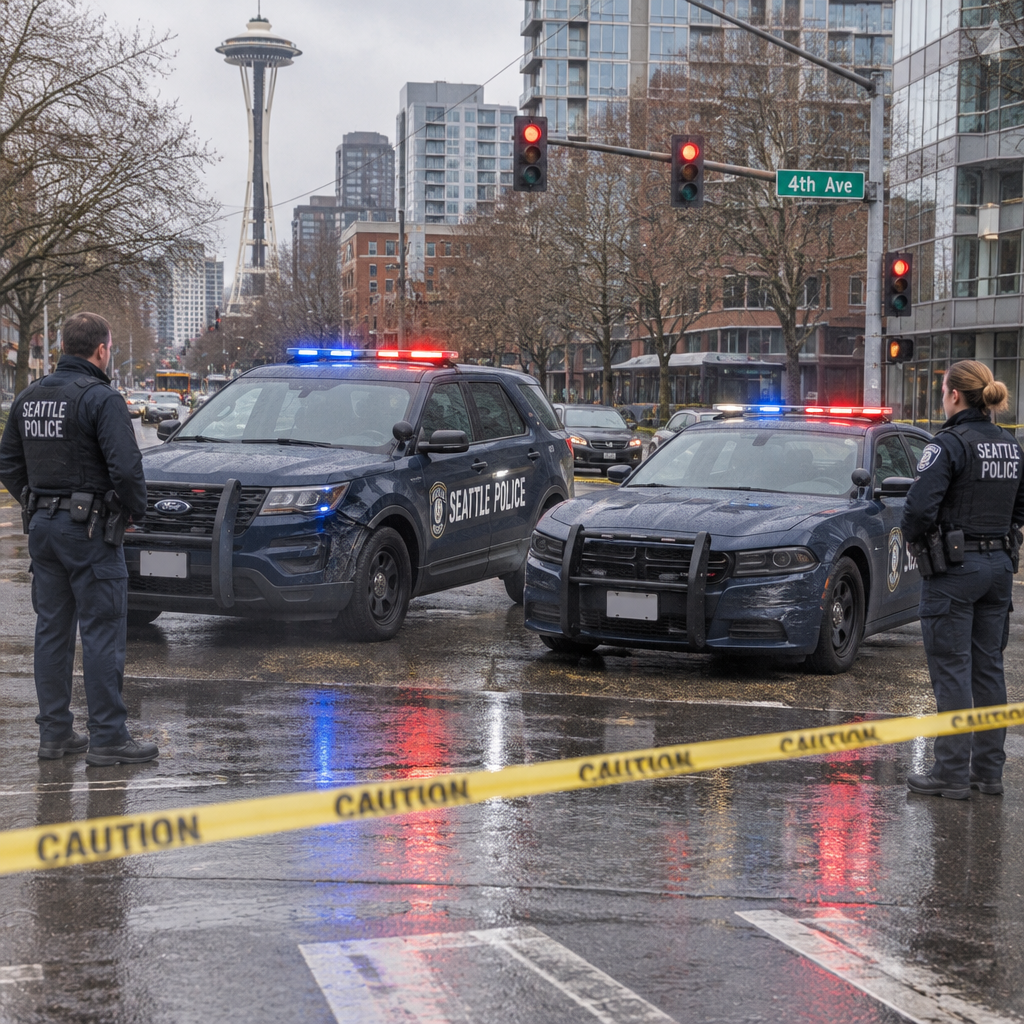
Two Seattle police vehicles collided at low speed shortly before 6 a.m. Friday as officers searched south Seattle for a driver who had fled a suspected DUI stop. Police later found the abandoned Dodge and a license plate from a stolen Kia inside it; the suspect had not been found, according to the Seattle Police Department account.
The known sequence is brief, but it contains several separate facts that should not be blurred together. A call prompted a police response; a driver left the scene; patrol vehicles collided during the search; and officers later found the Dodge, with a stolen Kia plate inside. The account does not say the Dodge itself was stolen, that the suspect stole the plate, or that officers identified who owned either vehicle. Those are not minor distinctions. They separate evidence from guesswork.
Frankly, the most useful report is the one that resists filling gaps with drama. Police described the call as a suspected DUI, not a confirmed finding of impairment. The driver’s identity, condition, and whereabouts remain unreported. The account also does not say whether anyone was hurt in the patrol-car collision. Here is what is known, what remains unclear, and why the details matter to public safety.
What happened in south Seattle?
The Seattle Police Department account describes officers responding Friday morning to a report of a man slumped over the steering wheel of a running Dodge. The call was treated as a suspected DUI. That wording identifies the concern that led to the response; it does not establish that the driver was intoxicated, tested, arrested, or charged. No result of an impairment investigation appears in the account.
Officers found the Dodge and placed a compact tire-deflation device near one of its tires. SPD called the device a terminator and said officers positioned it in case the driver tried to leave. The man woke, drove over the device, and fled. The account does not report whether the device deflated a tire or otherwise affected the Dodge’s condition. It also gives no further detail about the driver’s movements immediately after leaving.
Police searched around Martin Luther King Jr. Way South and South McClellan Street, the area where the Dodge was last seen. Shortly before 6 a.m., two officers in separate patrol vehicles collided at low speed while searching for it. Officers later found the Dodge abandoned. During a search of the vehicle, they found a license plate from a stolen Kia. The suspect had not been found, according to the account.
That is the confirmed outline. The Friday is not accompanied by a calendar date, and the report provides no officer names, vehicle damage assessment, injury information, or explanation of what happened to the plate after it was found. The absence of those details does not prove that nothing happened; it means the account does not say. I treat that distinction as basic reporting hygiene, not a technicality.
The location and sequence matter because the collision occurred during an active search, not during the initial contact with the Dodge. Even so, the account does not explain how the patrol vehicles collided, whether they were traveling in the same direction, or whether another vehicle was involved. Any more detailed reconstruction would be speculation. The department’s public reports and publications are a place to look for agency information, but the incident details here remain limited to the account described above.
Core details and context
A few facts carry most of the weight in this incident. They also need careful wording.
- The call concerned suspected impairment. A report that someone is slumped over the wheel of a running car can reasonably prompt a welfare or traffic-safety response. It does not, on its own, prove impairment. The account does not say whether officers made contact with the driver before he woke, whether they observed signs of intoxication, or whether any test was administered.
- The driver fled after waking. SPD says the man drove over the device and left. That is a reported action, not a finding about why he left. The report does not state whether he knew officers were present, whether he was injured or impaired, or whether he understood what the device was. Assigning a motive would go beyond the available facts.
- The patrol-car collision happened during the search. Two officers were in separate police vehicles, and the collision was described as low speed. That phrase gives a broad description of impact, not a full account of consequences. No injury status, damage estimate, or review of the collision is provided.
- A stolen Kia plate was found inside the Dodge. This is evidence about an item located in the vehicle. It does not establish that the Dodge was stolen, that the suspect stole the Kia, or that the suspect placed the plate there. Police did not report the plate’s history or how it came to be inside the Dodge.
- The suspect was not located. That is the status reported at the time of the account. It does not establish what happened later, whether investigators identified the driver, or whether the case remains active. No later update is included here.
The legal and safety context should not be mistaken for incident-specific proof. Washington’s DUI statute sets out legal provisions related to driving under the influence, but the account does not provide facts sufficient to determine whether any provision was met in this case. The National Highway Traffic Safety Administration’s impaired-driving information explains the broader road-safety risks of impaired driving. Neither reference establishes that this driver was impaired.
Here’s the kicker: the plate discovery may attract attention because it introduces a second vehicle and a possible stolen-property question. But the report gives no details tying the suspect to the Kia beyond the plate being found inside the Dodge. Good reporting keeps that boundary intact. A lead can justify further investigation without resolving who did what.
The public-interest questions are straightforward: Was anyone injured? How much damage did the patrol vehicles sustain? Was the plate traced, and did investigators identify the suspect? The account does not answer them. Those gaps should be treated as open questions, not invitations to invent a convenient ending.
Timeline: what happened, step by step
- A suspected DUI call came in Friday morning. The caller or observer reported a man slumped over the steering wheel of a running Dodge. The account does not provide the precise call time, caller identity, or a calendar date. It also does not describe the man’s condition beyond that initial observation.
- Officers found the Dodge. Police located the car and placed a compact tire-deflation device near a tire as a precaution in case the driver tried to flee. SPD called the device a terminator. The account does not specify the exact location where the car was first found or whether officers spoke with the driver before he woke.
- The driver woke and left. According to SPD, he drove over the device and fled. The report does not say whether the Dodge’s tires were affected, how fast the car traveled, or which route it took. Those missing details limit any attempt to describe the chase or the vehicle’s condition.
- Officers searched near two named streets. Police looked for the Dodge around Martin Luther King Jr. Way South and South McClellan Street, where the car had last been seen. The account does not say how many other officers joined the search or how large the search area became.
- Two patrol vehicles collided shortly before 6 a.m. The officers were in separate vehicles and were looking for the Dodge when the low-speed collision occurred. I would not infer a cause from that sentence alone. No information is given about visibility, traffic, speed beyond the broad description, road conditions, or the officers’ actions immediately before impact.
- Police later found the Dodge abandoned. During a search of the vehicle, officers found a license plate from a stolen Kia. The account does not state whether officers found other evidence, whether the plate was still attached to the Kia at the time it was taken, or whether anyone was charged in connection with it.
- The suspect remained unlocated. That is the final reported status. No identity, arrest, charge, or later outcome is provided. I read that as a snapshot of what SPD reported—not proof that no subsequent investigative step occurred.
The order matters. The patrol-car collision occurred as officers searched, and the Dodge was found later; the account does not supply enough timing detail to say how much later. It also does not establish that the collision caused the search to stop or change. A timeline can clarify sequence without pretending to know every interval between events.
Comparing the Dodge and the stolen Kia plate
The most useful comparison in this report is not between rival agencies or competing accounts; it is between the two vehicle references that could easily be confused. One is the Dodge associated with the suspected DUI call and the driver’s flight. The other is the Kia identified through a plate found during the later search. The report connects them only through that plate.
| Detail | Dodge | Kia identified by the plate |
|---|
| Role in the account | The car in which the man was reported slumped over the wheel; it was later driven away and found abandoned. | The vehicle described as stolen in connection with a license plate found inside the Dodge. |
| What police reported | Officers found it, the driver fled in it, and officers later searched it. | A license plate from a stolen Kia was found during the Dodge search. |
| What is not reported | Whether the Dodge was stolen, who owned it, its registration status, or its condition after the device was driven over. | The Kia’s make, model, theft date, location, owner, or whether it was recovered. |
| What the connection proves | The Dodge was the vehicle at the center of the reported search. | The plate was inside the Dodge, according to SPD. |
| What the connection does not prove | It does not establish who placed the plate there or why. | It does not establish that the Dodge’s driver stole the Kia or its plate. |
The comparison is narrow by design. A license plate can be an investigative lead, but the account does not say whether police confirmed the plate’s status through a records check or what conclusions investigators drew. The reported finding should not be stretched into a claim about a larger theft operation, a stolen Dodge, or a suspect’s criminal history.
There is a practical reason to be precise. Vehicle identity can shape public understanding of a crime, and inaccurate wording can unfairly attach suspicion to an owner or driver. A stolen plate might have been placed in a car by someone other than the driver; it might have been there for reasons the account does not disclose. Those possibilities are not findings either. They simply show why the evidence needs more context before it supports a conclusion.
The same restraint applies to the Dodge’s flight. The sequence is clear enough to report: the driver woke, crossed the device, and left. The account does not say the device worked, that the car was disabled, or that officers pursued it at speed. It says officers searched the area and that the Dodge was later abandoned. That is a meaningful distinction for anyone trying to describe the event accurately.
Common misconceptions and what to know
Misconception: the driver was confirmed to be driving under the influence. The call was for a suspected DUI, and the report says the man was found slumped over a running car. Those details explain why officers were dispatched. They do not establish intoxication, a test result, an arrest, or a charge. The word suspected matters, particularly when a person has not been identified publicly and no finding has been reported.
Misconception: the suspect was caught because police found the Dodge. Police found the vehicle abandoned, but the account says the suspect had not been found. Locating a car and locating its driver are different outcomes. The report does not explain how long the car had been abandoned, who left it, or whether officers had identified a possible driver.
Misconception: finding a stolen Kia plate proves the suspect stole the Kia. It does not. The plate was reportedly found inside the Dodge. That establishes a reported location for the item, not the identity of the person who took or moved it. The account does not say the plate was connected to the driver, and it does not identify any person as responsible for the Kia theft.
Misconception: low-speed means no one was hurt and no damage occurred. The phrase describes the collision broadly. It is not an injury report or a repair estimate. The account does not state whether the officers were injured, whether either patrol vehicle was damaged, or whether the collision was reviewed. Until those details are reported, the careful wording is that the vehicles collided at low speed and the consequences were not specified.
Misconception: the collision happened during a high-speed chase. The account says officers were searching for the Dodge when their vehicles collided. It does not describe a pursuit, give a speed for the Dodge, or state that police were chasing it at the moment of impact. Adding the word chase would make the story more dramatic but less accurate.
Misconception: the account tells us what happened next. It does not. The last reported status is that the suspect had not been found. There is no later arrest information, court filing, charging decision, or update about the Kia. Readers should not treat the absence of a follow-up in this account as proof that investigators did nothing or that the case had a particular outcome.
What can responsibly be said? Officers responded to a suspected DUI call, a driver fled in the Dodge, two patrol vehicles collided at low speed during the search, and officers later found the abandoned Dodge with a plate from a stolen Kia inside. Beyond that, the account leaves unanswered questions. The public deserves clear information, but fairness requires resisting claims the evidence has not established.
There is also a wider civic point. Police resources, road safety, and the dignity of people involved—including officers, vehicle owners, and the unidentified driver—are all part of the public interest. Stewardship of those resources calls for careful reporting as well as effective investigation. That is not soft language; it is the minimum standard for separating accountability from accusation.
Frequently asked questions
Where did the police vehicles collide?
The account places the search near Martin Luther King Jr. Way South and South McClellan Street, where the Dodge was last seen. It does not give a precise collision location beyond saying the officers were searching in that area.
Was anyone injured in the collision?
The available account does not say whether either officer or anyone else was injured. It describes the crash as low speed but provides no injury information or damage estimate.
Was the driver arrested?
No arrest is reported. The account says officers later found the Dodge abandoned and that the suspect had not been found. It does not provide a later update or identify the driver.
Does the stolen Kia plate mean the Dodge was stolen?
No. The report says a plate from a stolen Kia was found inside the Dodge. It does not say the Dodge was stolen or identify who placed the plate there.
Final thought
This incident is a reminder that a short police account can contain several different questions, and only some of them have answers. The response began with a concern about a person in a running car. The driver left after waking. Officers searched, two patrol vehicles collided at low speed, and the abandoned Dodge was later found with a plate from a stolen Kia inside. The suspect was not located at the time described.
That sequence is enough to report. It is not enough to declare the driver impaired, assign responsibility for the Kia theft, explain the patrol-car collision, or say whether anyone was injured. Those findings may emerge through later reporting or official records, but they are not in the account now. If investigators or the department release an update, the most useful details will be the ones that resolve these specific gaps: the collision’s consequences, the plate’s connection to the Kia, and whether the suspect was identified.
Most coverage misses the real discipline here: precision is not a lack of urgency. A suspected DUI call and a fleeing driver raise legitimate safety concerns. A collision involving two police vehicles merits clear answers. And a plate linked to a stolen car deserves investigation. But public confidence depends on evidence being described honestly, not inflated to fill space. The common good is served when the public gets facts, officers are treated fairly, and suspicion is not presented as proof.
{"@context":"https://schema.org","@type":"FAQPage","mainEntity":[{"@type":"Question","name":"Where did the police vehicles collide?","acceptedAnswer":{"@type":"Answer","text":"The account places the search near Martin Luther King Jr. Way South and South McClellan Street, where the Dodge was last seen. It does not give a precise collision location beyond saying the officers were searching in that area."}},{"@type":"Question","name":"Was anyone injured in the collision?","acceptedAnswer":{"@type":"Answer","text":"The available account does not say whether either officer or anyone else was injured. It describes the crash as low speed but provides no injury information or damage estimate."}},{"@type":"Question","name":"Was the driver arrested?","acceptedAnswer":{"@type":"Answer","text":"No arrest is reported. The account says officers later found the Dodge abandoned and that the suspect had not been found. It does not provide a later update or identify the driver."}},{"@type":"Question","name":"Does the stolen Kia plate mean the Dodge was stolen?","acceptedAnswer":{"@type":"Answer","text":"No. The report says a plate from a stolen Kia was found inside the Dodge. It does not say the Dodge was stolen or identify who placed the plate there."}}]}