Seattle Schools AI Rules: Parents Demand Limits as District Tightens Screen Time
Seattle is tightening classroom technology rules. After parents protested outside district headquarters, Seattle Public Schools leaders outlined narrower AI access, screen limits, age-based guidance still in development, and new restrictions on elementary apps. Who sets the boundary? That question now matters to families.
The clash is not a simple choice between modern technology and old-fashioned classrooms. It is a dispute over consent, instructional value, and how much control a school system should exercise over tools children encounter during the school day. Parents are asking for practical limits, not another promise that adults will keep an eye on things.
The district, meanwhile, says it cannot treat AI as if students will never encounter it. That argument has force, but it does not settle the hard question: whether a particular tool improves learning enough to justify its risks and screen time. A tool can be available without being educationally useful.
The reported changes make this a policy debate with immediate consequences. They affect which sites students can reach, how often elementary pupils use devices, and whether families can decline certain forms of technology. The district has announced several restrictions, but some details remain unsettled, including the full age-by-age guidance and how the screen-time limits will work in practice.
What Is Seattle’s Classroom AI Debate?
Seattle’s classroom AI debate concerns how Seattle Public Schools should govern generative artificial intelligence and student screen use. Generative AI systems can produce or revise text, images, and other material in response to prompts. In a school setting, that can mean a student uses a tool to brainstorm, get feedback, generate an image, or complete work. The central issue is not whether the technology exists. It is who decides when it belongs in a lesson, what students may submit, and how the district protects children’s learning and agency.
The district’s present approach is controlled access rather than open access. It blocks generative AI websites generally and permits one district-approved program, MagicSchool. Teachers decide when, whether, and how students can use it. Assistant Superintendent of Academics Dr. Mike Starosky has said the default assumption should be that AI use is not allowed unless guidance permits it. That default matters: it puts the burden on students to know the rule before using a tool, rather than treating every use as acceptable until someone objects.
Yet a rule on paper is not the same as a rule a child can apply. Students may meet AI through a search engine, a school assignment, or a tool embedded in a service they already use. The district’s announcement of a Gemini ban addressed one route students had been able to access through Search. The district is also developing age-based guidance and says it may adjust that guidance after hearing from ITAC, families, educators, and technology staff. The final policy is therefore still in motion.
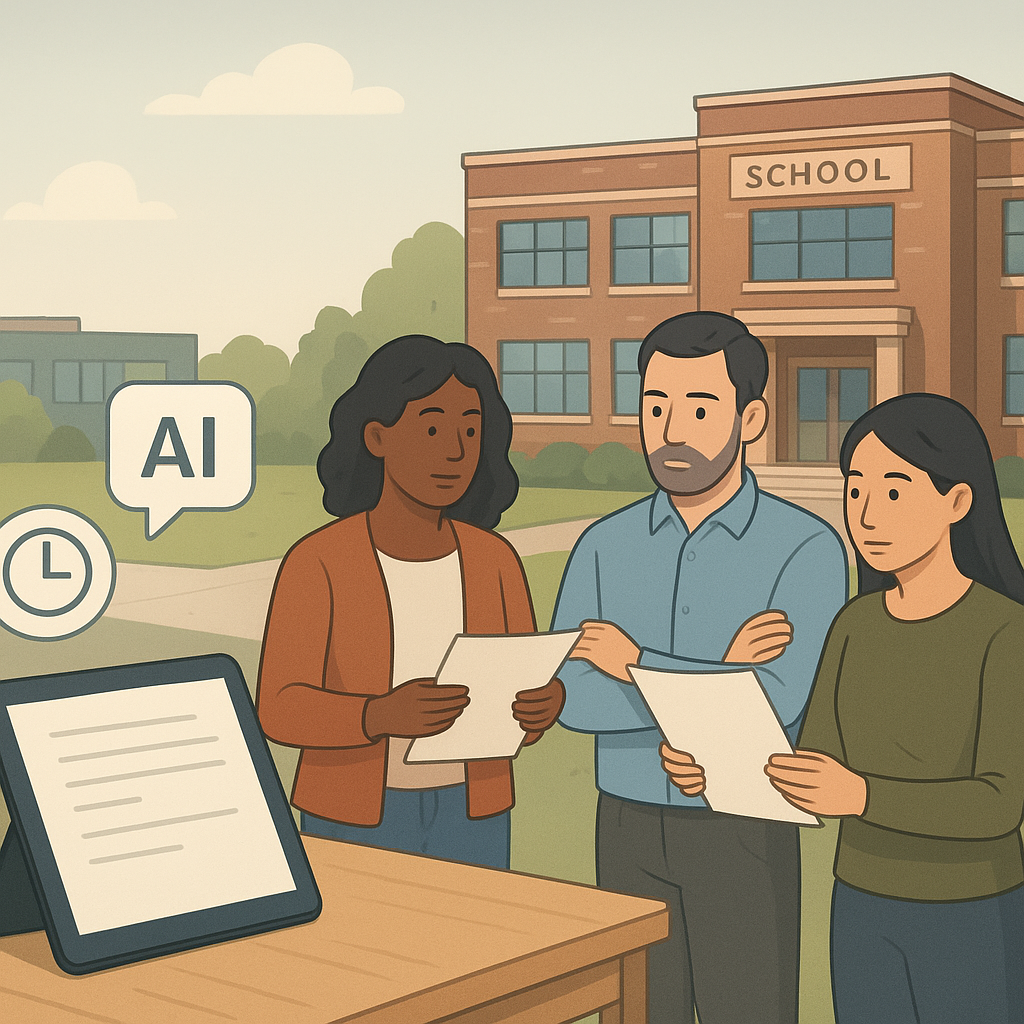
Parents’ concern is concrete. Mike Holm, a father of three students in the district, said a drawing by his daughter was fed through AI during a school assignment. He questioned why the work had been changed and worried that the experience could weaken a child’s confidence in her own ideas. The account does not identify the tool, explain the assignment’s full instructions, or say what the teacher intended. Those gaps matter; they prevent a fair judgment about that specific classroom decision. But the concern itself is easy to understand: children should know when their work is being altered and why.
I read the dispute as a question of educational purpose, not a referendum on whether every new tool is good or bad. A school has obligations beyond convenience: it must teach judgment, protect children’s dignity, and make room for a student’s own effort. The U.S. Department of Education’s report on AI in teaching and learning discusses the need for human-centered oversight and appropriate safeguards. UNESCO’s guidance likewise treats privacy, age, and human agency as central considerations. Those broad principles do not dictate Seattle’s policy, but they are useful standards for testing it.
Core Details and Context
The district’s announcement contains several separate decisions, and they should not be blurred together. One is about AI access. Another is about elementary students’ devices and screen time. A third is about staff preparation. Each requires a different measure of success. A website block may be technically clear, while a classroom rule about when AI supports learning requires judgment, explanation, and follow-up.
- AI access: Seattle Public Schools blocks generative AI sites except for the district-approved MagicSchool program. Teachers determine if and how students use that program. The district also announced a ban on Google’s Gemini AI, which students had been able to reach through Search. The details provided do not say how the district will detect work produced with outside tools or how exceptions will be handled.
- Elementary technology: The district announced a ban on YouTube and Minecraft for elementary school students. It also said it is ending the one-to-one device policy for elementary pupils. That does not, by itself, establish that every elementary student will lose access to a device. The precise classroom distribution and exceptions were not reported.
- Screen time: New caps are set at 30 or 60 minutes, depending on a student’s age. The exact age bands, whether minutes are counted daily, and which school activities count toward the cap were not specified in the account. Those details will determine whether families and teachers can understand and apply the policy consistently.
- Teacher training: Nearly 3,000 teachers have completed an AI training program launched at the beginning of the year. That is a participation figure, not proof that a course changed classroom practice or improved student outcomes. Training matters, but the district still needs to explain what teachers learned and how it will be assessed.
- Policy development: Age-based student guidance is being written, with possible revisions based on input from ITAC, the community, and educators. The district’s own statements indicate that the final rules may change. Families should distinguish announced restrictions from guidance still under development.
Here’s the kicker: the district has given a number for teacher training, but the public still needs outcome measures. How many classrooms use AI, for what tasks, and with what effect on student work? The available information does not answer those questions. Without them, both sides can overstate their case: advocates can point to training as evidence of readiness, while critics can treat any classroom use as proof of harm.
The question of a student’s own work deserves particular care. Holm’s account of his daughter’s drawing raises practical issues that policy should answer: Was AI use explained beforehand? Could a student decline? Was the original work preserved? Did the task assess drawing, image editing, or critical judgment? A clear rule would make the assignment’s purpose visible to the child and family. If the point is to study AI’s influence, that should be stated. If the point is to assess a child’s unaided drawing, changing the drawing with AI would be a different matter.
Schools also need to account for unequal access and support. A policy that relies on students knowing which tool is approved may work differently for a child with close adult guidance than for a child who has to figure out the rule alone. A good policy should be understandable to families, teachers, and students—not only to the district staff who drafted it. That is ordinary accountability, not a demand for perfect prediction.
Timeline: What Happened and What Comes Next
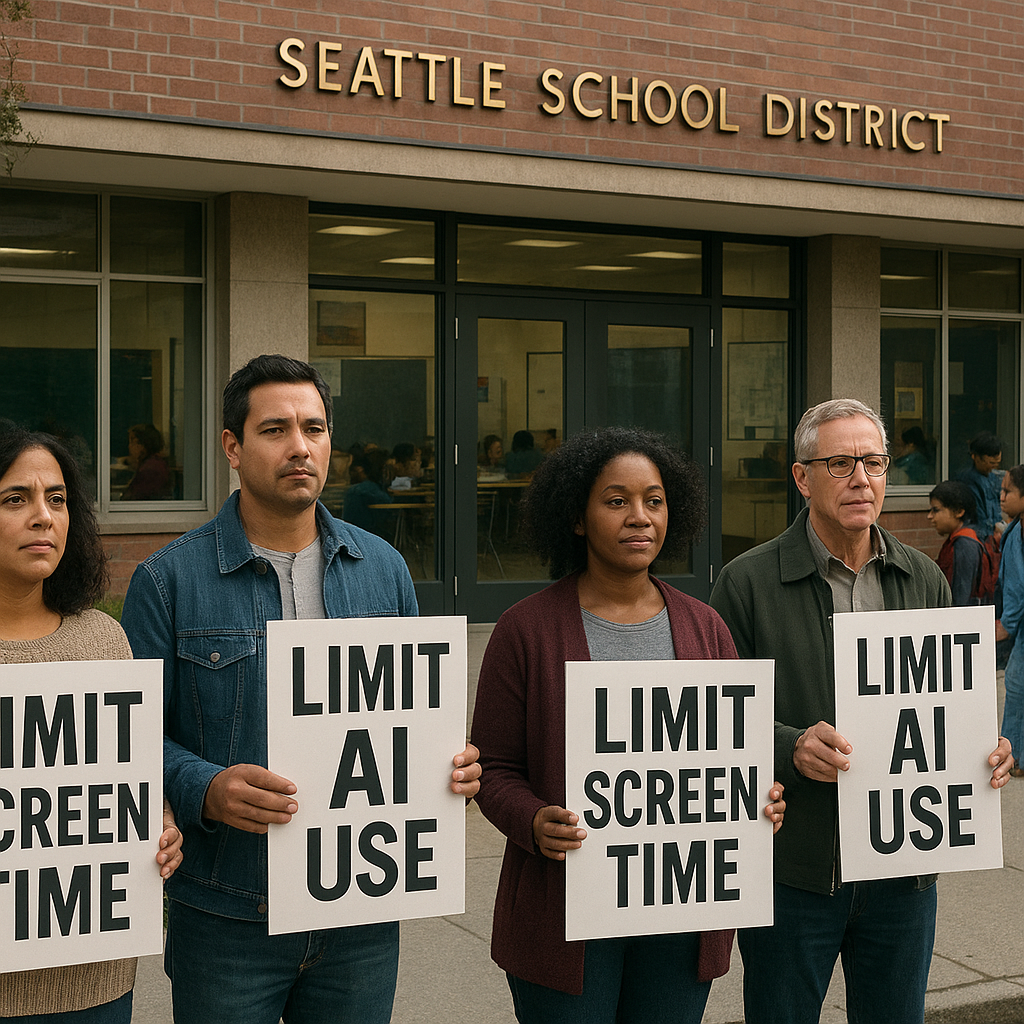
- Parents voiced their concerns. Dozens of parents gathered outside Seattle Public Schools headquarters on Wednesday. They called for screen-time limits, opt-out choices for technology use, and tighter restrictions or a pause on AI in classrooms. The protest made the disagreement visible, but the account does not report a formal vote by the group or a single detailed proposal shared by all attendees.
- A family example sharpened the debate. Holm described a school assignment in which his daughter’s drawing was processed through AI. He said the change concerned him because it could affect students’ confidence in their own work. The specific tool and assignment instructions were not reported, so the episode should be treated as a parent’s account of a classroom experience, not as a full investigation into the teacher’s decision.
- District leaders described their approach. At the school board meeting on Wednesday, Starosky said the district’s default should be that AI is not allowed unless guidance says otherwise. The district already blocks generative AI sites apart from MagicSchool, with teachers deciding when and how to use the approved program. Starosky also said age-based student rules are being developed and may be revised after consultation with educators and the community.
- The district announced new restrictions. Starosky announced a ban on Gemini, which students had been able to access through Google Search, as well as bans on YouTube and Minecraft for elementary students. The district also said it would end the elementary one-to-one device policy and cap screen time at 30 or 60 minutes depending on age. The precise age bands and counting rules were not reported.
- The board debate continued. Superintendent Ben Shuldiner argued that AI should be managed within Seattle Public Schools rather than ignored or banned outright. District 3 Director Evan Briggs questioned whether AI is actually improving learning and asked who can use it responsibly. The disagreement is not resolved by either statement; it points to the evidence the district needs to gather.
- The next stage is implementation. Nearly 3,000 teachers have completed the district’s AI training program, but the age-based student guidance remains in development. The district has said it may adjust its approach after hearing from ITAC, families, and educators. The useful next test is whether the resulting rules explain approved tasks, prohibited use, family choices, and how a school will respond when a student is unsure.
When I sort the announcements by timing, one distinction stands out: some restrictions were announced, while a broader framework is still being written. That creates a transition period. Teachers and families need plain instructions during that interval, especially if the district expects students to ask whether AI use is allowed before they begin an assignment.
Comparison: District Management vs. Parent-Requested Pause
The alternatives are not two fully specified programs. Seattle Public Schools has described a managed-use model, while protesters have called for stronger limits, opt-outs, or a pause. The protest account does not set out one complete alternative policy, so the table compares what has actually been stated rather than inventing details.
| Policy question | Seattle Public Schools’ managed-use approach | Parent-requested pause or opt-out approach |
|---|
| Generative AI access | Generative AI sites are blocked except for approved MagicSchool; teachers decide when and how it is used. | Parents called for AI to be limited or paused; a full access plan was not reported. |
| Default expectation | District leaders say the default should be no AI use unless guidance allows it. | Protesters want tighter limits and a way to opt out of technology use. |
| Gemini | District announced a ban on Gemini, which students had reached through Search. | Parent demands also include tighter AI limits; a separate Gemini proposal was not reported. |
| Elementary apps | District announced elementary bans on YouTube and Minecraft. | Protesters sought screen limits and technology opt-outs; specific app rules were not reported. |
| Screen limits | Caps announced at 30 or 60 minutes depending on age; exact age bands and counting rules were not reported. | Parents called for screen-time limits; a competing cap was not reported. |
| Implementation | Nearly 3,000 teachers completed AI training; age-based guidance is being developed. | The account does not describe a complete implementation or training plan. |
The managed-use model makes room for supervised instruction about AI, but it places substantial responsibility on teachers and on rules that are still being completed. The pause model puts caution and family choice first, but a lasting version would still need to explain how students learn to evaluate AI encountered outside the classroom. Neither model can be judged solely by its slogan.
The fairest comparison asks which approach produces better learning with fewer avoidable costs. The district should publish the rationale for each approved use, the limits on student data, and evidence that the tool serves the lesson. Families pressing for a pause should also be clear about what counts as technology use and how an opt-out would work without isolating a student from ordinary instruction. Those are answerable questions. They are more useful than arguing over whether AI is inevitable.
Common Misconceptions and What to Know
Misconception: Seattle has opened classroom doors to every AI tool. It has not, according to the district’s described policy. Generative AI sites are blocked except for MagicSchool, and the district announced a ban on Gemini. The teacher’s role in approving use remains central. At the same time, a block list is not a complete instructional policy. Students and teachers still need rules for assignments, disclosure, and work completed outside approved tools.
Misconception: The district has already finished its AI rules. It has not. Starosky said age-based guidance is being developed and could change after input from ITAC, the community, and educators. That means families should not mistake the current access rules for a finished account of what students may do in every grade. Interim rules need to be explicit while the larger framework is written.
Misconception: The training figure proves AI is improving education. Nearly 3,000 teachers completing a training program is a useful measure of participation. It does not tell us whether the training changed practice, whether students learned more, or whether the approved tool was appropriate for a particular task. A completion count is a starting point, not an outcome. The district should report what it evaluates next.
Misconception: A screen-time cap answers every concern about devices. The district has announced limits of 30 or 60 minutes depending on age, but the reported account does not specify age bands or how time is counted. Nor does a time limit alone tell parents what students are doing on a screen. A child reading a lesson, watching a video, and using an AI image tool are not necessarily doing the same kind of work. A usable policy should define the cap and explain the educational purpose of allowed screen use.
Misconception: Talking about AI means endorsing it. Shuldiner’s argument was that the district should manage AI rather than pretend it does not exist. That is not the same as saying every student should use it or that its educational benefits have been established. Briggs’s objection—that the district does not know whether it enhances learning—also raises a legitimate question, but uncertainty does not automatically show that every controlled use is harmful. Good policy can test narrow uses and stop them if they fail.
Frankly, the public debate gets weaker when either side treats a broad principle as a substitute for classroom evidence. The Department of Education report and UNESCO guidance offer useful frameworks for discussing human oversight and safeguards, but neither can tell Seattle whether a particular assignment worked. The district must evaluate its own practices and say what it finds. Families deserve enough detail to judge those results, including whether students had a real choice and whether their personal work was handled carefully.
There is also a basic difference between teaching about AI and assigning work through AI. A lesson can ask students to inspect an AI-generated image, identify errors, or discuss authorship without making AI the student’s author. A task that changes a child’s original drawing raises a different question, especially if the child was not told what the system would do. Clear consent and clear instructional purpose are not bureaucratic clutter; they are how schools respect the student’s effort.
Frequently Asked Questions
Is AI currently allowed in Seattle Public Schools?
The district blocks generative AI sites except for its approved MagicSchool program. Teachers decide when, whether, and how students may use it. District leaders have said the default should be that AI is not allowed unless guidance permits it. Age-based student rules are still being developed, so families should check the district’s published guidance and ask the teacher about a specific assignment.
What technology changes did Seattle announce for elementary students?
The district announced bans on YouTube and Minecraft for elementary students, the end of its one-to-one device policy for elementary pupils, and screen-time caps of 30 or 60 minutes depending on age. The reported details do not specify the exact age bands, how screen minutes are counted, or how device access will work in every classroom.
Why are parents asking for an AI pause or opt-out?
Parents at the protest said they want limits on screen time and a way to opt out of technology use. Some want AI limited or paused entirely. Holm described concern after his daughter’s drawing was put through AI for an assignment, saying he worried that changing students’ work could weaken confidence in their own creativity. The complete assignment details were not reported.
Has Seattle proved that classroom AI improves learning?
The information reported does not establish that. Nearly 3,000 teachers have completed AI training, but training participation is not the same as evidence of student learning outcomes. Board Director Evan Briggs questioned whether AI is enhancing learning, while Superintendent Shuldiner argued the district should manage the technology rather than ignore it. Evaluations of specific classroom uses would help answer the question.
Final Thought
Seattle’s district has made some real moves: restricting access to Gemini, YouTube, and Minecraft for elementary students, ending the elementary one-to-one device policy, setting screen-time caps, and training thousands of teachers. Those decisions deserve close attention, but the harder work is still ahead. Families need to see the finished age-based rules, the exact screen-time definitions, the reason each tool is approved, and the process for handling an assignment when a student or parent objects.
The district should not confuse instruction about AI with routine dependence on it. Students can learn to question, check, and discuss AI without giving the system control over every creative task. Nor should a district treat the technology as harmless simply because a teacher is present. Human oversight only means something when the teacher has clear standards, time to apply them, and the authority to say no.
I would judge the policy by a few plain measures: Are students learning the skill the assignment is meant to teach? Do they know when AI is involved? Can families understand the rules and raise concerns? Does the district protect student work and data? If the answer is unclear, the sensible next step is not a sales pitch for innovation or a reflexive ban. It is a narrower policy, explained in ordinary language, tested against real classroom results, and revised when it falls short.
That is stewardship in practical terms: use public resources carefully, treat children as people rather than accounts, and insist that tools serve the common good of education. Seattle parents are asking the district to slow down enough to prove that its choices meet that standard. The district need not pretend AI will vanish. It does need to show why a child should use it in the first place.