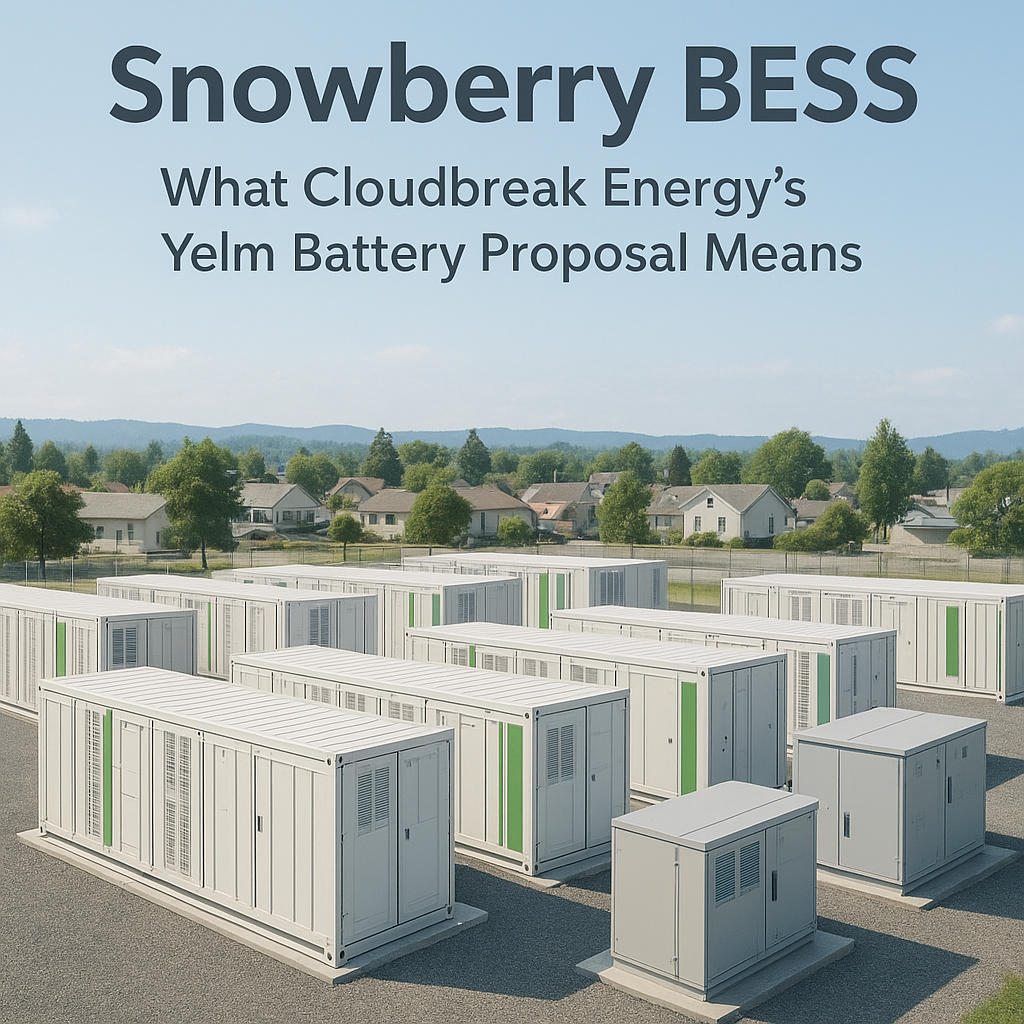
Snowberry BESS: What Cloudbreak Energy’s Yelm Battery Proposal Means
Cloudbreak Energy has proposed an 8.7-megawatt battery energy storage system near Yelm, Washington, called Snowberry BESS. The plan is at an early review stage: a county pre-submission conference is meant to surface requirements, not approve construction, and key details such as storage duration and final permits have not been reported.
Key Takeaways- Snowberry BESS is proposed at 13742 Vail Road in Thurston County.
- The proposal describes a standalone, lithium iron phosphate battery system rated at 8.7 megawatts AC.
- It is intended to connect to Puget Sound Energy’s distribution system through the Longmire substation and LON-26 feeder.
- A pre-submission conference is an early planning step, not a land-use approval or construction permit.
- The project’s storage duration, site design, safety plan, cost, construction schedule, and current application status have not been reported.
The announcement places Snowberry among several battery-storage proposals in Thurston County, but it does not establish that any of them have been approved or built. That distinction matters. A project narrative can describe what a developer hopes to build; it cannot answer whether a proposal meets county requirements, whether the utility can connect it, or whether construction will follow. I see the most useful question as a practical one: what can the public verify now, and what remains an open question?
The county notice identifies a conference date of Nov. 19 but does not state the year in the information available here. That missing year makes it unwise to describe the meeting as upcoming or to assume it has already taken place. For the same reason, the project’s present permitting status should be checked against county records rather than inferred from the conference notice. Frankly, these are not minor details; they set the limits of what can responsibly be said about Snowberry today.
What Is Snowberry BESS?
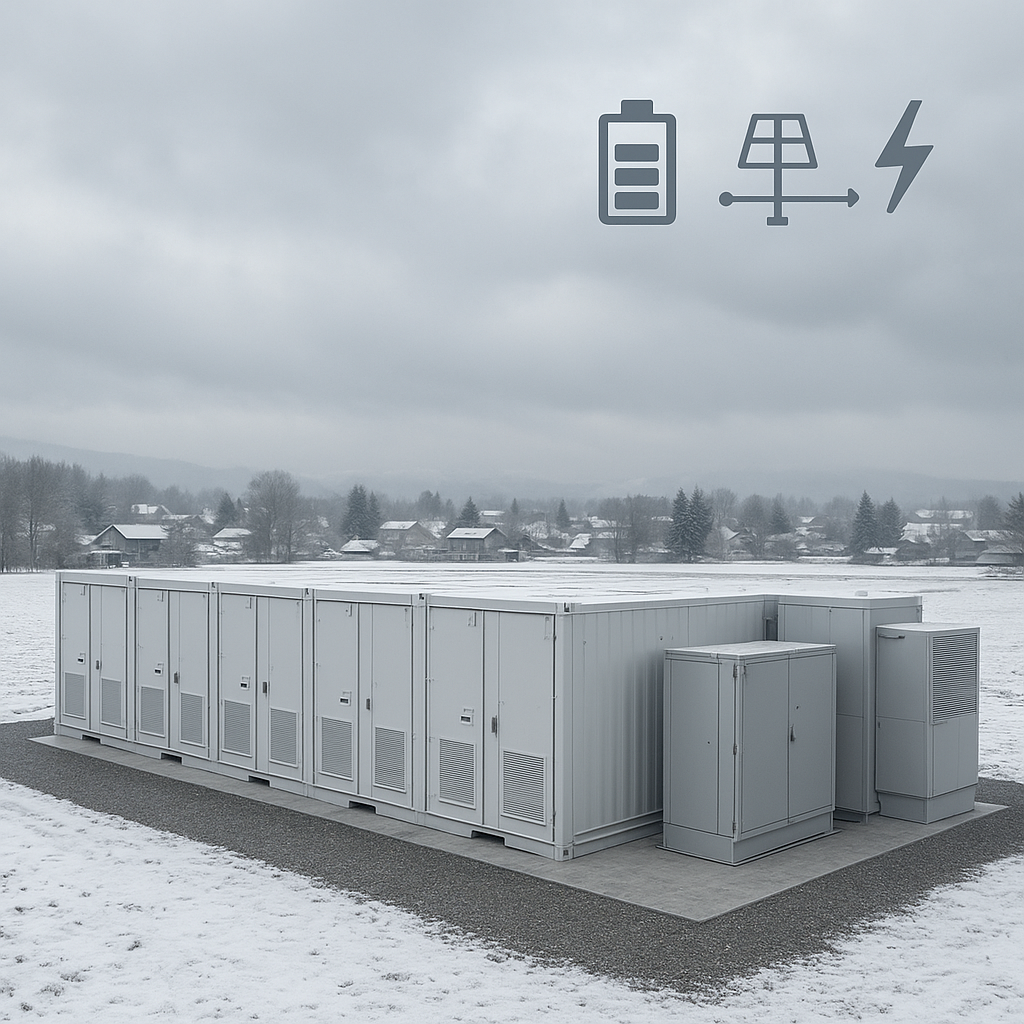
Snowberry BESS is the name given to Cloudbreak Energy’s proposed battery energy storage system at 13742 Vail Road, near Yelm in Thurston County. BESS stands for battery energy storage system. In plain terms, a facility charges batteries with electricity and later sends electricity back to the grid, subject to its equipment, operating rules, and the needs of the power system. It stores electricity; it does not generate it in the way a solar array or wind turbine does.
The project narrative describes Snowberry as a standalone system using lithium iron phosphate batteries, often shortened to LFP. It gives the planned output rating as 8.7 megawatts of alternating current, or AC, and says the system is intended to connect to Puget Sound Energy’s distribution network through the Longmire substation along the LON-26 feeder. These are proposed specifications, not proof that the equipment has been ordered, the connection approved, or the facility built.
A megawatt rating measures power at a particular moment. It does not tell readers how much energy the batteries can hold or how long they could deliver electricity. That figure is generally expressed in megawatt-hours, or MWh. An 8.7 MW system might operate for different durations depending on its energy capacity and operating limits, so the missing MWh figure prevents a clear description of how many hours Snowberry could discharge at full power. That is the kicker: a power rating alone is not a full picture of a battery project.
The distinction also shapes claims about local benefits. A battery may help shift electricity from one time of day to another, respond to grid needs, or support a constrained part of a network, but those outcomes depend on dispatch rules, interconnection studies, contracts, and operating conditions. The proposal links Snowberry to Puget Sound Energy’s 2025 Distributed Solar and Storage Request for Proposals and says the solicitation seeks strategically located resources with system-wide and local grid benefits. The stated connection to a solicitation is not, by itself, evidence of a signed contract or a guaranteed operating role.
For general background, the U.S. Department of Energy explains energy storage technologies and their uses on its energy storage resource page. Puget Sound Energy’s official site is the place to look for utility information and project announcements. Those broad resources can explain the technology and utility context; they do not settle Snowberry’s local approvals.
Core Details and Context
The known project facts are limited but useful. Cloudbreak Energy is the business proposing the system; the site address is 13742 Vail Road; the project name is Snowberry BESS; the stated AC output is 8.7 MW; and the technology is lithium iron phosphate. The narrative also identifies the Longmire substation and LON-26 feeder as the planned route into Puget Sound Energy’s distribution system. Each item describes the proposal, not a final county or utility decision.
The location of a grid connection matters because batteries are not interchangeable blocks that can be placed anywhere without consequence. A utility must assess how a proposed resource would affect the network and what upgrades, controls, or operating limits may be needed. A feeder name tells the public where the developer hopes to connect; it does not show that the feeder has available capacity or that the utility has completed its review. No interconnection study result is reported in the project description.
The project is described as part of Puget Sound Energy’s 2025 Distributed Solar and Storage Request for Proposals. The stated aim of the solicitation is to find distributed resources that can offer both wider grid value and localized benefits. The proposal does not report whether Snowberry was selected, what its contract terms might be, or how its output would be dispatched. Those unknowns matter to ratepayers and neighbors alike. A procurement process can be a route toward a project, but it is not a substitute for a permit or a public explanation of site impacts.
Several practical details are not reported: the battery’s energy capacity in MWh; the number and arrangement of battery containers; the project footprint; fencing and lighting; stormwater plans; construction traffic; noise estimates; fire protection and emergency access; decommissioning arrangements; and a construction or operating schedule. None should be guessed from the 8.7 MW figure. County review documents, if filed, are where these topics can be assessed against actual plans rather than an outline.
Battery chemistry also deserves precision. Lithium iron phosphate is a lithium-ion chemistry. Naming the chemistry does not establish the safety performance of a specific installation, nor does it tell the public what safeguards are planned. A responsible review would look for equipment standards, spacing, monitoring, emergency shutdown procedures, fire-service coordination, access routes, and a clear response plan. The U.S. Environmental Protection Agency’s guidance on used lithium-ion batteries addresses handling and disposal, a different issue from siting a utility-scale facility, but it reinforces why battery lifecycle management should not be an afterthought.
There is a larger public-interest question here. Grid projects can serve the common good when their benefits are real, their costs are accounted for, and risks are managed openly. That is not a claim that Snowberry has failed or succeeded on those measures; the reported information is too thin to decide. It is a reason to ask for clear records and for a fair account of who gains, who pays, and who carries the burden if something goes wrong.
Timeline: What Has Happened and What Comes Next
- Cloudbreak Energy develops the proposal. The company’s project narrative describes a standalone 8.7 MW AC lithium iron phosphate battery facility. The information available does not give a date for when the proposal was first prepared, and it does not say whether all design details are final. Treat the narrative as a description of the concept, not a finished construction package.
- The project is associated with a utility solicitation. The narrative says Snowberry is being advanced as part of Puget Sound Energy’s 2025 Distributed Solar and Storage Request for Proposals. It says the solicitation seeks distributed resources that can provide system-wide and local grid benefits. It does not report a selection decision, contract award, or final interconnection approval. I would not turn a stated procurement link into a claim that the project is already secured.
- Thurston County schedules a pre-submission conference. County Community Planning & Economic Development announced a conference for Nov. 19, where representatives of the business were expected to present the concept and receive feedback about what would be required if the project moved forward. The year is not stated in the information summarized here. That means the meeting’s timing and outcome should not be assumed.
- A proposal may then proceed through later review. A pre-submission meeting can help identify application requirements, but it is not itself a permit hearing or an approval. If the developer files formal applications, county staff would review the materials under the applicable local processes. The exact permits, studies, and public-comment opportunities for Snowberry are not reported, so readers should consult the project’s county file rather than assume a standard path applies in every detail.
- Utility review and local land-use review answer different questions. The county considers land use and other matters within its authority; the utility evaluates the proposed connection to its system. A project can face requirements from both tracks. A county planning discussion does not certify the electrical interconnection, and a utility interest does not settle local land-use questions. I have covered enough infrastructure proposals to know that the two processes are often blurred in public discussion. They should not be.
- The next verifiable milestones are not reported. There is no reported final permit, construction start, operating date, or confirmed application outcome in the available description. The sensible next step for residents is to check Thurston County’s Community Planning & Economic Development information and ask whether a project file or later notice has been posted. That is more reliable than treating a planning conference as a green light.
Comparison: Snowberry BESS and Other Thurston County Proposals
The closest comparison identified in county-area reporting is the Silver Springs 4 Megawatt Solar and Battery Project, proposed at 13835 Military Road SE. The two proposals are not identical. Snowberry is described as a standalone battery installation with a stated 8.7 MW AC rating, while Silver Springs is identified as a solar and battery project with a 4 MW figure. The available information does not clarify whether the 4 MW figure refers to the solar portion, the battery, or a project-wide rating, so a direct capacity ranking would be shaky.
| Measure | Snowberry BESS | Silver Springs project |
|---|
| Proponent | Cloudbreak Energy | Not identified in the information summarized here |
| Reported location | 13742 Vail Road, near Yelm | 13835 Military Road SE |
| Project description | Standalone lithium iron phosphate BESS | Solar and battery project |
| Reported rating | 8.7 MW AC | 4 MW, with the rating basis not specified here |
| Grid connection | Longmire substation, LON-26 feeder, per project narrative | Not reported here |
| Review status | Pre-submission conference announced; later status not reported | Recently proposed, according to local reporting |
| Energy capacity and duration | Not reported | Not reported |
A megawatt comparison is only meaningful when the figures measure the same thing. Snowberry’s description explicitly gives an AC rating for the battery system; the Silver Springs summary calls it a 4 MW solar and battery project without clarifying the component ratings. Comparing 8.7 to 4 as if one were automatically more than twice the other would give readers false precision. The energy capacity, measured in MWh, is not stated for either project in the information available here.
Two other proposals add context, but not a clean numerical comparison. A project in the Rochester area was proposed and later withdrawn, while a similar project was proposed near Bucoda, according to The Olympian’s reporting. Their names, capacities, technical details, and current statuses are not included here. A withdrawn proposal is not evidence that all battery projects will be withdrawn; a proposal in another community is not proof that it will be approved. Each site and application must stand on its own record.
So the projects are better understood as a cluster of planning activity than as a contest. Whether Snowberry is larger, more useful, or more suitable cannot be decided from the figures supplied. The hard questions are site-specific: what is the actual energy capacity, what grid need is being addressed, what conditions would apply, and how will impacts be monitored? Numbers matter, but only when their labels are clear.
Common Misconceptions and What to Know
A pre-submission conference does not mean the county approved the project. It is an early discussion about what may be expected if a proposal advances. The conference may help the applicant understand process requirements, but the announcement does not report a permit decision. Residents should distinguish between a meeting, a filed application, a staff recommendation, and a final approval. They are different steps, and calling them all approval would confuse rather than inform.
An 8.7 MW rating does not mean 8.7 MWh of storage. Power and stored energy are different measurements. MW describes the rate at which a system can charge or discharge; MWh describes the amount of energy it can store or deliver over time. Without the MWh rating and operating duration, the public cannot tell how long Snowberry could run at its full stated power. That gap is not a technical footnote; it is central to understanding the facility’s role.
A battery project does not generate electricity by itself. It stores electricity supplied from the grid or another energy source and releases it later, subject to system design and operating instructions. That shifting function can be useful when the timing of supply and demand does not match. But the specific source of charging electricity and the project’s dispatch schedule are not reported for Snowberry. It is not sound to claim, based on the proposal alone, that the project will always charge from renewable sources or deliver power at particular peak hours.
A utility solicitation is not the same as a completed contract. The project narrative links Snowberry to Puget Sound Energy’s 2025 solicitation. That tells readers how the developer says the proposal is being advanced; it does not reveal whether the utility selected it, negotiated a contract, or accepted a final interconnection design. Those distinctions matter because a project’s commercial status and its local permitting status can move on separate tracks.
A familiar battery chemistry does not answer every safety question. LFP is a lithium-ion chemistry, but the chemistry name alone does not reveal equipment quality, installation design, fire controls, maintenance practices, or emergency planning. It also does not justify alarmist predictions. The sensible position is neither nothing to see here nor disaster is inevitable. Ask for project-specific safety documents, clear contact procedures, and coordination with local responders, then assess the evidence.
Several proposals do not prove a county-wide trend by themselves. Snowberry is at least the fourth battery-storage proposal mentioned in the available account, alongside Silver Springs, the withdrawn Rochester proposal, and the Bucoda proposal. That is evidence of multiple proposals being discussed, not proof that all will be constructed or that they share one design. A proposal count is a starting point for public questions, not a substitute for a complete record.
Finally, the public should not have to choose between reliable electricity and responsible land use as if those aims were enemies. A fair review can ask whether the project offers a documented grid benefit, whether safety and environmental obligations are funded, and whether nearby residents receive timely, plain-language information. Stewardship means treating the site, the grid, and the people who live nearby as real responsibilities—not as boxes to tick after the business case is made.
Frequently Asked Questions
What is the proposed Snowberry BESS project?
Snowberry BESS is Cloudbreak Energy’s proposed standalone battery energy storage system at 13742 Vail Road near Yelm. The project narrative describes lithium iron phosphate batteries with an 8.7 MW AC rating and a planned connection to Puget Sound Energy through the Longmire substation and LON-26 feeder. The project’s energy capacity in MWh and discharge duration have not been reported in the information summarized here.
Has Thurston County approved Snowberry BESS?
No approval is reported. The county announced a pre-submission conference, a planning discussion intended to provide feedback on requirements if the project advances. A conference is not a final land-use decision or a construction permit. The current application and permitting status should be confirmed in county records because it is not established by the conference announcement alone.
How is Snowberry different from the Silver Springs project?
Snowberry is described as a standalone battery project rated at 8.7 MW AC. Silver Springs is described as a 4 MW solar and battery project at 13835 Military Road SE, but the information here does not identify what component the 4 MW figure measures. Their storage capacities, durations, and grid connections are not reported, so the two figures should not be treated as a precise apples-to-apples comparison.
What information should residents look for next?
Look for a formal county application and site plans, the project’s MWh capacity and operating duration, utility interconnection findings, emergency-response and fire-safety plans, traffic and noise information, stormwater measures, and proposed operating and decommissioning arrangements. Ask whether the developer has been selected through the utility solicitation and what that selection means. Where a fact is not in a public record, it should remain an open question—not a confident claim.
Final Thought
Snowberry BESS is a concrete proposal with a named developer, an address, a stated battery chemistry, a power rating, and a proposed utility connection. Those facts are enough to explain what Cloudbreak Energy says it wants to build. They are not enough to judge whether the site is suitable, whether the grid can accept the project without changes, how long it could deliver electricity, or what safeguards and obligations would apply.
That is where careful reporting is more useful than either boosterism or reflexive opposition. A battery can help a power system shift electricity across time, but a local project still needs a clear account of its costs, benefits, and risks. The county’s planning process, the utility’s interconnection review, and any future public documents should be treated as separate pieces of evidence. Residents deserve to know what is proposed, what remains undecided, and when they can weigh in.
For now, the best conclusion is also the least dramatic: Snowberry is a proposal, not a finished facility. Watch for the formal record, especially details on energy capacity, safety, land use, and the utility’s decision. If those documents show a sound project with enforceable protections and a real public benefit, the case can be assessed on its merits. If key facts remain missing, the right response is to ask for them. Good stewardship begins with clear information.
FAQPage Schema