Tacoma Card Shop Burglary: Sealed Pokémon and Magic Cards Stolen
Burglars rammed a Tacoma card shop’s warehouse door with a pickup truck early Monday, then took sealed Pokémon and Magic: The Gathering cards. Owner Don Knutsen says it was the third time his business had been hit by crime in recent months, and the shop is offering $5,000 for information leading to an arrest.
This is more than a story about collectible cards disappearing from a storeroom. It is a direct hit on a nearly 40-year business, where inventory, repairs, lost sales, and the strain on a family all compound the damage. The account does not give the exact calendar date, the value of the stolen stock, a police case number, or details about arrests. Those gaps matter: a reported estimate of replacement costs should not be mistaken for a confirmed theft total, and a possible connection between two crimes is not proof that the same people committed both.
The market figure deserves similar care. Card Ladder was cited as reporting Pokémon card values up more than 145% as of April compared with the prior year, but the report does not specify which cards, how the figure was calculated, or whether the stolen products would sell for that amount. The percentage supplies context—not a receipt for this burglary.
What Happened at the Tacoma Card Shop?
Northwest Sportscards, owned by Don Knutsen, was burglarized early Monday morning when a black Dodge pickup was used to break through a rear warehouse door. Surveillance footage reportedly shows the burglars moving into the warehouse and loading about eight large totes with sealed boxes of Pokémon and Magic: The Gathering cards. The account does not state the exact number of boxes, the specific sets involved, or the value of the goods taken.
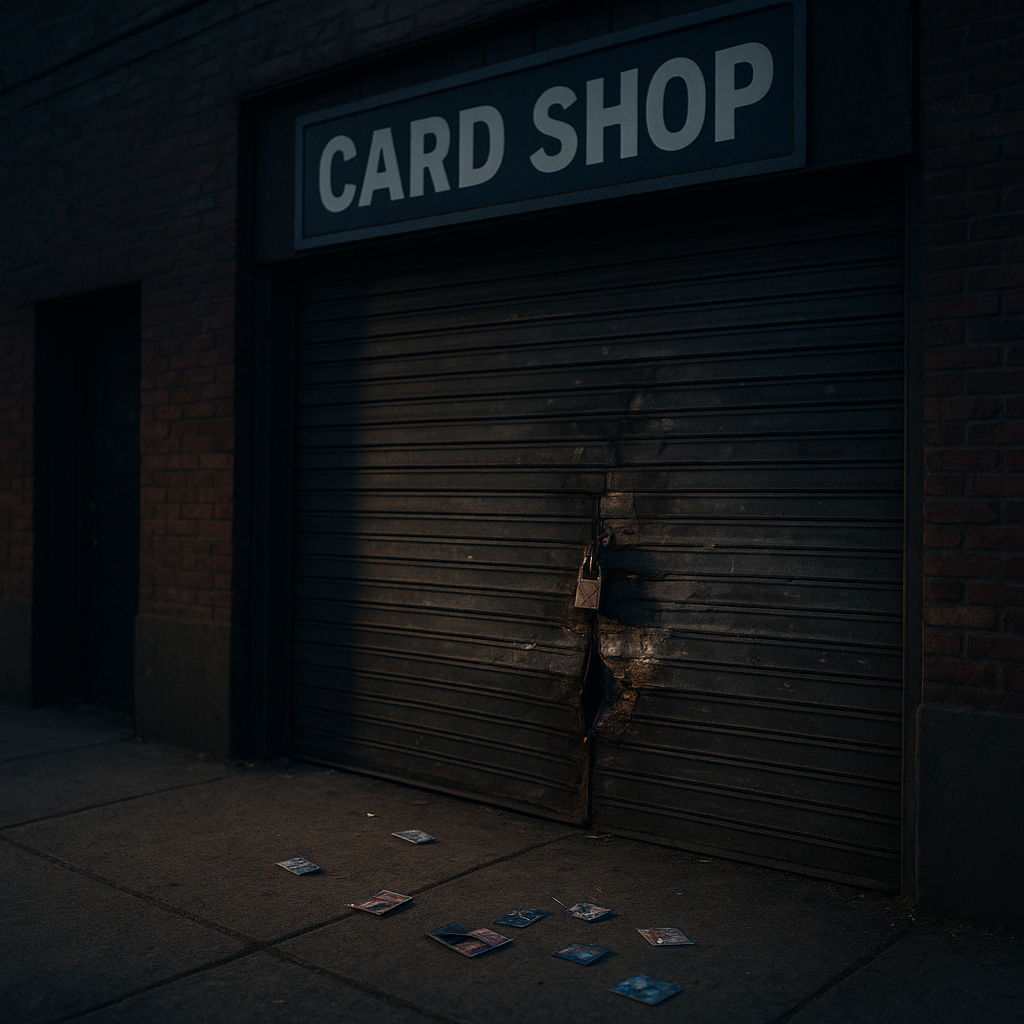
Knutsen said this was the third time the shop had been hit by crime in the past few months, with the incidents beginning in July. Tacoma police said the July burglary and Monday’s break-in are likely connected. That is a working investigative assessment, not a public finding that the same suspects committed every incident. The details of the other reported crime or crimes were not provided, so they should not be merged into a single, fully documented sequence.
The owner’s reaction was blunt. Watching the footage, he said, “Oh no, not again.” He described feeling devastated and violated. Those words make sense in a business where merchandise represents not only stock on shelves but also money already invested, planned sales, and the work required to replace what vanished.
The reported financial impact has two parts. Knutsen said replacing products and repairing doors, windows, or display cases could cost many tens of thousands of dollars. He also emphasized the sales the shop now cannot make from the stolen stock. The available account does not break out those expenses, provide an insurance figure, or say how much merchandise was recovered. The distinction is important: “many tens of thousands” describes the owner’s estimate of replacement and repair pressure, not a precise theft valuation.
The shop is offering a $5,000 reward for information leading to an arrest. Anyone with information is asked to contact the Tacoma Police Department; the reward inquiry can be sent to northwestSportscards@yahoo.com. A reward is an appeal for useful leads, not proof that a suspect has been identified or that an arrest is imminent.
The Business Cost Goes Beyond Stolen Inventory
A burglary removes goods, but the bill does not stop at the empty shelves. A business may have to secure a damaged entrance, repair fixtures, check remaining stock, document losses, coordinate with police and insurers, and adjust orders. In this case, Knutsen specifically cited product replacement and repairs to doors, windows, or display cases. The remaining operational details—including whether the shop closed, how long repairs might take, and whether insurance applies—were not reported.
Lost sales are a separate burden. A sealed box that is gone cannot be sold to a customer, and the expected revenue from it cannot simply be recovered by repairing a door. Knutsen said the shop must sell many times more to break even after a theft. That is his description of the squeeze his business faces; no accounting statement or margin data was provided to calculate the exact sales needed.
Frankly, this is why a theft’s retail price is not the whole story. Inventory may have been purchased earlier, and a replacement order may require additional cash before it can generate revenue. Meanwhile, repair work and administrative tasks take time away from serving customers. Those are ordinary business pressures, not confirmed line items for Northwest Sportscards; the owner’s own comments establish that replacement, repairs, and lost sales are concerns here.
Knutsen said the losses are tough on his family. That detail should not be treated as decorative color. A long-running shop can be a livelihood built through decades of work, and repeated crime threatens both the business and the people who depend on it. Respect for the dignity of work means taking that impact seriously without pretending that every financial consequence has already been measured.
There is also a practical limit to what a small retailer can absorb. The incident account offers no information on the shop’s cash reserves, insurance coverage, borrowing, or current operating hours. Without those facts, outsiders cannot responsibly pronounce the business doomed—or claim that recovery will be easy. The honest point is narrower: Knutsen says the combined losses and repair costs are substantial, and the theft creates a sales hole on top of physical damage.

Timeline: What Is Known, and What Is Not
- July: Crime at the business begins. Knutsen said the recent run of incidents began in July. The account does not identify the exact July date, describe that burglary in detail, or say whether it involved the same method or stolen goods.
- Following months: Further trouble is reported. Knutsen characterized the latest burglary as the third time the business had been hit by crime in the past few months. Details about the intervening incident are not reported. That limits what can be said about a pattern beyond the owner’s count of repeated incidents.
- Early Monday: The warehouse is breached. Surveillance footage reportedly shows a black Dodge pickup being used to smash through the rear warehouse door. The burglars then took about eight large totes containing sealed trading-card boxes. The exact calendar date and time are not stated.
- After the break-in: The losses become clear. Knutsen described the cost of product replacement and repairs as many tens of thousands of dollars, while also warning that lost sales deepen the impact. No itemized inventory or final loss assessment was reported.
- Police assess a possible connection. Tacoma police said the July burglary and Monday’s incident are likely connected. “Likely connected” describes the police view reported at this stage; it does not establish the identities of the people involved or confirm that all three incidents share suspects.
- A reward is offered as the investigation continues. Northwest Sportscards is offering $5,000 for information leading to an arrest. Knutsen said he trusts investigators to identify those responsible. The account does not report an arrest, a suspect description, a license-plate number, or a public police case reference.
The sequence is plain enough to follow, but it is not complete. I would not fill the missing dates or investigative details with guesses, because a tidy timeline is not worth a false one. The known facts establish a break-in, stolen sealed merchandise, physical damage, a reported reward, and a possible link to a July burglary. They do not establish who did it, how the truck was obtained, whether the merchandise has been resold, or whether the third reported incident is part of the same police investigation.
For anyone passing information to police, concrete details are more useful than speculation: observations about a vehicle, people, timing, or attempts to sell identifiable stock may help investigators assess a lead. That is general common sense, not a police instruction about evidence handling. Anyone with information should use the department’s official contact channels rather than circulate unverified accusations online.
Comparison: Pokémon and Magic Cards in the Reported Theft
The closest comparison available here is between the two product lines named in the burglary account: Pokémon and Magic: The Gathering. They are not interchangeable products, and the available information does not provide a brand-by-brand count or loss estimate. The comparison below sticks to what was reported and marks the missing data plainly.
| Measure | Pokémon cards | Magic: The Gathering cards |
|---|
| Included in the reported theft | Yes; sealed boxes were taken | Yes; sealed boxes were taken |
| Number of boxes stolen | Not reported separately | Not reported separately |
| Specific sets or editions | Not reported | Not reported |
| Value of stolen stock | Not reported by product line | Not reported by product line |
| Market figure cited | Card Ladder was cited as reporting values up more than 145% as of April year over year | No comparable figure was reported |
| What the figure establishes | A broad market statistic as described in the account; it does not price the stolen boxes | No market movement can be inferred from the account |
The difference in available market data should not be mistaken for a difference in the amount stolen. The report mentions a Pokémon value trend but gives no matching Magic figure; that is a gap in the information, not evidence that one line made up most of the loss. The stolen inventory’s exact mix remains unknown.
The Card Ladder figure also needs a boundary around it. The reported rise of more than 145% is described as a year-over-year increase as of April, but the account does not identify the index, card sample, condition grades, or individual products behind that number. It cannot tell readers what a specific sealed box at Northwest Sportscards was worth, or what a buyer might pay for it after a theft.
Likewise, the fact that both brands appear in the same burglary does not show that the products have the same audience, resale behavior, supply, or price history. Official product information is available from the Pokémon Trading Card Game and Magic: The Gathering, but those pages do not verify the stolen inventory or quantify the loss. The useful comparison is modest: both named categories were reportedly taken in sealed form, while the account supplies a market statistic only for Pokémon.
Here’s the kicker: a high market-wide percentage can make a headline sound more precise than it is. It may help explain why certain collectible products attract attention, but it does not establish motive, identify a buyer, or prove that this specific burglary was driven by a price spike. Police have not publicly attributed a motive in the account. Treating a market trend as an explanation for a particular crime would be speculation.
Common Misconceptions: What Readers Should Keep Straight
A reported market increase does not equal the value of the stolen goods. Card Ladder’s cited figure concerns Pokémon card values, reported as up more than 145% by April compared with the prior year. The account does not say that every Pokémon product rose by that amount, or that the sealed boxes taken from this shop belonged to the rising segment. No inventory list, valuation, or sale price is supplied. A broad index cannot replace a product-by-product assessment.
“Likely connected” is not the same as “solved.” Tacoma police reportedly see a likely connection between the July burglary and Monday’s break-in. That is meaningful investigative context, but it does not disclose a suspect, establish guilt, or confirm that every crime Knutsen counted has the same perpetrators. Public language matters. Calling the incidents definitively linked would go further than the police statement reported here.
The owner’s estimate is not a final accounting. Knutsen said replacement merchandise and repairs could cost many tens of thousands of dollars. He also described the lost-sales burden. No final total was reported, and the two kinds of loss should not be collapsed into one number. The value of missing inventory, the cost of repairs, lost revenue, and any eventual insurance payment are separate questions.
The reward is not evidence of an arrest. The shop is offering $5,000 for information leading to an arrest. That does not mean police have accepted a particular tip, publicly named a suspect, or promised that the reward will be paid for every piece of information. The stated condition is information leading to an arrest.
Repeated victimization does not justify blame. The owner says the business has been hit three times in a few months. That fact does not show what security was in place, whether earlier incidents were reported, or what changes the shop can afford. It is easy to demand that a business owner install every possible measure from the comfort of a comment section. The more useful questions are what investigators can establish and what practical steps can reduce exposure without assuming the shop caused the crime.
A dramatic video is not the full investigation. Footage reportedly shows a vehicle breaking through a door and people loading totes. The available account does not say whether video captured faces, a readable plate, the full approach, or the getaway. Surveillance can provide evidence, but the details available to viewers may be incomplete. Publicly identifying someone from partial footage would be reckless.
The underlying standard is simple: separate confirmed statements, reported observations, and guesses. That discipline is not timid; it protects the investigation and keeps attention on the people whose work and property were targeted. It also serves the common good by resisting rumor when the facts remain incomplete.
Frequently Asked Questions
What was stolen from Northwest Sportscards?
The burglars reportedly took sealed boxes of Pokémon and Magic: The Gathering cards, loading them into about eight large totes. The number of boxes, specific products, and product-by-product value were not reported.
How much is the shop offering as a reward?
Northwest Sportscards is offering $5,000 for information leading to an arrest. The reward inquiry email provided by the shop is northwestSportscards@yahoo.com. People with information are also asked to contact Tacoma police through the department’s official channels.
Did Tacoma police confirm the same people committed both burglaries?
No. Police said the July burglary and Monday’s break-in are likely connected. The account does not report an arrest or identify suspects, and it does not establish that all three incidents mentioned by Knutsen involved the same people.
How much did the burglary cost the business?
An exact total was not reported. Knutsen said replacing products and repairing doors, windows, or display cases could cost many tens of thousands of dollars, and he said lost sales add to the harm. The account does not provide an itemized loss, insurance figure, or final repair estimate.
The unanswered questions are not minor details. They are the difference between a useful account of a crime and a confident story built on assumptions. Readers can recognize the scale of the owner’s burden while still insisting on careful language about value, motive, and responsibility.
A nearly 40-year business should not have to rebuild the same sense of security repeatedly. Knutsen’s comments make clear that the latest break-in is felt as more than a repair bill: it is a violation, a hit to inventory, and a demand for future sales just to recover ground. His hope that detectives will find those responsible is understandable, but hope is not evidence, and an investigation deserves room to establish what happened.
The practical questions now belong to investigators and the people who may have useful information. The public can help by sharing concrete observations with police, not by naming suspects online or guessing at the value of merchandise. The $5,000 reward gives the community a direct reason to pass along a credible lead, while the business faces the slower work of repairs, replacement orders, and lost revenue.
There is no need to inflate the story to see its stakes. The reported facts are stark enough: a truck forced entry, sealed cards disappeared, damage and lost sales now weigh on a family business, and authorities see a possible link to an earlier burglary. Fair dealing begins with accurate facts—and with recognizing that the cost of crime lands on real people who have spent years building a livelihood.