Thanksgiving 2026: Turkey Leads the Menu as Stormy Weather Hits Western Washington
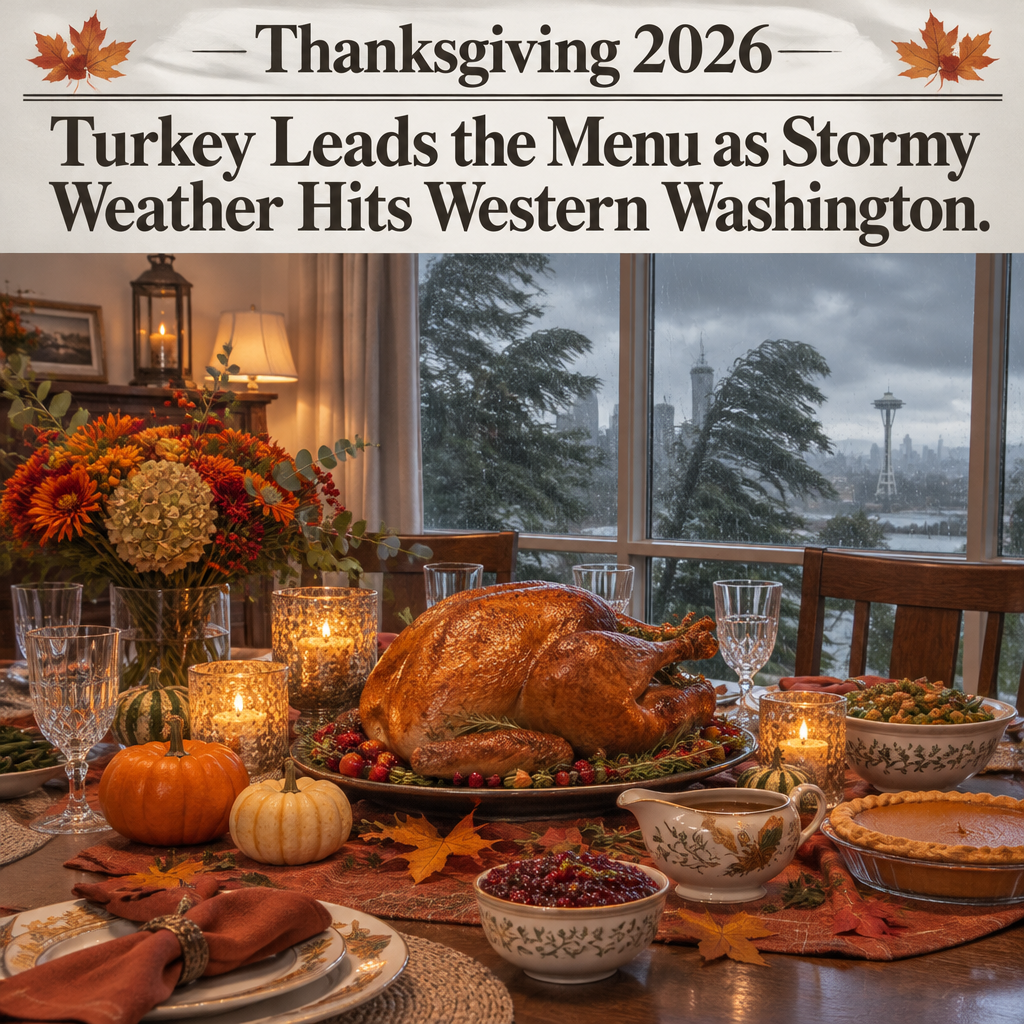
Thanksgiving 2026 brings two practical concerns to the table: what families plan to eat and how Western Washington’s wet, windy holiday morning affects their plans. A November YouGov survey found that 82% of respondents expected to eat turkey. Meanwhile, the region was beginning Thursday under stormy skies, with conditions expected to ease later.
The holiday still has a familiar center: a shared meal, often built around dishes people know by heart. But no single menu fits every home. Some people expect a traditional roast turkey dinner; others bring regional foods, cultural practices, and recipes passed between generations. The survey offers a snapshot of plans, not a rulebook for the table.
That distinction matters on a day when the forecast can shape everything from the drive to a relative’s home to whether dinner is cooked on schedule. The storm brought heavy rain, strong winds, powerful waves, and blackouts to parts of Western Washington overnight, according to the local report. Waldenberger’s forecast called for gradual improvement through the afternoon, with more breaks in the rain and a chance of sunshine. A better afternoon was possible, not promised.
What Is Thanksgiving 2026?
Thanksgiving in the United States is a yearly holiday centered on gratitude, gathering, and a shared meal. In 2026, it falls on Thursday, November 26. For many households, the table is part of the tradition, but the precise menu changes with family history, region, culture, budget, and personal taste. Turkey is common; it is not a test of whether anyone is celebrating correctly.
The YouGov figures reported for this year offer a useful measure of what respondents planned to eat. Turkey led at 82%, while mashed potatoes reached 74%. Pie, stuffing, and dinner rolls were also among the most frequently expected dishes, although the reported figures do not give percentages for those foods. The numbers point to familiar favorites without proving that every household will serve them.
I read the turkey figure as an indicator of intention, not a count of meals actually served. Survey percentages describe the people who answered a particular question, at a particular time, using particular wording; they do not establish what every American will eat. The report does not provide enough methodological detail to assess sample size, question wording, or the margin of error. That is a reason for restraint, not a reason to dismiss the finding.
The menu is also more flexible than the headline number suggests. A family might serve turkey alongside several dishes, choose a different main course, or share a meal that does not resemble the standard holiday spread. For someone working a shift, traveling, living alone, or dealing with tight finances, the day may look different again. The common thread is the act of making room for other people, not a mandatory bird.
Frankly, food surveys can make a holiday sound like a popularity contest. They are more useful as a look at shared habits. Turkey’s lead shows that it remains a strong tradition; it does not make mashed potatoes, a family’s own recipe, or a simple meal any less part of Thanksgiving.
Core Details: The Menu, the Storm, and Safe Cooking
Three facts define the day’s practical picture: what respondents plan to eat, how the weather is expected to change, and how safely the meal is prepared. They are related, but they are not the same story. A poll cannot forecast rain, and a forecast cannot tell a household what belongs on its table.
The food figures have a clear order. Turkey was at 82%, mashed potatoes at 74%, and pie, stuffing, and dinner rolls were also described as common choices. The eight-point gap between turkey and mashed potatoes says the bird is more widely planned in that survey. It does not mean the two foods compete for the same place in a meal; many people serve both.
The weather was less settled. Western Washington had a wet and windy start after overnight storm impacts that included heavy rain, strong winds, powerful waves, and blackouts in parts of the region. KOMO News Meteorologist George Waldenberger said the worst of the storm had passed by Thursday morning. His outlook still included scattered downpours, isolated thunder, and gusty winds through the morning, followed by a gradual improvement and more rain breaks later in the day.
That forecast carried a useful distinction: improving conditions do not mean dry roads or calm weather everywhere. Rain can persist in one area while another gets a break. For anyone making a drive, the wise response is to check current local conditions before leaving and allow extra time rather than treating a morning forecast as a guarantee for the whole region. The National Weather Service offers general advice on wind safety and flood safety; those pages are guidance, not a substitute for local alerts.
A storm can also complicate meal preparation. If a household loses power, it should avoid assuming that food is safe or unsafe based on appearance or smell. Keep refrigerator and freezer doors closed as much as practical, then consult official food-safety instructions about the length of the outage and the food involved. When uncertainty remains, protecting people is more important than salvaging a dish.
For the turkey itself, the USDA sets a minimum internal temperature of 165°F. Measure with a food thermometer at the thickest part of the breast and the innermost portions of the thigh and wing. A browned exterior, a particular cooking time, or a family member’s confidence is not a substitute for a temperature reading. The USDA’s turkey preparation guidance explains safe handling and checking multiple locations.
The department recommends cooking stuffing separately because it makes it easier to ensure the turkey and the stuffing each reach a safe temperature. Stuffing cooked inside the bird can be safe if the center also reaches 165°F, but that takes a separate check. Food safety guidance is not fussiness. It is basic care for guests, especially children, older adults, pregnant people, and anyone with a weakened immune system.
After dinner, timing matters again. The USDA advises refrigerating leftovers within two hours and eating refrigerated leftovers within three to four days. The USDA leftovers guidance explains the basic window. Divide large amounts into shallow containers so they cool more readily, and do not leave a crowded platter on the counter while the gathering drifts into the evening.
Timeline: What Happened and What Families Should Watch
- Overnight: the storm moves through. Heavy rain and strong winds affected Western Washington, with powerful waves and blackouts reported in parts of the region. The account does not specify every affected location or the duration of each outage, so there is no basis for claiming that conditions were the same across the whole area.
- Thursday morning: the worst is reported to have passed. Waldenberger said the strongest part of the storm was over by morning, but scattered downpours, isolated thunder, and gusty winds remained possible. That is a more careful description than saying the storm had ended. People heading out still had reason to monitor conditions and take care around water or downed hazards.
- Through the afternoon: gradual improvement is forecast. The outlook called for more breaks in the rain and possible sunshine as families gathered. Forecasts give people a planning window; they do not guarantee that every neighborhood gets the same weather. If plans depend on a drive, checking a current forecast close to departure is more useful than relying on a single morning update.
- Before the meal: handle the turkey safely. Thawing, preparation, and cooking all need attention. Follow USDA handling directions and use a food thermometer rather than judging doneness by color or elapsed time alone. If stuffing goes inside the turkey, check its center as well as the bird’s recommended locations. Cooking it separately is the simpler option.
- At serving time: make the meal work for the people present. Keep hot foods hot and avoid letting perishable dishes sit out for hours. A household does not need an elaborate spread to host well. Clear information about ingredients, enough time for guests to arrive, and a safe place to eat matter more than a picture-perfect table.
- Within two hours after the meal: refrigerate leftovers. Pack food into containers and get it into the refrigerator promptly. Then plan to eat refrigerated leftovers within three to four days, following USDA advice. If the power has gone out, do not guess about food safety; use official outage guidance and discard food when safety cannot be established.
When I analyze the sequence, the most useful point is that weather and cooking safety both reward modest preparation. A flexible travel plan helps with an unsettled forecast. A thermometer and a clear leftovers routine help with the meal. Neither requires alarm, and neither should be replaced by wishful thinking.
Comparison Table: Turkey and the Next Most-Reported Dish
The closest comparison available in the reported survey is turkey versus mashed potatoes, the next item with a percentage. They are not direct competitors: one is commonly served as the main dish and the other as a side. The comparison shows relative frequency in the poll, not a choice in which one food must replace the other.
| Thanksgiving food | Share planning to eat it | What the figure supports |
|---|
| Turkey | 82% | The leading reported choice in the November YouGov survey |
| Mashed potatoes | 74% | The next-highest percentage provided; eight points below turkey |
| Pie | Not reported | Identified as one of the common expected foods |
| Stuffing | Not reported | Identified as one of the common expected foods |
| Dinner rolls | Not reported | Identified as one of the common expected foods |
The eight-point difference is worth describing plainly and no more. It shows turkey ahead among these two reported items; without survey details, it does not establish a statistically meaningful difference. Nor does it tell us which dish respondents consider most important, which one they eat the most of, or whether they plan to make it themselves.
The missing percentages matter. Pie, stuffing, and rolls appear in the report as common foods, but assigning them numbers would create information that was not reported. A clean table should distinguish between a measured percentage and a qualitative description. Otherwise, a tidy-looking chart can smuggle in false precision.
The table also reveals the limits of a simple turkey-versus-alternative frame. Since many households serve multiple dishes, turkey and potatoes can both be expected on the same plate. A more useful question is not which food wins, but how families adapt a familiar pattern to their own needs. Some add a regional dish; some change the main course; some keep the meal small. All of those choices fit the broad idea of gathering.
Here’s the kicker: the survey’s strongest finding is not that every family agrees on dinner. It is that a large share still expects turkey to be there. The rest of the menu remains open, and the reported figures do not tell the full story of how people celebrate.

Common Misconceptions and What to Know
Misconception: the survey says 82% of Americans actually ate turkey. It does not. The reported figure concerns respondents who planned to eat turkey during the holiday meal. Plans can change, and a survey is not a final count of what appeared on plates. The number is useful as a measure of stated intention, not proof of completed behavior.
Misconception: turkey is the only traditional Thanksgiving main dish. The survey identifies it as the most widely planned dish among the foods listed, but families do not share a single menu. Regional specialties, cultural traditions, personal preferences, and practical limits all shape a meal. Calling one version standard should not turn it into a test for everyone else.
Misconception: if the storm’s worst has passed, travel is automatically safe. Waldenberger’s morning forecast still allowed for downpours, isolated thunder, and gusty winds. Conditions can vary across a broad region, and a break in the rain is not the same as a guarantee of dry roads. People should look at current local information and avoid unnecessary risk, particularly near floodwater or hazards created by wind.
The National Weather Service’s flood safety advice and wind safety advice can help people understand general hazards. They do not report the live condition of a specific road or neighborhood. Follow local emergency messages when they apply, and do not drive into floodwater. A calendar date does not make a dangerous route less dangerous.
Misconception: a turkey is safe once its skin looks done. Appearance cannot confirm that the deepest parts have reached a safe temperature. The USDA’s minimum is 165°F, checked in the thickest part of the breast and the innermost thigh and wing. A reliable food thermometer is the useful tool here. Cooking time charts can help with planning, but they cannot account perfectly for every bird, oven, or cooking method.
Misconception: stuffing inside the turkey is always unsafe—or automatically safe. The USDA says cooking stuffing separately is recommended to reduce foodborne illness risk. Stuffing prepared in the bird can be safe when it reaches 165°F in its center. That extra check can be inconvenient during a busy meal, which is one reason separate cooking is a straightforward choice.
Misconception: leftovers can wait until everyone has finished visiting. The recommended window is two hours before refrigeration, not whenever the kitchen is finally cleared. The USDA says refrigerated leftovers should be consumed within three to four days. The FoodSafety.gov temperature chart also provides minimum cooking temperatures for other foods, useful when the meal includes more than turkey.
There is also a quieter misconception: that hospitality depends on abundance. A full table can be generous, but generosity is not measured only in the number of dishes. A safe plate, a welcome seat, and respect for a guest’s needs reflect the more important part of the occasion. That is practical stewardship, not sentimentality.
Frequently Asked Questions
How many people planned to eat turkey at Thanksgiving in 2026?
A November YouGov survey cited in reporting found that 82% of respondents planned to eat turkey during the Thanksgiving meal. That is a reported intention, not a count of the meals Americans ultimately served. The report also placed mashed potatoes at 74% and described pie, stuffing, and dinner rolls as common choices, without giving percentages for those foods.
What was the Thanksgiving weather outlook for Western Washington?
Western Washington had a wet, windy start after an overnight storm brought heavy rain, strong winds, powerful waves, and blackouts to parts of the region. KOMO meteorologist George Waldenberger said the worst had passed by Thursday morning, while scattered downpours, isolated thunder, and gusty winds could continue through the morning. Conditions were expected to improve gradually in the afternoon, with more breaks in the rain and possible sunshine.
What temperature should turkey reach?
The USDA recommends an internal temperature of at least 165°F. Check the thickest part of the breast and the innermost portions of the thigh and wing with a food thermometer. If stuffing is cooked inside the turkey, its center also needs to reach 165°F. The USDA recommends cooking stuffing separately to reduce the risk of foodborne illness.
How long can Thanksgiving leftovers stay in the refrigerator?
Refrigerate leftovers within two hours after the meal, then consume refrigerated leftovers within three to four days, following USDA guidance. If a power outage affects a refrigerator, do not rely on smell or appearance to decide whether food is safe. Consult official food-safety guidance and discard food when its safety is uncertain.
Final Thought
Thanksgiving is often described through its familiar dishes, and the survey numbers confirm that turkey and mashed potatoes remain common plans. But the more useful reading is modest: traditions endure because people keep choosing them, while each household still decides what the day needs. A percentage cannot measure the meaning of a recipe carried across generations or the kindness of making room for someone who would otherwise eat alone.
The weather adds an unromantic reminder that plans meet real conditions. Western Washington’s forecast offered a rough morning followed by a chance of improvement, not a promise that every drive would be easy or every block would see sunshine. Paying attention to local updates, keeping travel flexible, and taking power interruptions seriously are ordinary acts of care. So is cooking poultry to a measured temperature and getting leftovers cold on time.
I see the day’s practical lesson in those small choices. Good hosting is not a performance staged around a perfect roast or a spotless forecast; it is a form of responsibility toward the people at the table. The meal can be traditional or improvised, large or spare. If it is shared safely and with respect for the people gathered, it has done the job that matters.