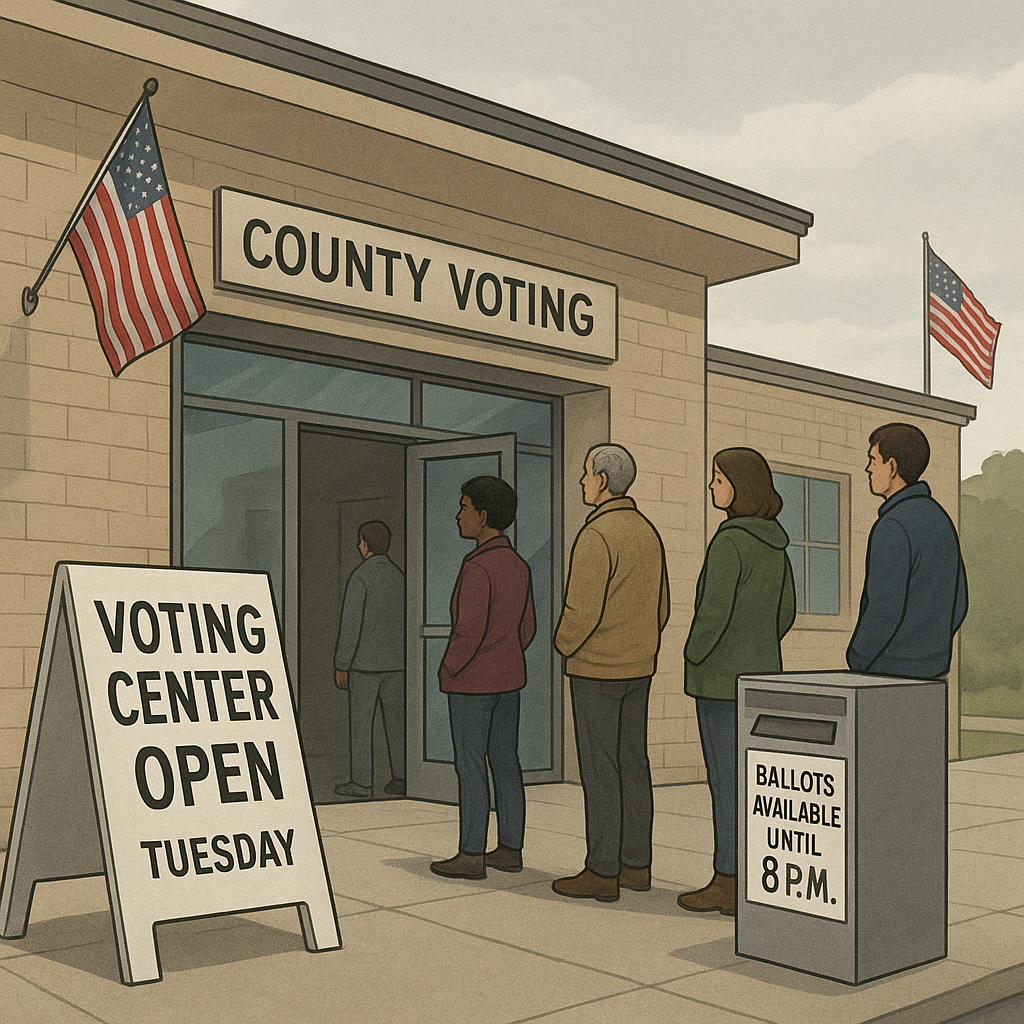
Two voting centers are open in Thurston County, and ballot boxes remain available until 8 p.m. Tuesday. That is the basic fact, and it matters because election...
Thurston County Voting Centers Open Tuesday as Ballot Boxes Stay Available Until 8 p.m.
Two voting centers are open in Thurston County, and ballot boxes remain available until 8 p.m. Tuesday. That is the basic fact, and it matters because election access is not a slogan but a process, one that depends on location, timing, clear rules, and voters actually showing up. Who can get a ballot in on time?
Key Takeaways
- Two voting centers are available in Thurston County for in-person help.
- Ballot boxes remain open until 8 p.m. Tuesday.
- The story is about access, not drama.
- Election rules reward people who act early, not those who assume there is slack.
- A fair election depends on orderly administration and respect for the common good.
What is Thurston County voting center access?
Thurston County voting center access is the local system that lets voters return ballots, ask for assistance, or handle election tasks at designated sites rather than at a single traditional precinct. In plain terms, it is a practical answer to a dull but important problem: how to make voting work without turning Election Day into a bottleneck.
This matters more than the chatter suggests. People love to argue about elections as if the only issue is politics, but the mechanics are where trust is built or broken. When I looked at local election reporting over the years, the same pattern kept showing up: the counties that explain their rules clearly, keep ballot drop sites open, and give voters a straightforward path tend to avoid confusion. That is not flashy. It is just competent government.
The setup in Thurston County reflects a broader shift in American election administration, where counties balance security, convenience, and staffing. Critics sometimes pretend that any early or drop-box option is suspect. Frankly, that argument usually collapses once you compare the actual safeguards. Secure drop boxes, regular collection schedules, chain-of-custody procedures, and public deadlines are not mysteries. They are routines. They protect the vote while respecting the dignity of the voter, which is the point if you care about civic order rather than campaign theater.
Most news coverage misses the real story. The headline is not that two centers are open. The headline is that local election offices are trying to make sure ballots get where they need to go before the deadline. That is stewardship in the civic sense: manage the process well, waste little, and serve everyone fairly.
For readers tracking broader election issues, local administration like this fits into a larger pattern seen in NPR’s election-day voting coverage, which has repeatedly shown how deadlines, site access, and county operations shape turnout just as much as big campaign headlines do.
Core details and context
Here is the part people tend to skip, which is usually the part that matters most.
- Two voting centers are open in Thurston County for voters who need in-person service.
- Ballot boxes remain available until 8 p.m. Tuesday, the standard closing time for many Election Day drop-off options.
- Voters who wait until the last minute face the usual problems: traffic, parking, lines, and the possibility of missing the cutoff by minutes.
- If a ballot arrives after the deadline, the rules usually do not care about excuses. The clock is the clock.
- Election offices emphasize clear procedures because ambiguity is where disputes grow.
The practical effect is simple. Voters who still need to return ballots should not assume there is extra time after the posted deadline. There is not. A ballot box does not stay open because someone was stuck in traffic, because a meeting ran long, or because the weather turned ugly. Rules exist so everyone is treated the same, and that is a basic form of justice, not a bureaucratic mood.
Let’s be real: local election administration rarely gets the attention it deserves unless something goes wrong. Yet the process depends on it. County staff have to maintain sites, keep signs visible, answer questions, and handle ballots securely. That is labor, and labor deserves respect. In a country that likes to praise democracy while ignoring the people who keep it running, that seems like a bad habit.
When compared with broader state guidance, Thurston County’s open voting centers and ballot boxes fit the common Washington election model. Ballot return is built around convenience and verification, not a mad scramble on one central site. For readers who want a wider lens on state-level election logistics, The Seattle Times has covered Washington ballot box security and access in detail, and the basic conclusion has been consistent: secure ballot return is about process discipline, not slogans.
A few points deserve emphasis:
- Access does not remove responsibility. It gives voters a workable path.
- Deadlines are not suggestions. They are the line between counted and rejected.
- Election workers are not extras. They are the backbone of the system.
- Public trust depends on visible rules. Hidden procedures breed suspicion.
Some people still act as if convenience and integrity are opposites. They are not. In competent hands, they reinforce each other. A county that makes it easy to vote while keeping strong controls is doing the public a service. That is how the common good works in practice, not in campaign pamphlets.
Timeline and step-by-step view
The path to Tuesday’s deadline is not complicated, but it is worth laying out because confusion thrives on simplicity ignored.
- Before Election Day or ballot deadline day, voters receive their ballots, review the choices, and decide whether to mail, drop off, or vote in person if allowed.
- During the day, Thurston County’s voting centers provide assistance for voters who need help with a ballot, replacement materials, or procedural questions.
- Until 8 p.m. Tuesday, ballot boxes remain open for drop-off.
- At 8 p.m. sharp, the deadline closes. No late ballot gets in just because someone is nearby.
- After collection, ballots are secured, transported, verified, and processed according to county and state rules.
I have covered enough election-night operations to know where the trouble usually starts: not with malice, but with procrastination. People assume there will be enough time. Then they hit a line. Then a parking lot is full. Then they arrive at 8:01 and act shocked that the rule still applies. Here’s the kicker: election administrators cannot improvise fairness for one person without risking unfairness for everyone else.
The timeline also reveals why county communication matters. If a voter hears only fragments, the result is avoidable stress. If the county posts clear hours, clear locations, and clear deadlines, the vote moves smoothly. That is not bureaucratic perfection. It is simple competence.
For voters unsure about ballot tracking and county election procedures, The Washington Post’s voting explainer offers useful context on how ballot deadlines, drop-off rules, and verification steps operate in practice. The details differ by state, but the principle remains the same: precision beats assumption.

If you want the step-by-step logic without the fog:
- Step 1: Confirm the nearest voting center and drop-box location.
- Step 2: Check the county’s closing time.
- Step 3: Bring the ballot in good condition.
- Step 4: Use the official box or center, not a random mailbox or unofficial handoff.
- Step 5: Do not cut the deadline too close.
That last point sounds obvious, which is exactly why it gets ignored. People trust that there will be a grace period. There usually is not. Good government is boring that way.
Comparison table
The local system is best understood by comparing it with the older, more rigid precinct-only model that many voters still picture when they think about elections.
| Feature | Thurston County voting centers and ballot boxes | Traditional precinct-only voting |
|---|
| Access | Multiple points of return and assistance | Usually one assigned location |
| Deadline handling | Clear 8 p.m. cutoff for boxes | Depends on polling place hours |
| Voter convenience | Higher, especially for ballot return | Lower if travel is long |
| Ballot security | Secure boxes with chain-of-custody procedures | Secure, but less flexibility for return |
| Error risk | Lower when voters use official sites correctly | Higher when voters are sent to the wrong place |
| Best for | Absentee or vote-by-mail systems | In-person precinct-based systems |
The biggest competitor here is the old precinct-only model, and it loses on convenience without automatically winning on trust. That is the part pundits often dodge. Security is not just about having one building and a long line. It is about controlled access, documented handling, and clear deadlines.
When I analyze election systems, I care less about ideology than outcomes. Do voters know where to go? Are ballots counted properly? Can the county explain its rules without contradiction? If the answer is yes, then the system is doing its job.
That is why county-level election administration deserves more than casual attention. It is where broad democratic ideals become a physical process: signs, seals, deadlines, staff, and boxes. Nothing glamorous. Everything essential.
For another look at how local election infrastructure shapes participation, AP News election coverage remains a reliable source for election operations, turnout issues, and voting access across states.
Common misconceptions and what to know
People tell themselves stories about voting because stories are easier than rules. That is the problem.
- Misconception: Ballot boxes stay open all day and night.
No. The deadline is fixed. In Thurston County, the available ballot boxes close at 8 p.m. Tuesday. - Misconception: A late ballot is close enough.
It is not. Deadlines are binary. The county does not round up your arrival time out of sympathy. - Misconception: Voting centers are only for some voters.
Usually, county voting centers exist to help voters with a range of needs, including ballot assistance and replacement materials. - Misconception: Convenience weakens integrity.
This one is common and weak. Properly run convenience measures can strengthen turnout without lowering standards. - Misconception: Election workers are just paper pushers.
Frankly, that is nonsense. They are civil servants handling a process that depends on precision and neutrality.
The most persistent mistake is believing that access and seriousness can’t coexist. They can. In fact, they should. A society that values the human person does not make civic duty harder than it needs to be, but neither does it shrug at order. There is a balance here, and it is worth preserving.
Everyone talks about outrage, but few explain the quiet things that keep elections credible: signage, hours, staffing, and the willingness of voters to follow instructions. Those are not sexy topics. They are the real ones.
If you’re comparing county election practices across Washington, it helps to read how other outlets cover state election rules and ballot handling, such as KING 5’s reporting on ballot deadlines. The details change by county, but the pattern is steady: voters who know the rules avoid headaches.
Frequently asked questions
What time do Thurston County ballot boxes close?
Ballot boxes remain available until 8 p.m. Tuesday. After that, ballots placed in the box are at risk of missing the deadline.
How many voting centers are open in Thurston County?
Two voting centers are open. They provide in-person help for voters who need assistance or who still need to complete ballot-related tasks.
Can I still vote if I miss the ballot box deadline?
If you miss the posted cutoff, the ballot may not count. The deadline is usually enforced strictly, so it is best not to wait until the final minutes.
Why do counties use voting centers and ballot boxes?
They help voters return ballots safely and get help without forcing everyone into a single precinct model. It is a practical system built around access, security, and clear rules.
Final thought
This is a small story with a plain moral. Democracy is not only decided in speeches, court battles, and campaign ads. It is also decided at parking lots, ballot boxes, and county counters where ordinary people make ordinary choices before a hard deadline. That is where civic trust is either honored or wasted.
I’ve covered enough elections to know that the public usually notices the scramble and misses the structure. The structure is the part that matters. When a county keeps two voting centers open and leaves ballot boxes available until 8 p.m. Tuesday, it is doing the unglamorous work of letting people participate without drama. That should not be controversial.
The real question is not whether voters care. Many do. The real question is whether they act on time. In a healthy civic order, responsibility and access go together. That is not a partisan point. It is common sense, shaped by the older idea that public life should serve the good of all, not the convenience of a few.