Trump’s new tariff move is a blunt escalation. It targets select Canadian imports, uses an obscure legal authority, and adds fresh pressure to a trade...
Trump’s New 50% Tariff on Canadian Goods: What the Trade Fight Means Now
Trump’s new tariff move is a blunt escalation. It targets select Canadian imports, uses an obscure legal authority, and adds fresh pressure to a trade relationship that has already been battered by retaliation, political theater, and real-world costs for businesses and consumers. What’s the catch? The bigger story is not the sticker price on hockey sticks or cement. It is the signal: Washington is willing to widen the fight, and Ottawa now has to decide whether to answer in kind or wait for the next round.
Key Takeaways- The Trump administration says it will impose an additional 50% tariff on certain Canadian goods.
- The duties cover roughly $20 billion in annual imports and take effect next month.
- The policy will be imposed under Section 338 of the Tariff Act of 1930, a rarely used authority.
- Canada is being accused of retaliating against earlier U.S. tariffs and of using policies that hurt U.S. exporters.
- The move raises the risk of wider disruptions in trade, manufacturing, agriculture, retail, and border-state commerce.
What is Trump’s new tariff on Canadian goods?
Trump’s tariff is a fresh import duty aimed at selected Canadian products, including hockey sticks, wine, and cement, with the rate set at an additional 50% on top of existing costs. Frankly, that is not a small tweak; it is a hard shove. The administration says the action is justified because Canada has discriminated against U.S. exports and retaliated against prior U.S. trade penalties.
The legal hook matters. The White House says it will use Section 338 of the Tariff Act of 1930, an old statute that, according to reporting, has never been used before for this purpose. That is unusual even by tariff-war standards. When I analyzed the policy choice, the key point was obvious: this is not just about one set of goods. It is about leverage, signaling, and a willingness to test legal limits in a trade dispute that has moved far beyond normal bargaining.
Most coverage treats tariffs like a narrow tax on foreign goods. That is only half the story. Tariffs are also political weapons. They punish imports, but they can also raise prices for domestic buyers, squeeze supply chains, and invite countermeasures. That is the part people tend to skip because it is less dramatic than a press conference. But it is the part that hits workers, shop owners, and families.
Canada matters here because it is not some distant supplier. It is one of America’s closest economic partners, with cross-border trade woven into autos, steel, aluminum, food, building materials, and energy. When a government rattles that relationship, the effects do not stay on paper. They show up in invoices, shipping delays, and price tags. And yes, that means the common good—the plain duty to treat workers, consumers, and communities with fairness—gets dragged into the mess whether officials admit it or not.
For background on how tariff politics have evolved, see Reuters coverage of U.S. trade policy, Associated Press reporting on tariff retaliation, and CBC News on Canada-U.S. trade tensions.
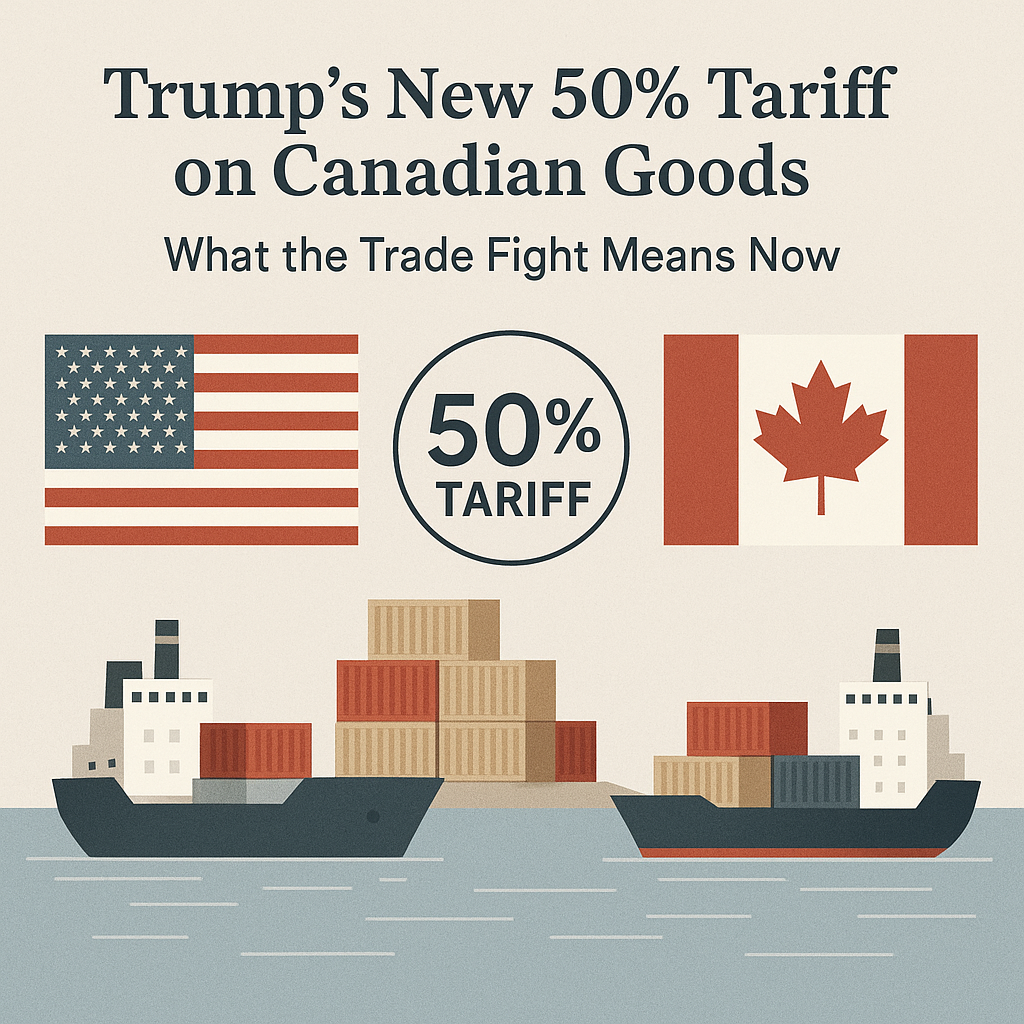
Core details and context
- The administration says the duties will hit roughly $20 billion in annual Canadian imports.
- The products named so far include hockey sticks, wine, and cement—a mix that touches both consumer goods and industrial inputs.
- The tariffs are scheduled to start next month.
- Officials argue Canada has discriminated against U.S. exports and that provinces removed U.S. liquor from store shelves in retaliation.
- The White House also pointed to auto policies it says favor Canadian interests over American ones.
Here’s the kicker: the list of goods may look quirky, but the economics are not. Cement is not a novelty item. It feeds construction. Wine affects retail and hospitality. Hockey sticks may be symbolic, but symbols can matter in a trade fight, especially when the point is to show political resolve. That mix suggests the tariff is designed to spread pain across more than one sector.
I have covered enough trade fights to know the pattern. Officials rarely frame tariffs as broad consumer taxes. They call them “targeted,” “strategic,” or “reciprocal.” But the burden almost never stays neatly where it starts. Importers may eat part of the cost for a while, but the rest lands on buyers, distributors, contractors, and in some cases workers whose hours get trimmed when margins shrink.
A few practical effects are already easy to see:
- Manufacturers that rely on Canadian inputs may face higher production costs.
- Construction firms could see cement prices rise, which can push up project bids.
- Retailers may struggle with inventory costs and pricing decisions.
- Consumers may pay more for imported goods or substituted domestic products.
- Provinces and border communities could see tension spill into local commerce.
Canada’s retaliation matters because it changes the calculation. The administration says Canada is one of only two countries, alongside China, to respond to Trump’s earlier tariffs. That framing is politically useful, but the trade data story is broader and messier. Retaliation from one side often invites more retaliation from the other. Then both governments claim they are merely defending national interests. That is the old script.
And yet the moral arithmetic is simple. Governments do have a duty to protect workers and producers. They also have a duty not to treat ordinary people like disposable chess pieces. A tariff that looks forceful in a statement can still be a blunt instrument in practice. That is not ideology. That is basic stewardship.
For more on trade politics and business effects, read The Wall Street Journal’s Canada trade coverage and Financial Times reporting on North American trade.
Timeline and what happened
- Earlier U.S. tariffs went into effect. Washington imposed trade penalties first, framing them as necessary pressure on Canada and other partners.
- Canada retaliated. Provinces and federal officials responded with countermeasures, including pulling some U.S. liquor products from shelves.
- The Trump administration escalated again. On Monday, officials announced an additional 50% tariff on selected Canadian goods.
- The legal basis shifted. The administration said it would rely on Section 338 of the Tariff Act of 1930, a little-used authority that had not previously been used in this way.
- Implementation was set for next month. That matters because it gives markets a short window to adjust, hedge, or lobby.
- The wildfire-tariff threat stayed on the shelf—for now. A senior administration official said the announced tariffs were not the wildfire tariffs previously threatened by President Trump, though other options remain under review.
- The dispute broadened beyond one grievance. Officials also cited auto policy complaints, suggesting the fight is now layered: tariffs, retaliation, industrial policy, and political posturing.
When I look at the timeline, the real story is not the pace but the escalation ladder. Each step is supposed to restore leverage. Instead, it often creates a stronger reason for the other side to answer back. That is why trade wars rarely stay tidy. They are supposed to be tactical. They become cumulative.
Let’s be real: a tariff announcement is often a bargaining message dressed up as policy. Maybe Ottawa blinks. Maybe it doesn’t. But until there is a negotiated settlement, the market has to price uncertainty, and uncertainty is expensive. Businesses hate it because they cannot budget around it. Families hate it because it shows up as higher costs with no vote attached.
The deeper lesson is about responsibility. Public officials should not pretend the costs are abstract. They are not. If a policy is justified, it should be defensible in facts, law, and effect—not merely in applause lines. That is a small but serious standard, and too many governments fail it when the cameras are on.
For a wider view of the policy backdrop, see The New York Times business and economy coverage.
Comparison table
The current tariff fight sits beside a broader competitor for policy attention: free-trade stability. That is the real rival here. One path leans on tariffs and retaliation; the other leans on negotiated access, predictable rules, and lower friction. Here’s how they compare.
| Factor | Trump’s tariff strategy | Free-trade stability |
|---|
| Core method | Higher import duties, selective pressure | Lower barriers, negotiated rules |
| Main goal | Force concessions, punish retaliation | Keep commerce steady, reduce costs |
| Legal posture | Uses Section 338 and other tariff tools | Uses treaties, arbitration, and diplomacy |
| Short-term effect | Higher prices, market disruption | More predictable pricing |
| Business impact | Margin squeeze for importers and users of Canadian inputs | Easier planning for manufacturers and retailers |
| Political message | Strong retaliation, domestic toughness | Cooperation, restraint, and order |
| Consumer effect | Risk of higher prices on goods like cement and wine | Lower friction, fewer price spikes |
| Retaliation risk | High | Lower |
| Border-state effect | More uncertainty for trade hubs | More stable cross-border commerce |
| Moral framing | National defense through pressure | Stewardship through restraint and fairness |
The comparison is not academic. It goes to the core of what government is for. If policy reduces the dignity of work by making it harder for firms to hire, invest, and plan, then it is not solving the problem it claims to fix. A healthy economy is not built on endless punishment. It is built on order, trust, and rules that ordinary people can actually live with.
The Trump approach here is obviously more confrontational. That may please people who want retaliation to look forceful. But force is not the same thing as wisdom. Sometimes the harder move is the cheaper one for politicians and the costlier one for everyone else. That is the sort of trade-off press conferences tend to hide.
A calmer model would focus on settlement, exemptions where justified, and clear timelines. Instead, the current plan seems built for pressure. That can work for a while. Then it starts to bite back.
Common misconceptions and what to know
The first misconception is that tariffs only hurt foreign countries.
They don’t. Not by a long shot. Tariffs often hit domestic buyers first, because importers still need the product and may have limited substitutes. The cost can move through wholesalers, retailers, and contractors before it ever reaches a consumer. That is the unglamorous truth. And it’s usually missing from political speeches.
The second misconception is that this is just about a few odd items, like hockey sticks.
Nope. The named goods are only the visible tip. The larger issue is the precedent: if a government is willing to impose a novel, steep duty under an obscure statute, then the range of future targets widens. Markets notice that. So do trade lawyers.
The third misconception is that Canada is a simple passive victim.
Not quite. Canada retaliated. Its provinces removed U.S. liquor from shelves, and officials have their own political incentives. That does not make the U.S. action right; it means both sides are operating in a cycle of pressure. Trade disputes rarely have saints. They usually have strategists.
The fourth misconception is that this is all theater and no substance.
Also wrong. There is theater, sure. But the costs are real. The duties affect real import flows, real firms, and real jobs. I’ve seen plenty of policy fights where the rhetoric was loud and the consequences were hidden in accounting lines. This looks like one of them.
The fifth misconception is that tariffs are a free way to show strength.
That is a fantasy. Tariffs are a tax with a flag on top. They can be useful in narrow cases, but when used broadly or repeatedly, they become a drag on growth and trust. A government that forgets that tends to confuse motion with prudence.
Here’s the practical view:
- Watch for retaliatory steps from Canada.
- Watch for sector-specific exemptions or carve-outs.
- Watch for price changes in construction and retail inputs.
- Watch for business lobbying from firms caught in the middle.
- Watch for court challenges if the legal authority is tested.
Most coverage misses the bigger moral question: who bears the cost of public brinkmanship? In a decent system, policy should serve the common good, not just the loudest faction. That includes workers, families, and small businesses, not just politicians scoring points.
If you want the broader trade context, see Bloomberg’s tariff coverage and Reuters Americas trade reports.
Frequently asked questions
Why is the Trump administration imposing a 50% tariff on Canadian goods?
The administration says Canada has discriminated against U.S. exports and retaliated against earlier U.S. tariffs. Officials also pointed to provincial actions against U.S. liquor and to Canadian auto policies they say hurt American interests.
What goods are affected?
The tariff list includes items such as hockey sticks, wine, and cement, with the broader package covering about $20 billion in annual Canadian imports.
What law is being used?
The administration says it will rely on Section 338 of the Tariff Act of 1930, a rarely used authority that officials say has not been used in this way before.
How will this affect consumers and businesses?
It could raise costs for importers, retailers, construction firms, and consumers. Cement matters for building projects, wine for retail and hospitality, and other imported goods may face similar pressure if the trade dispute widens.
The tariff fight between Washington and Ottawa is not just a policy squabble. It is a reminder that governments can damage trust faster than they can rebuild it. A wise state uses power with restraint, because power without restraint tends to punish the innocent along with the guilty. That has been true for a long time, and no press release changes it.
If the dispute deepens, the real test will not be who sounds tougher on television. It will be who protects workers, keeps commerce honest, and remembers that trade exists to serve people, not the other way around. That is the part worth watching.