Tumwater’s 400-Year-Old Garry Oak: Who Will Put Its Fallen Limbs to Work?
The old oak will keep serving Tumwater. After two large limbs fell during September’s high winds, the city’s Tree Board voted at its Nov. 9 meeting to give reclaimed wood to four groups for public and community projects. What becomes of a fallen landmark?
This is a small municipal decision with a surprisingly large set of questions behind it: who gets a piece of a historic tree, how should a city weigh public benefit against private craft, and what does responsible reuse look like when the material is too heavy for ordinary hauling? The city chose salvage over disposal, then asked applicants to explain what they would make and how they would take the wood away.
The board’s decision is not simply a sentimental gesture. It also puts the value of a public landmark into practical terms: the oak’s remains may become furniture and teaching material, rather than an anonymous load sent to a dump. I see the central issue as stewardship, not nostalgia. The city had limited staff capacity, a finite amount of wood, and more applicants than it could accommodate.
The meeting account identifies Nov. 9 but does not state the year, and it gives no delivery schedule. Nor does it name all four approved recipients. Those gaps matter; the city’s vote is clear, but the exact timing and complete distribution list are not reported here.
What Is the Davis-Meeker Garry Oak Wood Reuse Project?
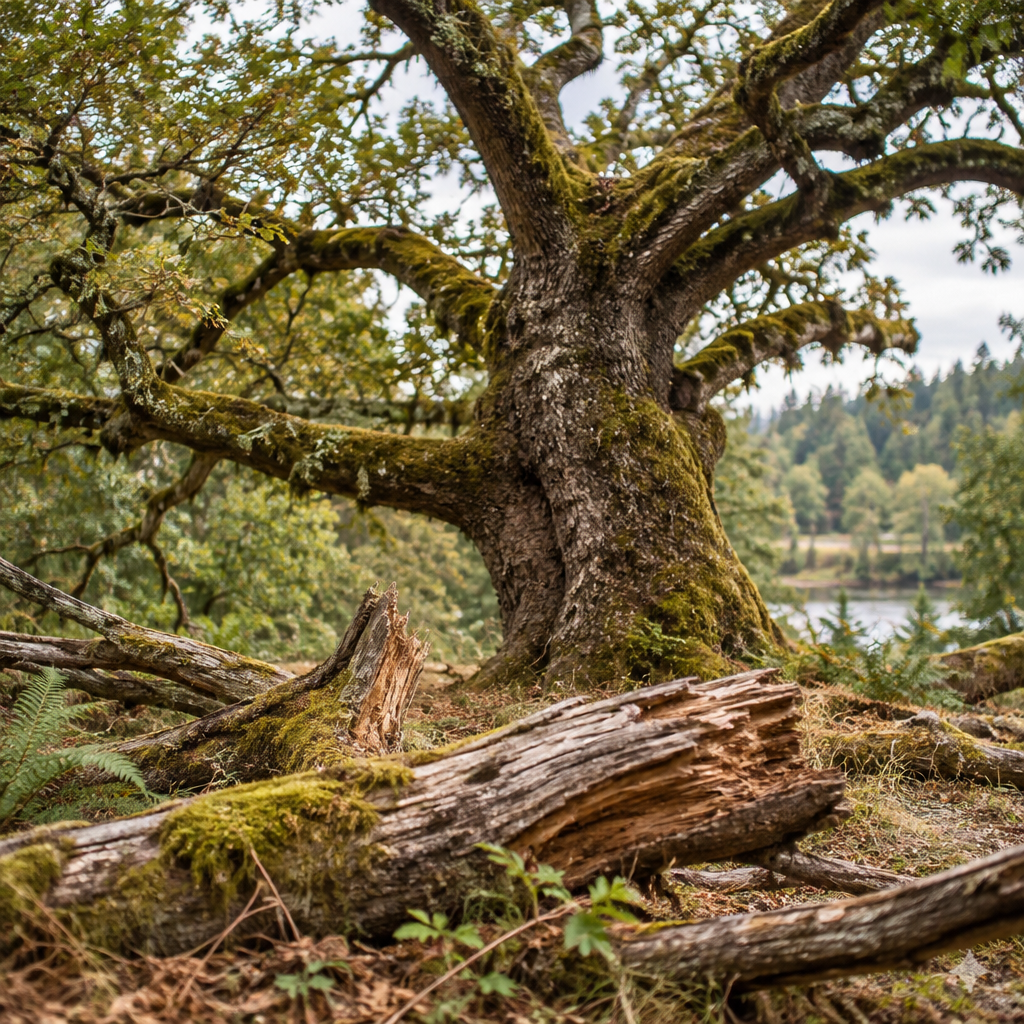
The Davis-Meeker Garry oak is a historic tree in Tumwater, Washington, described as roughly 400 years old. In September, high winds brought down two of its large limbs. Wind speeds topped out at 54 miles per hour, according to Sustainability Manager Alyssa Jones Wood’s comments at the Nov. 9 Tree Board meeting. The city salvaged the fallen wood rather than sending it to a landfill, and staff stored it in the backyard of the Operations & Maintenance facility while the allocation process took shape.
The proposal is straightforward: turn material from a recognizable local landmark into useful objects that retain a connection to the tree’s history. But calling it a reuse project does not make the logistics simple. The two largest limbs measured about 24 inches and 20 inches across, and both were longer than eight feet. Some sections remained long enough to require a large trailer, while other pieces had been cut small enough to make bowls.
Garry oak, or Quercus garryana, is a native oak of the Pacific Northwest. The U.S. Forest Service’s species profile describes its habitat and growth characteristics; it offers useful botanical context, though it does not verify the age of this particular Tumwater tree. The city’s age estimate and the tree’s local history are separate claims from general information about the species. That distinction is worth keeping clear.
The proposal also differs from ordinary municipal wood disposal. The value is not just the timber’s possible resale price. Applicants described uses tied to fire service, school instruction, and public library space—projects intended to keep some of the tree’s story visible. Tumwater’s Tree Board information is the official place to follow the board’s work and public business.
I would not treat a 400-year-old tree as valuable only because a piece of it can be turned into furniture. Its significance also rests in the habitat, history, and public memory attached to it. Still, once limbs have fallen, careful reuse is a reasonable way to respect both the material and the community’s interest in it. The harder question is how to allocate a limited resource.
Core Details: How Tumwater Chose the Recipients
Tumwater received more than 20 applications. The applicants included artists, people interested in local history, schools, city departments, and others. That range made the Tree Board’s task more complicated than selecting the most attractive design. Each proposal had to be judged against practical constraints, including the city’s lack of staff capacity to transport and process bulky logs.
Jones Wood said Mayor Leatta Dahlhoff asked staff to create an application process and score the submissions for the Tree Board’s consideration. The scoring system favored applicants who could move the wood themselves. That criterion may sound unromantic, but it addressed a real limit: city crews could not be expected to provide custom hauling and milling for every successful project.
Tumwater residents and business owners were also given priority. Proposals with a public benefit scored better, as did projects that would not produce excess carbon emissions by burning the wood. The criteria make the city’s goals visible: keep the material in local hands where possible, create something people can use or learn from, and avoid turning the recovered wood into fuel.
The city contacted area tribes first to ask whether anyone wanted to reclaim the wood. Jones Wood said the city received no responses. That fact should be reported plainly, without guessing why no response came or assuming it represents a broader position. The outreach was part of the process; the available details do not report further discussion or explain how the city’s request was communicated.
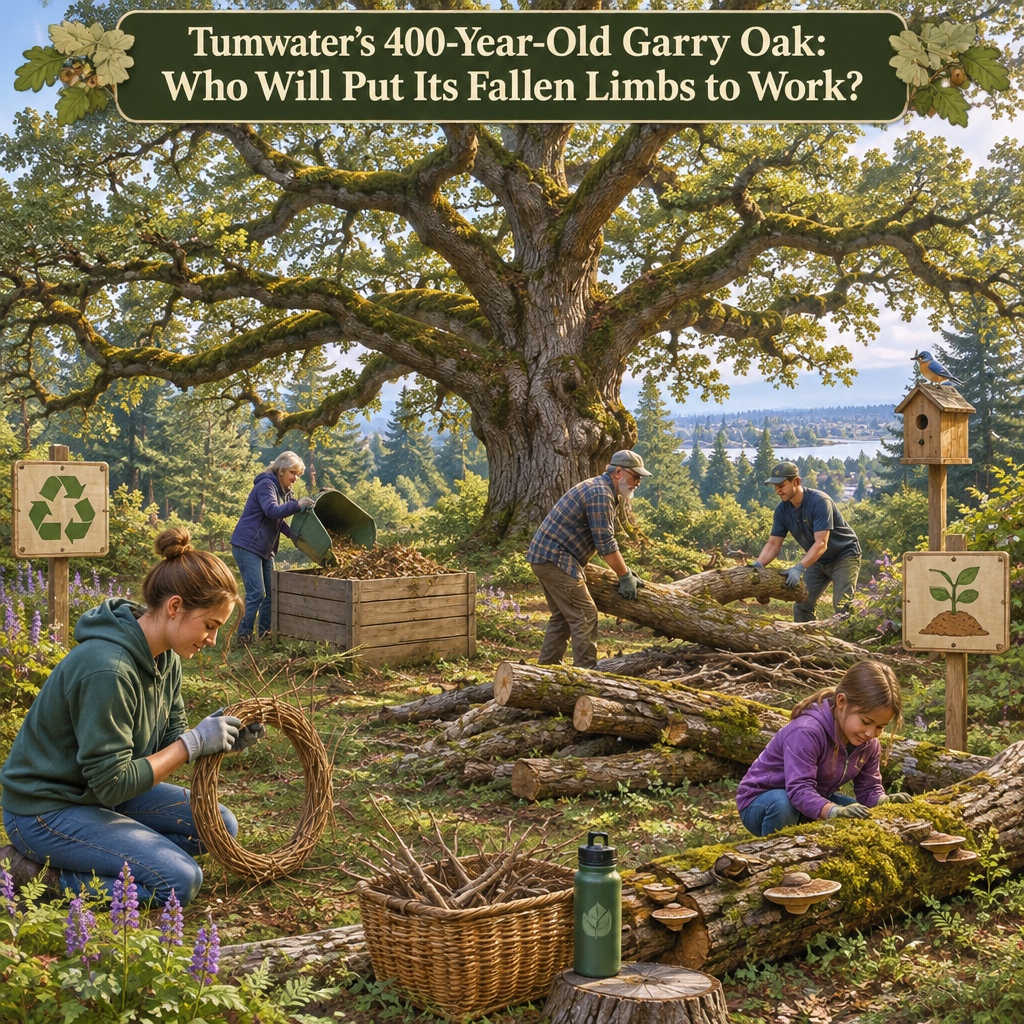
Four recipients were approved for the first batch. The meeting details available here name three. Tumwater firefighter Gunnar Christensen proposed a table for the new T2 fire station. He said the station’s existing table would be too small after a planned remodel and new staffing, and noted that he had built a table for the department’s headquarters station. He also said he could transport and process the oak using a knuckle-boom crane truck and a sawmill.
Aimee Opincarne, a natural resources and environmental science teacher at A.G. West Black Hills High School, proposed using a portion of the wood in lessons about local restoration and conservation. Her application said she wanted students to see the growth rings of the old oak. Cody Hanson, the Washington State Library’s information technology director and a seventh-generation woodworker, proposed making a bench for the library.
The fourth recipient’s name and project are not reported in the meeting details available here. The rest of the applicants may be reconsidered if wood remains after the first distribution. That makes the initial award a first allocation, not necessarily the final word on who may receive a piece.
Timeline: From Wind Damage to Board Vote
- September: two major limbs fall. A high-wind event brought down two large branches from the Davis-Meeker Garry oak. The recorded peak wind speed cited at the meeting was 54 mph. The information available does not give a precise date for the fall or a full account of damage to the rest of the tree.
- City staff choose salvage over disposal. Rather than send the limbs to a dump, Tumwater kept the wood at the Operations & Maintenance facility. That choice preserved the possibility of reuse, but it also occupied space in a working yard. Staff eventually wanted that space back, putting pressure on the city to settle the allocation rather than store the logs indefinitely.
- The city seeks proposals. At Mayor Leatta Dahlhoff’s request, staff created an application and scoring process for the Tree Board. More than 20 people and organizations applied. The proposals varied in scale: pieces could become a station table or library bench, serve as a teaching tool, or be cut into smaller craft objects.
- Applicants are scored against workable criteria. The city gave an advantage to people who could move the wood themselves, and also prioritized Tumwater residents and business owners. Public benefit and avoiding projects that would burn the wood counted in the evaluation. Area tribes were contacted before the wider allocation, but no responses were received, according to Jones Wood.
- Nov. 9: the Tree Board votes. The board approved four recipients for the first batch. The available meeting details identify Christensen, Opincarne, and Hanson, while the name and proposal of the fourth recipient are not reported here. The board’s vote sets the direction, but a delivery date and final inventory are not stated.
When I line up those steps, the point is plain: the city moved from an emergency event to a resource-allocation problem. Salvage created options, but it also created a storage and labor burden. The process turned on both the value of the proposed projects and the applicants’ ability to handle the material without shifting a large hauling job onto city staff.
Comparison: Salvaged Historic Oak vs. Newly Purchased Lumber
The closest alternative to this reclaimed wood is not another fallen landmark. It is newly purchased lumber for the same furniture or teaching projects. The comparison below uses the details reported about the Tumwater allocation and separates them from facts that were not provided.
| Factor | Davis-Meeker Garry oak wood | Newly purchased lumber |
|---|
| Origin | Fallen limbs from a locally historic oak, described as roughly 400 years old | Supplier and source would depend on the purchaser |
| Dimensions | Two main limbs were about 24 and 20 inches in diameter and longer than eight feet; other sections vary | Dimensions could be selected to fit a specific design |
| Handling | Applicants needed a plan and equipment to move and process heavy pieces | Delivery options depend on the seller and order |
| Public meaning | Each finished object could retain a direct link to a local landmark | No connection to this particular tree unless created through interpretation |
| Cost and value | No price, market valuation, or processing cost is reported | No price comparison is reported |
| Environmental information | The city favored projects that would not burn the wood; the wood’s full life-cycle impact is not reported | Forest source, transport, and production impacts depend on the product |
The reclaimed oak has an unusual provenance, but provenance alone does not make a project successful. Someone still has to move, mill, dry, design, and finish the wood; the meeting details do not report whether those steps have been completed or what they will cost. Freshly purchased lumber may be easier to specify and deliver, while the salvaged limbs carry a local story that a store-bought board cannot reproduce.
The city’s approach appears to put practical use ahead of a sale or auction. That does not mean there is no economic value in the wood; it means no sale price or bidding process is reported. The relevant measure may instead be whether the wood becomes a durable public object, with a clear plan for care and a modest demand on municipal staff. The Forest Service’s Garry oak profile helps explain the species, but it should not be confused with an appraisal of the fallen limbs.
Common Misconceptions and What to Know
A fallen limb is not the same thing as a dead tree. The report concerns two large branches that came down; it does not say the entire Davis-Meeker oak fell. It would be inaccurate to suggest the tree itself was removed or lost. The condition of the remaining tree and any future care plan are not reported in the meeting details available here.
The wood is not automatically ready for a finished project. A section that looks suitable for a table can still require safe lifting, cutting, drying, and skilled construction. Christensen’s application listed a crane truck and sawmill, which shows why the city rewarded applicants able to manage the work. Other applicants may need different equipment or a specialist. No milling or drying schedule is reported.
A public project is not the same thing as a city-funded project. The selected plans have public-facing uses, but the available information does not say that Tumwater will pay for all labor, materials, transportation, or finishing. In Christensen’s case, the application described equipment he could use himself. For the other projects, costs and responsibilities are not reported. Readers should not assume the city is supplying a full build-out simply because it is allocating the wood.
The city did not award every applicant a piece. More than 20 applications came in, while four groups were approved for the first batch. The remaining applicants may be considered if wood is left over. That is a constrained allocation, not a promise that every proposal will receive timber. A fair process must recognize the finite supply as well as the interest in it.
The tribal outreach detail has limits. The city contacted area tribes before considering the applications and received no responses, according to Jones Wood. That is what is known. It does not establish why no responses came, whether every potentially relevant group had the same opportunity to respond, or what any tribe’s view of the wood might be. Claims beyond the reported outreach would be guesswork.
The tree’s age and a species’ conservation status are different questions. The oak is described as roughly 400 years old. Opincarne’s application emphasized teaching students about an endangered Garry oak, but that wording should be attributed to her application rather than treated as a full conservation assessment of the species. Garry oak habitats face pressures in parts of the Pacific Northwest, but the status of a habitat, a local population, and a species are not interchangeable labels.
Finally, a reuse decision should not be reduced to a carbon slogan. Tumwater specifically preferred projects that would not burn the material, which is a meaningful criterion in this case. But no full emissions calculation, transport estimate, or comparison with purchased wood is reported. The stronger civic argument is simpler: use a limited resource carefully, tell the truth about what is known, and ensure that the resulting object serves more than a private keepsake. That is stewardship in a practical sense, tied to the common good and respect for the people who do the work.
Frequently Asked Questions
What happened to the Davis-Meeker Garry oak?
Two large limbs fell during a high-wind event in September, when wind speeds topped out at 54 mph. Tumwater salvaged the wood instead of sending it to a dump. The report does not say that the whole tree fell, and it does not describe the remaining tree’s condition.
Who will receive wood from the fallen limbs?
The Tree Board voted to approve four recipients for the first batch. The meeting details available for this report identify firefighter Gunnar Christensen, teacher Aimee Opincarne, and Washington State Library employee Cody Hanson. The fourth recipient is not named in those details.
What are the selected projects?
Christensen proposed a table for Tumwater’s new T2 fire station. Opincarne proposed using the wood to help students study the oak and its growth rings. Hanson proposed a bench for the Washington State Library. The fourth selected project is not reported here.
Why did applicants who could move the wood themselves score higher?
The city did not have staff capacity to transport and process every large piece. Applicants able to arrange their own hauling and equipment were therefore better positioned to take the material. Tumwater also prioritized local applicants, public benefit, and projects that would not burn the wood.
Final Thought
A fallen branch can become scrap, a hazard to clear, or a piece of local history with a second use. Tumwater chose the third option, then put real constraints around it: staff could not haul every log, the wood had to go somewhere, and more than 20 applications competed for a limited supply. That is ordinary municipal work, but it carries a useful lesson. Public stewardship is not only about protecting what remains standing; it is also about deciding carefully what to do with what has been lost.
The strongest proposals connect the oak to ongoing public life. A table at a fire station would sit where crews gather and work. A classroom display could give students a tangible view of growth accumulated over centuries. A library bench could place the wood in a shared civic space. None of those plans restores the limb to the tree, and none should be presented as a substitute for conservation. They offer something smaller and more honest: a durable object, a story attached to it, and a chance for residents to encounter a piece of their local past.
There are unanswered questions about delivery, costs, the fourth recipient, and what will happen to any remaining wood. Those details should be made public as the allocation proceeds. For now, the board’s decision sets a reasonable standard: favor plans with local connection and public use, insist that recipients can manage the material, and avoid wasting a resource simply because it is awkward to handle. That is not grand policy. It is the kind of careful civic judgment that earns trust.
The oak’s long life was measured in rings. Its next chapter will be measured in the care given to the pieces that remain.