Washington Counties Add National Guard Support at Ballot Drop Boxes
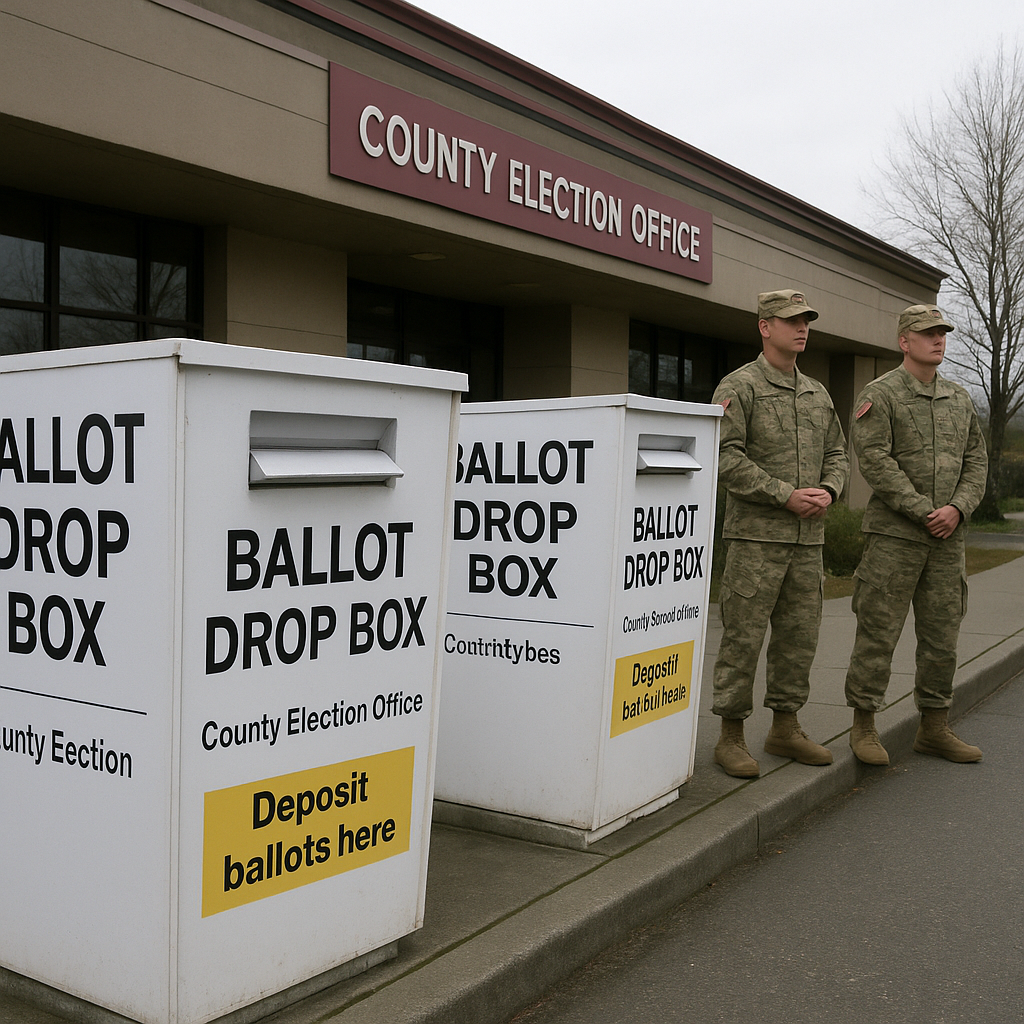
Seven Washington counties accepted Gov. Bob Ferguson’s offer to place National Guard personnel near ballot drop boxes and other busy voting locations. The personnel are meant to watch, report concerns and support local election security—not handle ballots, question voters or act as law enforcement. County officials say the measure adds another layer to existing safeguards.
What Is the National Guard Ballot Drop Box Offer?
The offer is a state-supported security measure for election locations, not a change to how Washington voters cast ballots or how election officials count them. Gov. Bob Ferguson invited county election auditors to use National Guard personnel around ballot drop boxes and other high-traffic places where voting occurs. The role described in his letter is watchful and supportive: personnel observe, stay out of voters’ way, and contact local authorities if an issue arises.
That distinction matters. A uniformed or armed presence could make a voter wonder whether they are being watched or challenged. The officials’ descriptions instead emphasize plain clothes, unarmed personnel and no interaction with voters. Thurston County Auditor Mary Hall said the Guard members would not handle, touch or take part in processing ballots, and would not act as law enforcement. Pierce County Elections Manager Kyle Haugh said personnel would call 911 if problems arose.
I read this as a supplemental presence rather than a new election-security system. Washington’s counties retain their election responsibilities, while the Guard’s role, as described publicly, is narrow. The Washington National Guard has also provided cybersecurity support during elections since 2016, according to Aho. The governor’s offer extends that support into the physical vicinity of ballot return locations.
Frankly, “watching” is not the same as preventing every possible incident. It can, however, create an additional channel for reporting trouble, provided the role stays limited and voters receive clear instructions. That is why the details—unarmed, plain clothes, no voter contact, no ballot handling—are more important than the dramatic shorthand of “Guard at the drop box.”
The offer followed two kinds of concern cited in Ferguson’s letter: reports of white powder sent to officials, including Washington’s secretary of state, and the 2024 arson attack on a ballot box in Vancouver. The letter also referred to suspicious packages reportedly mailed to members of Washington’s congressional delegation as part of a wider attack targeting election and congressional offices. Those events explain the administration’s stated rationale; they do not establish that every drop box faces a specific threat.
Core Details and Context
The counties’ decisions were not uniform. Aho said seven counties opted in: Pierce, Thurston, King, Snohomish, Clark, Lewis and Island. Spokane County declined. Its auditor told The Spokesman-Review that the county would prioritize local resources instead. That difference is worth noting: acceptance of state personnel is not the only way a county can secure voting sites, and refusal does not, by itself, show that a county is neglecting election security.
Pierce County Elections Manager Kyle Haugh called the offer “certainly unique” and said Pierce County had not received it before. Pierce County Auditor Linda Farmer said the county accepted out of “an abundance of caution,” adding that Guard members would call 911 if issues arose. In Thurston County, Auditor Mary Hall described the personnel as unarmed and purely supportive. Hall said any added security was welcome.
The arrangement’s stated limits offer a useful checklist for evaluating it:
- No ballot handling: Guard members are not to touch ballots or participate in processing them.
- No law-enforcement role: Thurston County said the personnel would not act as police.
- No voter interaction: Ferguson’s letter said they would not interact with voters.
- Plain clothes and a low profile: The letter said personnel would remain in plain clothes and out of the way.
- Escalation through local authorities: Pierce County said members would call 911; Ferguson’s letter described contacting local authorities if issues arose.
Those safeguards are not decorative. Election systems depend on voters being able to return ballots without feeling intimidated, and on election workers retaining control over official procedures. A security presence should protect access and operations, not blur who is responsible for decisions. The common good here includes both physical safety and public confidence—two goals that can support each other, but only when the rules are plain.
Aho also said the National Guard regularly supports election security through cybersecurity professionals, activated for each election since 2016. That is a separate function from the new offer to place personnel near physical voting locations. Cybersecurity work concerns digital systems and related risks; physical monitoring concerns activity around places where voters return ballots. Conflating the two makes the public less informed, not more secure.
Most coverage tends to frame security as a choice between “more protection” and “less protection.” That misses the operational question: who does what, under whose authority, and with what limits? Based on the public descriptions here, the Guard is not replacing auditors, election staff or local responders. It is an additional observer and reporting resource. County officials remain responsible for their election operations, and the specific practices may differ by county.
Voters should use official channels for practical instructions. The Washington Secretary of State’s ballot return guidance explains how to return a ballot; county election offices provide local information. The key deadline in the account is 8 p.m. Tuesday for depositing a ballot in an official drop box. A voter should not assume an unofficial container, a private box or a late deposit will be treated the same way.
Timeline: How the Offer Came Together
- Earlier election-security work: Aho said National Guard cybersecurity professionals have supported Washington elections since 2016. That established an existing pattern of state support, although the cyber role is not the same as monitoring drop-box locations.
- The Vancouver ballot-box arson: In 2024, a ballot box in Vancouver was set on fire. Ferguson’s letter referred to that attack and noted that then-Gov. Jay Inslee activated the National Guard to remain on standby during election week that November. The account does not provide further operational details about that activation, so it would be wrong to assume the earlier standby arrangement was identical to the current offer.
- Reports of suspicious mail: Ferguson’s letter cited white powder sent to officials, including Washington’s secretary of state, earlier in the month. It also referred to suspicious packages reportedly sent to some members of Washington’s congressional delegation amid a wider attack on election and congressional offices. The public account does not specify the contents, motive, or final findings for each package. Those details should not be guessed at.
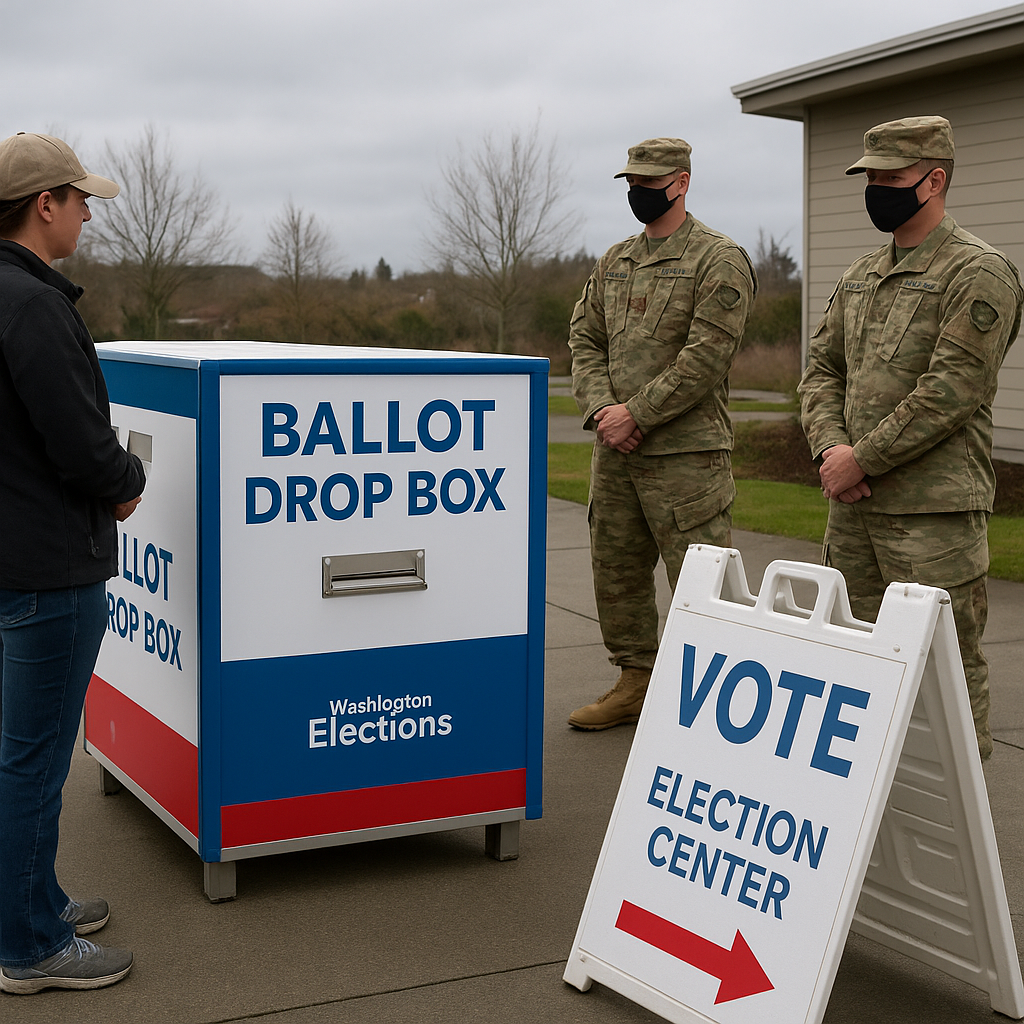
- The governor’s offer: Earlier in the election period, Ferguson wrote to county election auditors offering Guard personnel as an “Election Neighborhood Watch” around ballot boxes and other busy voting areas. The letter described a low-profile role and said personnel would contact local authorities if issues arose.
- County choices: Aho said seven counties accepted. Spokane County declined, with its auditor telling The Spokesman-Review that local resources were the county’s priority. The report does not give a complete breakdown of each county’s staffing plan or the number of Guard personnel assigned.
- County explanations: Pierce County cited an abundance of caution and said Guard members would call 911 if needed. Thurston County said the personnel would be unarmed, would not handle ballots or interact with voters, and would not act as law enforcement.
- Voter deadline: Officials urged voters to return ballots promptly. Haugh said early return helps officials get ballots into the count on election night. The Secretary of State’s website says ballots must be placed in an official drop box by 8 p.m. Tuesday for the election described.
When I lay out the sequence, the main point is not that officials announced a sweeping change to voting. They added a limited physical-security option against a backdrop of prior arson and reports of suspicious mail. There is no reported evidence in the account that a new threat targeted each participating county’s ballot boxes. The distinction between a precaution and a response to a confirmed local threat deserves to stay visible.
Comparison: National Guard Support vs. Local-Resource Approach
| Issue | National Guard support | Local-resource approach |
|---|
| Example in this report | Seven counties accepted Ferguson’s offer | Spokane County declined and prioritized local resources |
| Publicly described role | Observe near voting locations and report issues | County uses its own resources; specific methods are not reported |
| Ballot handling | Not permitted under the stated plan | No details reported in the account |
| Voter contact | Guard members are not to interact with voters | No details reported in the account |
| Law-enforcement authority | Thurston County said Guard members will not act as law enforcement | County’s response and authority structure are not described |
| Potential advantage | Adds another reporting presence without assigning ballot duties | Keeps security planning centered on local personnel and resources |
| Key unanswered question | How many personnel, at which sites, and for what hours? | What precise measures will be used and how are they staffed? |
This is not a head-to-head test with published performance results. The account gives no data showing that one approach reduces incidents more than the other, and it does not compare costs, staffing levels or response times. Treating the table as proof that one side is safer would be a stretch.
The comparison is still useful because it separates the decision from the slogan. Counties that accept the offer add state personnel under a stated set of limits. Spokane County chose to rely on local resources. Each approach can be reasonable in context, depending on available staff, site conditions, coordination with emergency services and the county’s assessment of risk. The information available does not tell readers enough to rank those plans.
There are practical questions officials should answer whenever a state security presence is proposed: Who directs personnel at each site? How are they briefed on the boundary between observation and voter contact? How quickly can local responders be reached? What happens if a voter raises a concern about the Guard presence itself? Those are not accusations. They are ordinary accountability questions for a public program involving elections, taxpayer resources and people exercising a fundamental civic right.
In my analysis, restraint is a feature, not a weakness. The more clearly the personnel remain in a supporting role, the less likely they are to confuse voters or interfere with the election workers who handle ballots. A visible show of force might look reassuring to some and unsettling to others. The reported plan avoids that problem by calling for plain clothes and no voter interaction, though the public account does not explain precisely how each county will communicate the arrangement at individual locations.
Common Misconceptions and What Voters Should Know
Misconception: Guard members will run the drop boxes. The described role does not include managing boxes, collecting ballots or counting votes. Thurston County explicitly said personnel would not handle, touch or participate in ballot processing. The distinction matters because the integrity of election procedures depends on authorized election workers carrying out official tasks.
Misconception: Guard members will question voters. Ferguson’s letter said they would not interact with voters. Thurston County repeated that boundary. A voter arriving to return a ballot should not be treated as a person subject to screening by Guard members under the plan described.
Misconception: The Guard is replacing local police or election officials. The public descriptions say the opposite. Guard members would contact local authorities if problems arose; Pierce County said they would call 911. Thurston County said they would not act as law enforcement. Counties and their election offices continue to have responsibilities that are not transferred by this offer.
Misconception: Every participating county has the same deployment. The account names seven counties but does not report how many personnel will be assigned, which boxes will have coverage, or the hours of deployment. A statewide offer does not automatically mean identical local arrangements. If a county publishes additional details, those details should be checked with that county rather than inferred from another county’s statement.
Misconception: Spokane County’s decision proves it has no security plan. The county’s auditor said it would prioritize local resources. The account does not spell out those resources or the county’s full security plan. A decision not to accept one state offer cannot establish that a county is doing nothing. Conversely, accepting the offer does not prove that every possible risk has been addressed.
Misconception: The cited incidents establish a specific, current threat at every drop box. Ferguson’s letter referred to suspicious mail and the 2024 Vancouver arson. These events provide context for a precautionary offer, but the account does not report a confirmed threat against every location in the seven counties. It is responsible to take threats seriously without turning uncertainty into a claim of fact.
What should voters do? Follow the instructions from their county election office and the Washington Secretary of State. For the election described, ballots placed in official drop boxes were due by 8 p.m. Tuesday. Haugh encouraged early return because it helps officials include ballots in the election-night count. The Washington Secretary of State’s election information is the proper place to verify statewide guidance, while the Pierce County Elections office and Thurston County Auditor’s Office provide county-specific information.
Frequently Asked Questions
Which Washington counties accepted the offer?
According to Gov. Ferguson’s communications director, Pierce, Thurston, King, Snohomish, Clark, Lewis and Island counties accepted. Spokane County declined and said it would prioritize local resources.
Will National Guard personnel handle ballots or interact with voters?
No, not under the plan described. Ferguson’s letter said personnel would not interact with voters. Thurston County said they would be unarmed, would not handle or process ballots, and would not act as law enforcement.
Why did Gov. Ferguson offer the support?
His letter cited reports of white powder sent to officials and the 2024 arson attack on a ballot box in Vancouver. It also referred to suspicious packages reportedly sent to members of Washington’s congressional delegation. The account does not establish that those incidents represented a specific threat to every participating county.
When must voters return ballots?
For the election described, ballots had to be placed in an official drop box by 8 p.m. Tuesday, according to the Secretary of State’s website. Voters should check current official guidance for the applicable election and their county.
Final Thought
Public confidence is built less by dramatic announcements than by clear rules and competent follow-through. Washington counties accepted a limited offer intended to add eyes near some voting locations, while Spokane County chose to prioritize local resources. Neither decision, on the facts reported, settles the larger argument about which security model works best. The deployment numbers, site coverage, costs and measured outcomes are not reported, so claims about effectiveness should wait for evidence.
The right standard is straightforward: safeguard voters and election workers, keep ballot handling in the hands of authorized staff, and make sure a security measure does not discourage lawful participation. Officials also owe the public plain answers about command, training, reporting and the limits of personnel’s role. This is ordinary stewardship of public resources and civic trust, not a demand for spectacle.
For voters, the immediate task is simpler than the political debate. Use official election information, return the ballot through an approved channel and respect the deadline that applies to the election. Haugh’s advice to return ballots early reflects a practical concern: earlier arrival gives election workers more opportunity to include them in the count on election night. The larger lesson is just as practical. Security should make the process safer without making it feel less accessible. That balance is the measure worth watching.
{"@context":"https://schema.org","@type":"FAQPage","mainEntity":[{"@type":"Question","name":"Which Washington counties accepted the offer?","acceptedAnswer":{"@type":"Answer","text":"Pierce, Thurston, King, Snohomish, Clark, Lewis and Island counties accepted. Spokane County declined and said it would prioritize local resources."}},{"@type":"Question","name":"Will National Guard personnel handle ballots or interact with voters?","acceptedAnswer":{"@type":"Answer","text":"No. Under the plan described, personnel will not interact with voters or handle ballots. Thurston County said they will be unarmed and will not act as law enforcement."}},{"@type":"Question","name":"Why did Gov. Ferguson offer the support?","acceptedAnswer":{"@type":"Answer","text":"His letter cited reports of white powder sent to officials, suspicious packages reportedly sent to congressional members, and the 2024 arson attack on a Vancouver ballot box."}},{"@type":"Question","name":"When must voters return ballots?","acceptedAnswer":{"@type":"Answer","text":"For the election described, ballots had to be placed in an official drop box by 8 p.m. Tuesday. Voters should verify current guidance with election officials."}}]}