Washington voters have approved Initiative 638, according to an Associated Press call, backing a rule that bars biologically male students from female-only...
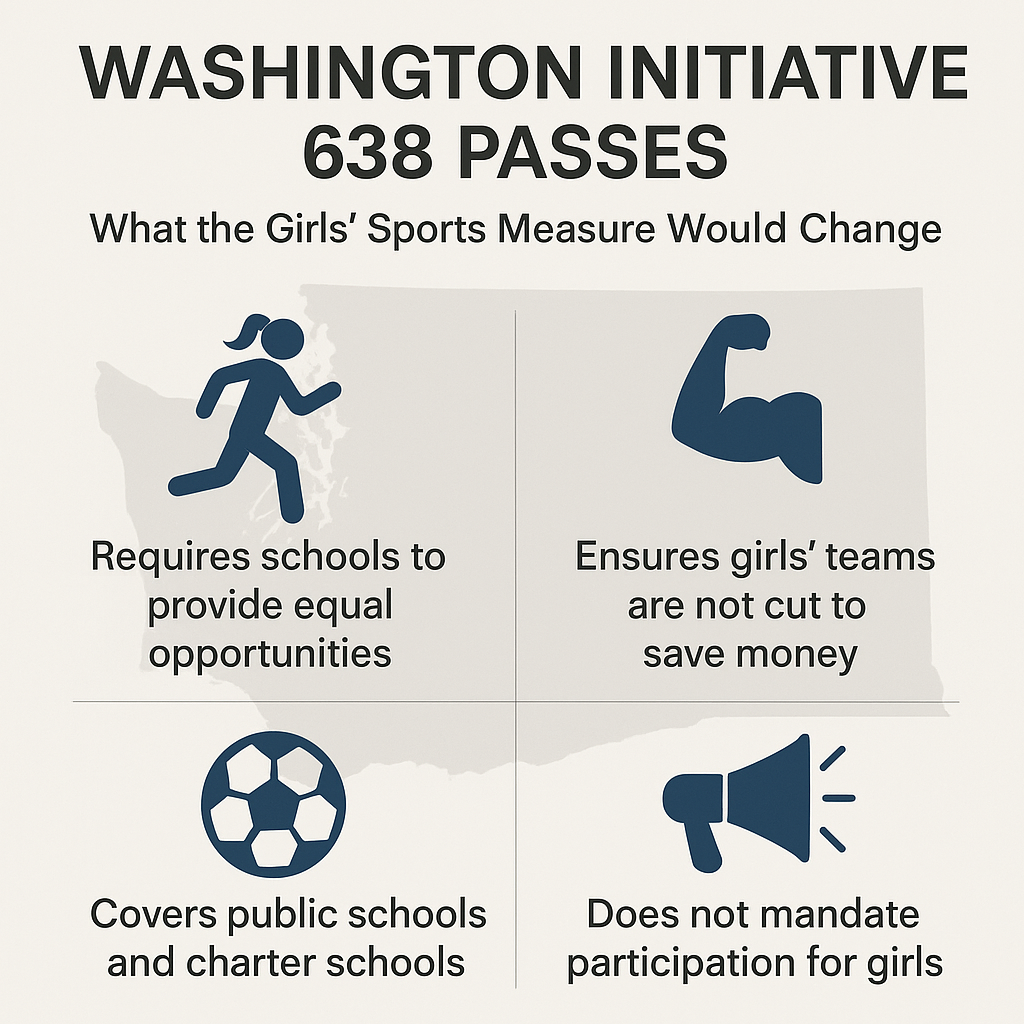
Washington Initiative 638 Passes: What the Girls’ Sports Measure Would Change
Washington voters have approved Initiative 638, according to an Associated Press call, backing a rule that bars biologically male students from female-only school athletic competitions and requires signed verification from a healthcare provider. The reported margin is clear; the measure’s legal, medical, and practical consequences are not yet settled.
Key Takeaways- The reported tally was 1,252,863 votes for Initiative 638 and 961,810 against it: 56.6% to 43.4%.
- The initiative directs school district boards and voluntary nonprofit entities to prohibit biologically male students from certain competitions reserved for female students.
- It requires a healthcare provider’s signed statement verifying biological sex using reproductive anatomy, genetic makeup, or natural testosterone levels.
- Supporters frame the measure as protection for fairness and opportunity in girls’ sports; opponents warn of harm to transgender students, privacy, and student safety.
- The Associated Press call is not the same as official certification. The final count, legal challenges, and implementation details matter.
The numbers show a substantial advantage for the measure, not unanimity. At the reported count, 2,214,673 votes were included, with the yes side ahead by 291,053 votes and 13.2 percentage points. That is enough for the AP to call the race, but ballot counts and official certification remain separate steps. Readers seeking the authoritative election record should check the Washington Secretary of State’s election and initiative information.
This vote settles a policy question at the ballot box only in the first sense: voters have chosen a direction. It does not, by itself, settle how schools will collect or protect health information, how providers will make the required determinations, or how courts may interpret the new rule alongside state and federal law. Those questions are where the argument moves next.
Supporters say female athletes deserve protected competition categories and a fair chance to participate. Opponents say the eligibility rule singles out a small group of transgender students and could expose children to intrusive scrutiny. Both sides are now arguing from a decisive reported result, but the responsibilities attached to that result are more demanding than a campaign slogan. The implementation needs to be lawful, consistent, and respectful of every student’s dignity.
What Is Washington Initiative 638?
Initiative 638 is a Washington ballot measure concerning eligibility for school athletic activities organized in separate male and female categories. The provision drawing the most attention says a school district board of directors or a voluntary nonprofit entity must prohibit biologically male students from competing with and against female students when the activity is intended for female students only and involves individual or team competition. In practical terms, the measure establishes a sex-based eligibility rule for the specified competitions.
The initiative also calls for a signed statement from a healthcare provider verifying a student’s biological sex. The reported description says verification may be based on reproductive anatomy, genetic makeup, or natural testosterone levels. That is why the measure is not simply a rule about who may enter a particular event: it also creates a process for documenting eligibility, with medical and privacy implications for students and families.
The precise language matters. A school board, a nonprofit sports organizer, a healthcare provider, and a student could each encounter different parts of the process. The available account does not establish every administrative detail, including the form of the documentation, how records would be stored, who could access them, how disputes would be reviewed, or what exceptions—if any—would apply. Those details should not be guessed at. They need to be answered by the enacted text, official guidance, and, where necessary, courts.
The measure’s supporters connect it to fairness, safety, and opportunity for female athletes. Let’s Go Washington founder Brian Heywood described passage as a victory for girls who he said had been told their concerns did not matter. He argued that voters had shown support for safe and fair sports. That is the campaign’s case, not proof that every competition presents the same circumstances or that the new procedure will work smoothly everywhere.
Opponents, including the statewide No Hate in WA State campaign, say the rule harms transgender students and may invade privacy or put children at risk. Co-chair Diane Bedwell said the group wanted every ballot counted and every girl to have the opportunity to play. The initiative therefore sits at the intersection of school policy, sports eligibility, privacy, and the treatment of transgender youth—not just the outcome of a single game.
Core Details and Context
Several parts of the vote deserve attention beyond the headline result.
- The reported margin is meaningful, but not universal. The yes vote led by 13.2 percentage points in the figures reported when the AP called the race. More than four in ten reported voters opposed the measure. That does not weaken the result; it does mean school officials will be applying a rule in communities where a large minority of voters rejected it.
- The measure assigns a documentation role to healthcare providers. A provider’s signature is not a minor administrative detail. Schools and organizers will need clear instructions about what information is required, whether a physical examination is necessary, how health records are handled, and what happens if a family disputes a determination. The available reporting does not answer those questions.
- The affected group is small, but the stakes for individual students are large. Opponents say transgender athletes could be excluded or singled out. The effects will vary by student, sport, school, and competition. A statewide eligibility rule can have a broad reach even when the number of students directly affected is limited.
- Title IX is part of the political argument, not a shortcut to a settled answer. Supporters say the initiative protects girls’ sports and enforces Title IX. The federal statute prohibits sex discrimination in education programs receiving federal financial assistance; how sex-based sports eligibility rules interact with federal law has been disputed. The text of 20 U.S.C. § 1681 is useful context, but the statute alone does not resolve every question about this specific measure.
- Safety claims need evidence, not just repetition. Supporters cite safety and fairness; opponents say the rule risks harm and does not protect children. Those are serious claims. They should be assessed with attention to the sport, age group, actual rules, and available evidence—not treated as self-proving because a campaign repeats them.
Frankly, public debate often collapses two separate questions: who should be eligible for a protected category, and how a school should treat a student who is subject to an eligibility decision. A policy may answer the first while leaving the second painfully vague. Clear limits on data collection, confidential records, respectful communication, and a fair way to challenge mistakes are basic administrative safeguards, not special favors.
Washington’s existing law and the initiative’s additions should be read together. The state Legislature’s RCW information on interscholastic activities provides relevant background on school sports rules, while the U.S. Department of Education maintains information on Title IX and sex discrimination. Those resources offer legal context; they should not be mistaken for a ruling on how Initiative 638 will be enforced.
Timeline: What Happened and What Comes Next
- The campaign framed the question around competing concerns. Supporters presented Initiative 638 as a way to protect girls’ sports, safety, and opportunity. No Hate in WA State opposed it, arguing that it would harm transgender students, invade privacy, and put young people at risk. The group also opposed a separate measure it called the Parents’ Bill of Rights, I-001. The two campaigns’ broader political claims should not be confused with the specific eligibility rule at the center of I-638.
- Voters cast ballots on the initiative. The reported results showed 1,252,863 votes in favor and 961,810 against. Those figures add to 2,214,673 votes, with the yes side ahead by 291,053. Because the report does not provide a certification date or a complete county-by-county canvass, the figures should be described as the tally reported when the race was called, not as a final certified total.
- The Associated Press called the race Thursday morning. A news organization’s call reflects its assessment that the outstanding vote is not expected to change the outcome. It is not the state’s formal certification. That distinction is routine in elections, but it matters especially when schools, families, and organizers are trying to determine when a new rule becomes operative.
- Supporters and opponents responded. Heywood praised the result and said female athletes had been heard. Bedwell said her group wanted every ballot counted and had not decided what steps, if any, it might take to challenge the initiative. She also said the campaign had focused on opposing what it considered harmful to transgender students and young girls. Neither statement changes the legal status of the vote; each shows how sharply the campaigns interpret its consequences.
- Implementation and possible legal disputes remain ahead. The account does not specify the measure’s effective date, the precise forms required, or the procedures schools must use. The next useful documents are the official certified results, the final initiative text, and any implementation guidance from state or local authorities. If a lawsuit is filed, the court record—not campaign predictions—will show which legal objections are actually raised and decided.
I would not treat “the race was called” as shorthand for “every operational question is answered.” It means the projected winner is clear. It does not tell a school who reviews a provider statement, how a student can correct an error, or what consequences follow if organizations interpret the requirements differently. Those are the details that determine whether a new law is administered predictably or turns into a fresh source of conflict.
Initiative 638 Compared With the Opposition’s Position
The closest comparison is not another ballot measure competing for the same policy space; it is the campaign position organized against I-638. The table separates what the initiative requires from what opponents argued and what the reported result establishes.
| Issue | Initiative 638 | No Hate in WA State and opponents |
|---|
| Main position | Restrict biologically male students from female-only individual or team school competitions. | Reject the initiative, which opponents said would harm transgender students and young girls. |
| Eligibility approach | Requires a healthcare provider’s signed verification of biological sex using the listed criteria. | Opponents objected to the policy and its effects; the reported account does not set out a competing eligibility framework from the group. |
| Stated concern | Supporters cite fairness, safety, and opportunity in girls’ sports, and invoke Title IX. | The group cited privacy, student harm, and risks to children; it also described the initiatives as poorly written. |
| Voter result reported | 56.6% yes, or 1,252,863 votes, when the AP called the race. | 43.4% no, or 961,810 votes, in the same reported tally. |
| What remains unresolved | Effective date, administration, privacy safeguards, and any legal challenges are not specified in the reported account. | The group had not determined next steps or announced a plan to overturn the measure, according to Bedwell. |
Here’s the kicker: the table does not mean the two sides made equivalent claims or offered equally detailed policy plans. The initiative contains a rule; the opposition’s public statements describe objections to it. Bedwell’s remark that every ballot should be counted was a response while the count was still a concern to her group. It should not be turned into a claim that the campaign conceded, conceded nothing, or had already filed a challenge.
The result gives the initiative democratic authority if it is certified, but a majority vote does not erase the need for sound administration. A law that affects minors should be applied with safeguards that protect the common good and the dignity of each child. That means defining who handles sensitive records, limiting access to information, and making sure students are not subjected to public humiliation or harassment during eligibility decisions.
Common Misconceptions and What to Know
A media call is not the same as final certification. The Associated Press called the race for the yes side based on the reported vote count. That is strong evidence of the likely outcome, not a substitute for the state’s official canvass and certification. If exact final totals or the measure’s formal status matter, use the official state record rather than a projection or a campaign post.
The measure is not described as a general ban on every activity involving every transgender student. Its quoted language concerns biologically male students in athletic activities with separate male and female classifications, when the activity is intended for female students only and is an individual or team competition. The consequences may be significant for some transgender students, as opponents argue, but the scope should be described from the text rather than inflated into a claim about all school activities, physical education, or recreation.
The provider statement is not just a box on a form. Requiring verification based on anatomy, genetics, or natural testosterone raises practical questions about what a provider must assess and what information the school receives. The available account does not define the examination protocol or record-retention rules. Anyone claiming those details are settled should point to the applicable text or official guidance.
A Title IX reference does not settle the federal-law question. Supporters say the initiative will enforce Title IX. Opponents dispute its effects and legal direction. The federal statute and agency guidance matter, but a campaign’s description is not a court judgment. The U.S. Department of Education’s Title IX information page and the statute are starting points for context, not a verdict on every application of I-638.
Claims of harassment or danger require careful attribution. Heywood accused opponents of bullying girls and described physical and verbal attacks during the campaign. That is his characterization; the reported account does not independently establish those allegations. Bedwell’s side said the measure could harm students and raise safety concerns. Those statements should be reported as claims unless supported by specific, verified incidents or evidence.
Most coverage misses the administrative question because it is less dramatic than the campaign fight. But it is where students and families will feel the rule: what a school asks for, who sees the answer, how a student is treated, and whether a mistaken decision can be corrected. An election can decide policy. It cannot relieve officials of the duty to apply policy carefully.
Frequently Asked Questions
Did Washington voters approve Initiative 638?
The Associated Press called the race for the yes side after 56.6% of the reported vote favored the measure: 1,252,863 votes for and 961,810 against. That is a projected result, not the same thing as official certification. Check the Washington Secretary of State’s election information for the formal record.
What does Initiative 638 require for school sports?
The measure directs school district boards and voluntary nonprofit entities to prohibit biologically male students from competing with and against female students in specified activities intended only for female students, when those activities are individual or team competitions. It also calls for a signed healthcare-provider statement verifying biological sex using reproductive anatomy, genetic makeup, or natural testosterone levels.
Why do supporters and opponents disagree about the initiative?
Supporters say the restriction protects fairness, safety, and opportunities for girls in sports. Opponents say it marginalizes transgender students, risks harm, and intrudes on privacy. The dispute also includes differing claims about Title IX and how sex-based eligibility rules should be applied. The election result identifies the voters’ choice; it does not make every factual or legal dispute disappear.
Has the opposition announced a plan to overturn the measure?
Not in the reported statements. Diane Bedwell said No Hate in WA State had not determined its next steps or decided whether it would take action to overturn Initiative 638. Any later legal challenge or political response should be described only after it is announced or filed.
Final Thought
Washington’s vote is a clear political decision in favor of Initiative 638, based on the tally reported when the AP called the race. The margin deserves to be stated plainly. So does the limit of what it tells us: voters chose a policy direction, but the vote alone does not show how the rule will work in a particular school, how private health information will be protected, or how a legal challenge would be resolved.
Supporters are right to insist that girls’ opportunities in sport should not be dismissed as trivial. Sports can build confidence, discipline, friendships, and a real sense of belonging. Opponents are also right that policies affecting transgender minors demand care, privacy, and restraint, not public spectacle. A responsible system should not treat young athletes as props in an adult political fight.
The test now is practical and moral. School officials need clear rules, providers need a defined role, families need honest explanations, and students deserve respectful treatment regardless of how they fall under the eligibility standard. If the measure is applied, it should be applied consistently and with protection against needless disclosure or humiliation. If disagreements arise, they should be resolved through transparent procedures and evidence, not intimidation or rumor.
A majority vote matters. So does the responsibility that follows it. The best outcome would be a sports system in which girls’ opportunities are protected, every student’s dignity is respected, and administrators can explain the rules without improvising them on the sidelines.