Washington State 2026 General Election: Ballot Measures, Key Races and What Voters Should Know
Washington’s 2026 general election took place on November 3. The ballot included statewide initiatives, all ten U.S. House seats, every state House seat and roughly half of the state Senate, while voters used the state’s mail-ballot system and counties continued counting after Election Day. The campaign is over.
Election night is not the same thing as election certification. Washington counties report early returns after 8 p.m., then add results as more ballots are processed; a close race can remain unsettled for days, and the first posted figures are not a final verdict. That distinction matters especially in a state where voting is conducted primarily by mail.
The race summaries here explain what was at stake and how the leading candidates were described before voting. They do not establish who won, whether an initiative passed, or the final vote totals. Those answers belong to county canvassers and the state’s official election records, not to a campaign description or a partial tally. Voters looking for current certified results should start with the Washington Secretary of State’s election page.
What Was the Washington State 2026 General Election?
The general election was the final statewide voting round of 2026, held Tuesday, November 3. It followed the primary, where candidates competed to advance to the general-election ballot. In Washington, the general election brought together federal, state and local contests, along with measures placed before voters. It was not one race but a collection of decisions made by voters across the state.
The federal ballot included all ten seats in Washington’s U.S. House delegation. The state House had all 98 seats up for election, and approximately half of the 49-seat state Senate was scheduled for election. A voter’s ballot depended on their residence: congressional district, legislative district, county and local boundaries determine which contests appear. That means two neighbors can vote in the same statewide measure but see different candidates on the rest of their ballots.
Washington conducts elections largely by mail. Registered voters receive a ballot, mark it privately and return it by mail or to an official drop box. The state’s voting information page explains the current return options and deadlines. Ballots mailed on time or placed in a drop box by the applicable deadline are handled by county election officials, who verify signatures and process ballots under state rules.
Here’s the part that gets lost in election-night coverage: ballot counting does not stop when television graphics turn red or blue. Counties can release initial totals after 8 p.m. on Election Day, but they continue reporting as eligible ballots are reviewed. A ballot that arrives on time may still need to be checked, and a signature issue can require follow-up with the voter. The state’s election system is designed to count valid votes, not merely the fastest ones.
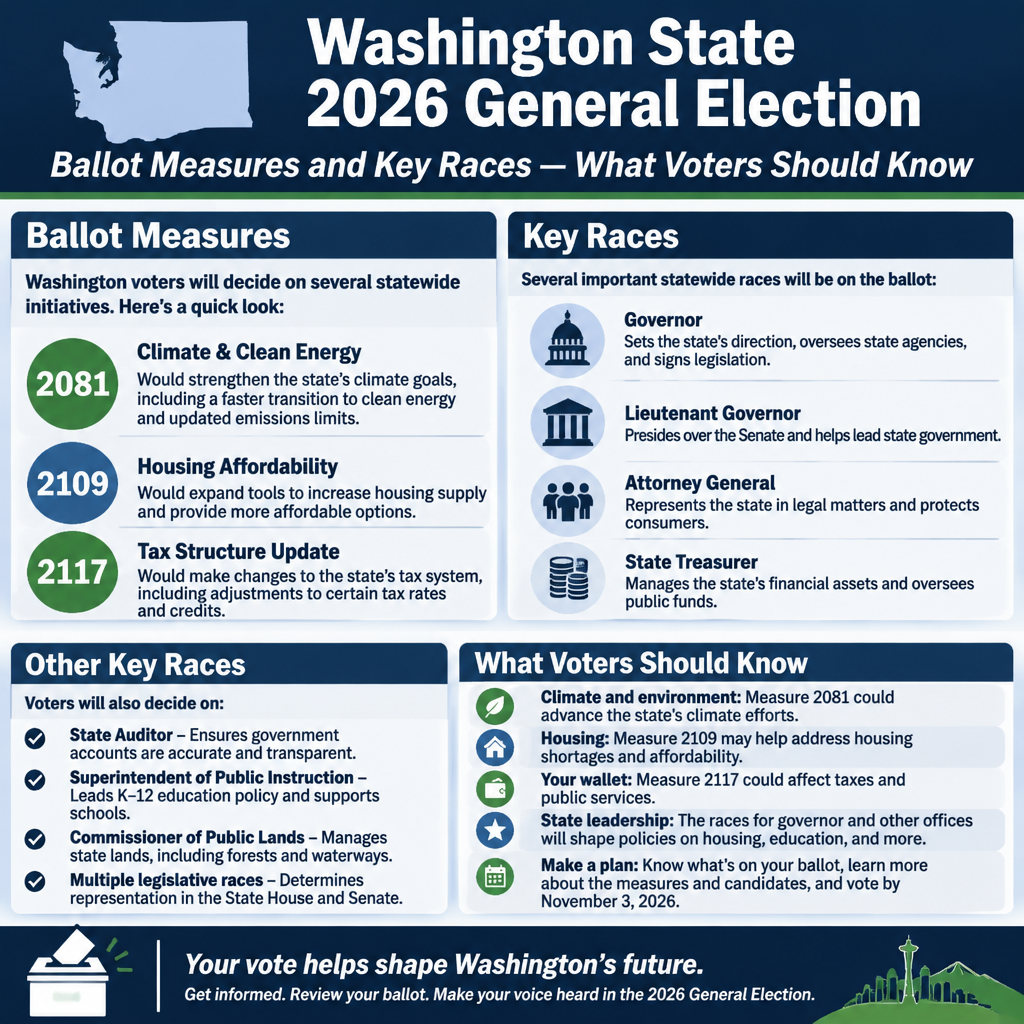
The ballot also put three initiatives in focus. I-645 addressed a proposed income tax on annual income above $1 million and whether that tax should remain in place. I-638 addressed eligibility rules for transgender girls in K-12 girls’ sports. I-001 addressed parents’ access to student records and information about school-provided services. Each raised a different question about government authority, public spending, privacy, fairness and the rights of families and students.
I’ve analyzed enough election coverage to be wary of one-size-fits-all narratives. A statewide result can be important, but it does not reveal every district’s priorities or settle how a policy will work in practice. The useful questions are more precise: What did the measure actually say? Who would administer it? What evidence would show whether it delivered what supporters promised?
Core Details and Context
The most consequential choices did not all concern candidates. Initiatives can change statutes or set policy direction, while elections determine who will write budgets, oversee agencies and vote on future legislation. Voters assessing the 2026 ballot faced both types of decision at once.
- Initiative 645 and the millionaires tax: The measure was described as repealing a 9.9% tax on income above $1 million and prohibiting state and local governments from taxing individual income. Under the tax plan described before the vote, the tax would take effect in 2028, with collection scheduled to begin in 2029. Revenue was intended for child care, K-12 education and free school meals, with an estimate of more than $3 billion a year. That revenue figure was an estimate, not a guarantee. Tax receipts depend on law, economic conditions and how the policy is implemented. The official Secretary of State initiatives and referenda page is the place to check measure documents and official descriptions.
- Initiative 638 and school sports: The proposal would prohibit transgender girls from competing on K-12 athletic teams designated for girls or women. It also would require female athletes to provide documentation from a health-care provider verifying biological sex through reproductive anatomy, genetics or testosterone levels. The described rules applied to school districts and nonprofit organizations overseeing interscholastic activities. The practical debate was not just about the wording of a rule; it involved student privacy, athletic eligibility, equal treatment and how schools would handle disputes. Those questions deserve careful, fact-based discussion rather than slogans.
- Initiative 001 and parental access: Voters were asked whether to restore provisions of a 2024 law known as the Parents Bill of Rights. The measure would require schools to provide student records and instructional materials within ten days of a parent’s request, rather than the 45-day timeline established by a 2025 law. It would also restore parental access to school medical and mental-health counseling records and require advance notice about medical services provided to a child at school. The difficult policy question is how to respect parental responsibility while protecting a student’s privacy and safety in particular circumstances. A short ballot label cannot resolve every case.
The congressional contests added a more familiar set of decisions. In District 2, longtime Democratic incumbent Rick Larsen faced Republican Edwin H. Feller. In District 3, Democrat Marie Gluesenkamp Perez faced Republican state Sen. John Braun. District 4 was open after Republican Dan Newhouse chose not to seek reelection; Republican Amanda McKinney and Democrat John Duresky advanced from a field of 11 candidates.
Those races carried different local concerns. Larsen’s campaign highlighted health-care, housing and child-care costs, jobs and infrastructure, along with oversight of the Trump administration. Feller emphasized reducing government spending, border security, law enforcement and lower taxes. Gluesenkamp Perez focused on working families, vocational education, manufacturing, infrastructure and rural communities, while Braun emphasized taxes, public safety, government accountability and economic growth. Candidate priorities are promises, of course. A campaign statement is not a budget, a bill or a record of results.
Public money is a trust. That principle applies whether the argument is about taxes, schools, roads or public safety: decision-makers should explain who pays, who benefits and what evidence will be used to judge the outcome. The same standard applies to voter claims. A big number in a campaign advertisement deserves a clear source and a plain explanation.
Timeline: How Voting and Counting Worked
- Before the election: registration and ballot preparation. Washington voters could register online or by mail ahead of the election, and the state also allows eligible residents to register in person through Election Day. Exact requirements depend on the registration method. The Secretary of State’s voter registration guidance lays out the rules. A voter who moved, changed a name or needed to update registration had reason to check their record rather than assume it remained current.
- Ballots went to registered voters. County election offices prepared and mailed ballots for the general election. Voters marked their choices, followed the ballot instructions and signed the return envelope. That signature is not decorative. Election officials compare it with the voter’s registration record as part of the verification process.
- Voters returned ballots. Ballots could be returned through an official drop box or by mail under the state’s deadline rules. Voters should use the official instructions for the election in question; a postmark and a drop-box deadline are not interchangeable details. When in doubt, use an official drop box and confirm its closing time with the county. The state’s VoteWA portal provides voter services, including ballot-status information.
- Counties reported the first returns. The first results were expected shortly after 8 p.m. on November 3, from ballots submitted early enough to be processed. Those totals were an opening snapshot. They did not include every eligible ballot, and no responsible reader should treat the first batch as a final count.
- Updates followed as processing continued. Counties typically posted additional results daily after Election Day. Election workers reviewed ballots, addressed signature questions and added eligible votes to the totals. When the margin is small, a late batch can change the apparent lead. That is not evidence of misconduct by itself; it is a normal feature of counting ballots that arrive and are processed under established rules.
- Canvassing and certification established the official result. County election offices review and certify their results, and the state completes its own certification process. Until that work is finished, projections and preliminary tallies should be labeled accurately. If an outcome is close, the applicable recount rules may also matter. A projected winner is a journalistic call; a certified result is an official election record. They are related, but they are not the same thing.
I would not infer a winner from the candidate biographies or the first batch of returns. The honest way to check a race after Election Day is to consult the official county or state results page, note whether the numbers are preliminary or certified, and return later if canvassing is still underway. If a ballot status shows a problem, voters should follow the county’s instructions promptly. Small administrative steps can determine whether a ballot is counted.
Comparison Table: Rick Larsen and Edwin H. Feller in District 2
District 2 offered voters a choice between a long-serving member of Congress and a first-time candidate with a career outside elected office. The table compares the profiles and priorities presented before the election; it does not describe the result or independently verify every campaign claim.
| Category | Rick Larsen | Edwin H. Feller |
|---|
| Party and district | Democrat; Washington’s 2nd Congressional District | Republican; Washington’s 2nd Congressional District |
| Public-service background | Represented the district in Congress since 2001; previously served on the Snohomish County Council | First run for elected office; served with the U.S. State Department supporting diplomatic facilities overseas |
| Earlier work | Worked for the Port of Everett and the Washington State Dental Association | Worked for decades in the heating and air-conditioning industry |
| Priorities described by campaign | Lower costs for health care, housing and child care; jobs and infrastructure investment; oversight of the Trump administration | Lower government spending and taxes; border security; support for law enforcement |
| Central choice for voters | Experience in Congress and a policy agenda centered on household costs, jobs and oversight | A first-time candidacy emphasizing spending restraint, public safety and lower taxes |
The contrast is real, but a two-column table can make the decision look simpler than it is. Voters also weigh party control, district needs, a candidate’s record, committee work and the practical odds of moving legislation through Congress. One candidate’s long tenure can mean institutional knowledge; it can also invite scrutiny over what has and has not changed. A newcomer may offer a different approach, but voters have less public voting history to assess.
District 3 presented another kind of contrast. Gluesenkamp Perez had built a reputation as a centrist Democrat who sometimes broke with her party on border security, government funding and law-enforcement issues. Braun, a Republican state senator and Senate Republican Caucus leader since 2021, emphasized tax reduction, public safety, accountability and economic growth. Their records and platforms should be examined against the same standard: what is promised, what is within the office’s authority and what measurable result would count as success?
District 4 was different again because it had no incumbent seeking another term. McKinney and Duresky advanced from a crowded primary field to compete for an open seat in traditionally conservative Central Washington. An open seat can draw attention, but the label “open” tells voters nothing by itself about who will represent the district effectively. The candidate’s proposals, experience and ability to answer hard questions matter more than the vacancy.

Common Misconceptions and What to Know
Misconception: Election-night totals are final. They are not. The first figures show ballots that have been processed and reported at that point. Counties continue counting eligible ballots, so early totals can change. A lead on election night is not the same as a certified result. Coverage should say “leading” or “projected” when that is what the evidence supports, and reserve “official” for the appropriate certification stage.
Misconception: A mailed ballot is automatically counted. A voter must return a ballot correctly and on time, and the county must be able to verify it under election rules. Signature questions can require a voter to take action. The useful habit is simple: track the ballot rather than assume. VoteWA and county election offices are better sources for an individual ballot’s status than a social-media post or a neighbor’s experience.
Misconception: A campaign’s estimate is the same as a guaranteed outcome. It is not. The more-than-$3-billion annual estimate tied to the tax at issue in I-645 was a projection. Projections rest on assumptions about income, behavior and economic activity. Likewise, promises about savings, school services or tax relief need scrutiny: who calculated the figure, what period does it cover, and what would have to happen for it to materialize? Frankly, a large dollar figure without its assumptions is more sales pitch than analysis.
Misconception: A ballot measure settles every implementation question. The text matters, but administration matters too. A rule affecting school sports may raise questions about who checks documentation, how privacy is protected and what recourse exists when eligibility is disputed. A parental-records measure may set response deadlines and access rights but still leave difficult cases for schools and families. Voters should distinguish the policy goal from the procedures used to carry it out.
Misconception: Candidate labels tell the whole story. Party affiliation helps voters understand broad political alignment, but it is not a complete job description. Gluesenkamp Perez’s occasional departures from her party were relevant to her profile, just as Braun’s legislative leadership role was relevant to his. Larsen’s tenure offered a record to review; Feller’s first campaign required voters to weigh stated priorities and outside experience. None of those details automatically proves competence or failure.
Misconception: A contested result is evidence that the process failed. A close count can be ordinary, particularly when ballots are processed over several days. The right questions are whether ballots were handled under published rules, whether voters had a way to resolve signature issues and whether election offices reported transparent totals. Claims of irregularity should come with verifiable evidence. Suspicion, repeated often enough, is still not evidence.
And one point deserves more attention: how public benefits are paid for. A campaign may promise lower taxes and better services at the same time, but the arithmetic has to work. Stewardship means asking how revenue is raised, how it is spent and whether the public can measure the result. That is not partisan. It is basic accountability to the people who fund government and depend on its services.
Frequently Asked Questions
When was Washington’s 2026 general election?
The general election was Tuesday, November 3, 2026. The candidate and initiative information in this article describes the contests before voting. For final outcomes, consult official state or county results and check whether the figures are preliminary or certified.
How could Washington voters track a ballot?
Voters could use the state’s VoteWA portal to check ballot status and access voter services. If a ballot was flagged for a signature issue or another administrative question, the voter should follow the county election office’s instructions. A status check is more reliable than assuming that a ballot was received simply because it was mailed.
What were the three initiatives discussed in the election?
I-645 addressed repealing a proposed 9.9% tax on income above $1 million and barring state and local individual income taxes. I-638 addressed restrictions on transgender girls’ participation in K-12 girls’ sports and documentation requirements. I-001 addressed parents’ access to student records, instructional materials and school medical or mental-health information. Consult official measure documents for exact language and final outcomes.
Which congressional races drew particular attention?
The District 2 contest paired incumbent Democrat Rick Larsen with Republican Edwin H. Feller. In District 3, Democrat Marie Gluesenkamp Perez faced Republican state Sen. John Braun. District 4 was open after Dan Newhouse opted not to run again, with Republican Amanda McKinney and Democrat John Duresky advancing to the general election. These descriptions identify the pre-election matchups, not the winners.
Final Thought
The 2026 ballot put practical questions in front of Washington voters: what taxes should fund, how schools should balance competing rights and responsibilities, and which people should represent districts in Congress and Olympia. Those questions do not become simple because the voting period ends. They move into budgets, court challenges, agency rules and the daily work of elected officials.
Now the useful discipline is to separate three things: what the measure said, what voters decided and what government does next. The first belongs in the official text. The second belongs in certified election results. The third requires follow-up reporting, because campaign promises do not implement themselves. If a measure passed, watch for the fiscal notes, administrative rules and funding decisions. If it failed, pay attention to whether lawmakers return to the same issue through legislation. Either way, the public deserves clear accounting.
I’m skeptical of coverage that treats a single election night as the whole story. The count is important, but so are the choices made after it—especially choices involving children, working families, public resources and the dignity of people affected by policy. Good citizenship is not just casting a ballot. It is keeping an eye on how authority is used and asking whether the results serve the common good.
Sources