Washington State Tire Chain Laws: When Chains, Traction Tires and Studded Tires Are Required
Washington’s tire-chain rules change with road conditions, vehicle weight and the signs posted on a route. Drivers heading into the mountains should know which tires or devices are allowed, where chains go, and when studded tires are legal. A posted chain requirement is not a suggestion; ignoring it can carry a fine.
The practical advice is simple: prepare before the weather turns, not after traffic slows to a crawl. Washington State Department of Transportation (WSDOT) warns that winter conditions can change quickly, especially at higher elevations, where a clear morning can become a snowy pass crossing. A vehicle that handles wet pavement well may still need different equipment when snow and ice arrive.
Check the vehicle owner’s manual, inspect your tires, and make sure any chains fit the tires you actually use. Then practice installing them at home, where cold fingers and passing traffic are not part of the lesson. I’ve analyzed the rules as a driver’s checklist, not a promise that any single device will suit every car or every road. The exact instruction on the sign controls.
What Are Washington State Tire Chain Laws?
Washington’s tire-chain laws and pass restrictions set the equipment drivers must use when winter conditions make a route hazardous. The rules are communicated through roadside signs and WSDOT updates, and they distinguish between passenger vehicles, heavier vehicles, traction tires, chains and approved alternatives. The central point is easy to miss: there is no single chain rule that applies identically to every vehicle at every moment.
A traction tire is a tire that meets Washington’s applicable requirements for winter traction. Drivers should check the state’s current definition and the tire’s markings rather than assume that a tire marketed for year-round use qualifies in every situation. WSDOT’s traction tire and chain information explains the equipment categories and road restrictions. The rules are about what is mounted or carried when required, not just what a driver considers suitable.
The law also treats weight as a dividing line. Passenger vehicles under 10,000 pounds face different instructions from vehicles over 10,000 pounds, including many larger commercial vehicles. That distinction matters at each stage of a chain advisory. A driver should not assume that a rule for a small car automatically applies to a truck, tractor-trailer or other heavy vehicle.
WSDOT’s posted levels move from traction tires advised to traction tires required, then to tire chains required, and finally to chains required on all vehicles. The final level is usually the last step before a pass closes. Conditions can deteriorate between signs or updates, so a plan made at home should include a way to check current information. Frankly, the sign is more important than yesterday’s forecast.
Washington’s state law on studded tires separately sets the ordinary dates when they may be used. Rules about studs do not cancel chain-up requirements. Nor should the word “alternative” be read as a free-for-all: a device counts only if it is accepted for the relevant requirement. Where the rule is unclear, check the state guidance before driving into a chain-control area.
Core Details: The Four Road-Condition Levels
WSDOT uses four main responses to worsening road conditions. Read each sign carefully, because the requirements change as conditions worsen and vehicle classes are treated differently. A driver who learns the categories before a trip is less likely to make a hurried, unsafe decision on the shoulder.
- Traction tires advised: Traction tires are recommended for passenger vehicles but are not required. Larger vehicles, including tractor-trailers, must have traction tires installed and chains in the vehicle in case conditions worsen. Oversized loads cannot travel on roads under this advisory.
- Traction tires required: Passenger vehicles under 10,000 pounds must have approved traction tires, chains or an approved alternative. Larger vehicles must use chains or an approved alternative.
- Tire chains required: Front-wheel-drive and rear-wheel-drive passenger vehicles, as well as all vehicles over 10,000 pounds, must use chains or an approved alternative. Other passenger vehicles under 10,000 pounds must have traction tires installed or use chains or an approved alternative.
- Chains required on all vehicles: Every vehicle must use chains or an approved alternative. WSDOT describes this as generally the final step before a pass closure.
The wording can feel technical, but the sequence is deliberate. Early advisories encourage drivers to improve traction and require larger vehicles to carry equipment; later levels require more vehicles to install it. A driver should not treat “traction tires advised” as proof that a pass will remain easy, or “chains required” as a cue to shop for equipment at the last open gas station. That is a poor place to discover the chains do not fit.
Weight matters, too. If you are unsure which class your vehicle falls into, check its listed gross vehicle weight rating and confirm the applicable state guidance. Do not guess based on how large the vehicle looks or how much luggage is inside. Commercial vehicles, trailers and oversized loads can have additional rules, and WSDOT provides separate instructions for some of them.
Approved alternatives deserve careful attention. Some vehicles have limited clearance or manufacturer restrictions that make ordinary chains unsuitable, but that does not mean any substitute is automatically legal. Washington State Patrol and WSDOT guidance should be checked for the specific equipment and road requirement. A device that works well in a driveway may not qualify under a posted chain rule. Keep its instructions and fit information with the vehicle, and make sure every driver knows how to use it.
The safest preparation also includes the basics. Check tire condition and pressure, lights, brakes, windshield wipers and fluid levels before a long winter drive. WSDOT’s winter driving advice is a useful companion to the equipment rules. Chains help with traction; they do not repair worn tires, shorten every stopping distance or make an unsafe speed sensible.
Timeline: How to Prepare and Respond
Preparation starts before the trip. The sequence below is a practical way to apply Washington’s rules without waiting for a roadside sign to become an emergency.
- Check your route and vehicle. Before departure, review WSDOT pass conditions and weather information for the roads you plan to use. Confirm the vehicle’s drive type, weight class, tire size and owner-manual instructions. I would verify those details before loading the car, when there is time to correct a mismatch.
- Choose compatible equipment. Buy chains or another approved device that fits the exact tire size and is allowed for your vehicle. Some vehicles have restrictions on chain use; the owner’s manual is the place to start. If an alternative is needed, confirm that it meets Washington’s requirement rather than relying on a product label alone.
- Practice at home. WSDOT recommends learning how to install chains before winter travel. Read the manufacturer’s directions and practice fitting the equipment to the correct tires. The first attempt should not happen in freezing weather beside moving traffic.
- Carry the equipment. Keep chains, gloves and any installation tools where they can be reached without unloading the whole vehicle. Check that the gear is complete and not damaged. For heavier vehicles, follow the specific requirements on whether chains must be carried, installed or both.
- Read the sign and act early. When approaching a chain-control area, obey the posted level. Install equipment at a safe, designated location before conditions become dangerous, and do not stop in a travel lane or an exposed shoulder to work. If installation cannot be completed safely, do not force your way onward.
- Install chains on the correct tires. For front-wheel drive, chains go on the two front tires; for rear-wheel drive, they go on the two rear tires. For four-wheel or all-wheel drive, the state guidance says to use either the front pair or rear pair and check the owner’s manual. Follow the chain manufacturer’s instructions, then recheck fit after moving a short distance if those instructions call for it.
- Reassess before returning to normal roads. Remove chains when road and manufacturer instructions permit, and avoid driving on bare pavement with chains unless conditions or guidance require it. Store equipment so it is ready for another trip. A cleared section of highway does not prove the next pass is clear.
There are special considerations for trailers. For non-commercial trailers and recreational vehicles under 10,000 pounds, the required chains are generally installed on the pulling vehicle in the normal way, though chains may also be put on the trailer. Commercial vehicles, trailers and loads over 10,000 pounds should follow WSDOT’s commercial chain guidance rather than a passenger-car rule of thumb.
Winter driving rewards patience. Leave extra time, create more space between vehicles, and avoid abrupt steering or braking where traction is poor. Chains are equipment, not permission to drive as if the road were dry. The common good here is quite practical: fewer blocked lanes, fewer preventable collisions and less risk to the people clearing the road.

Tire Chains vs. Studded Tires: What Is the Difference?
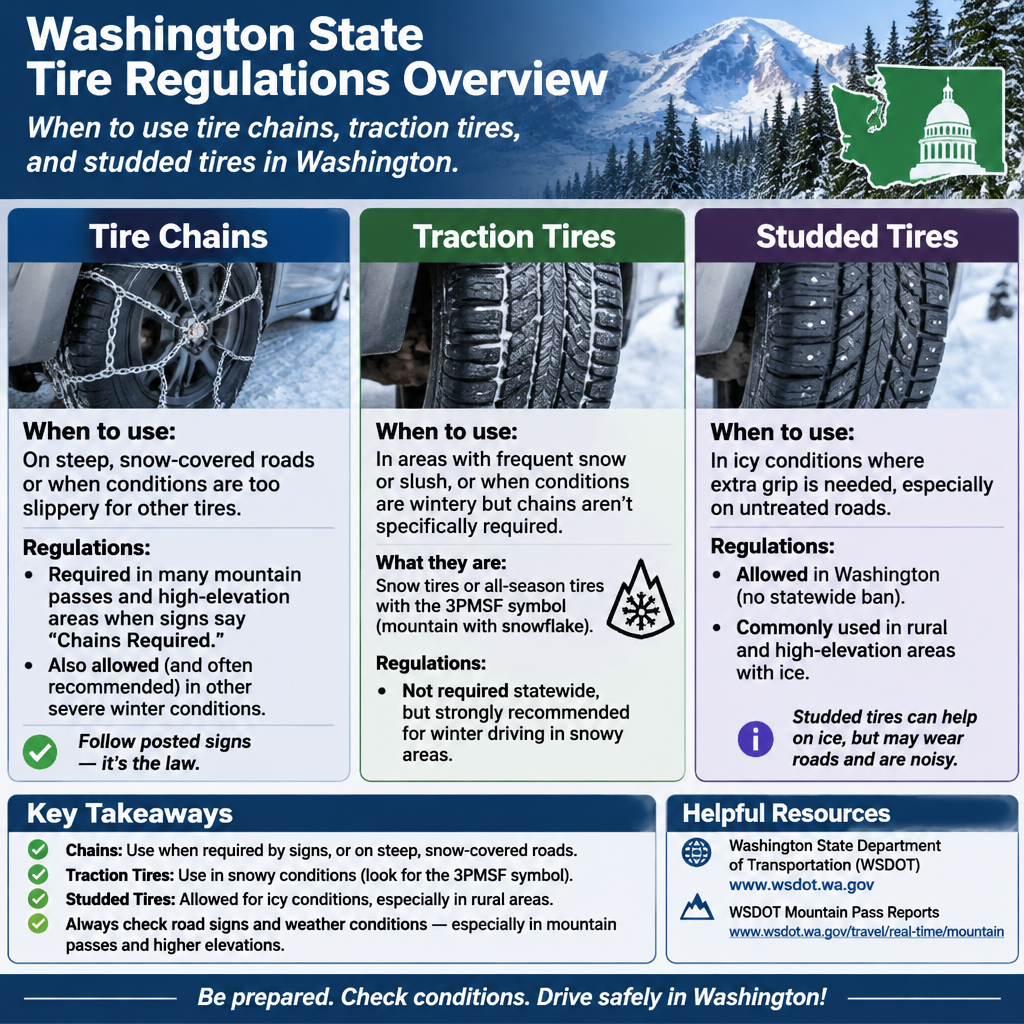
Chains and studded tires are not interchangeable. Chains are temporary traction equipment installed when road conditions or signs require them, while studded tires are tires with metal studs that may be used only during Washington’s permitted season unless the state extends the dates because of unusual weather. Most importantly, studded tires do not satisfy a chain requirement.
| Feature | Tire chains or approved alternative | Studded tires |
|---|
| Main role | Temporary equipment used when posted conditions require it | Seasonal tire option for winter traction |
| When required or allowed | Must be used when the applicable sign requires them; exact rules depend on vehicle and weight | Generally legal November 1 through March 31; WSDOT may extend the period in exceptional conditions |
| Replaces a chain requirement? | Yes, if the device is an approved chain or alternative for that requirement | No; studs do not meet chain requirements |
| Where installed | Placement depends on drive type, vehicle instructions and the applicable rules | Installed as tires on the vehicle; follow vehicle and tire guidance |
| Road impact | Temporary use; follow directions and remove when appropriate | Studs can damage road surfaces, especially when used longer than needed |
| Main caution | Confirm fit, approval and safe installation | Observe dates and recognize that stopping on dry pavement may take longer |
The comparison is not a contest with one universal winner. Chains provide a response to a specific road requirement, while studded tires are a seasonal choice that does not override the sign. A driver who owns studded tires may still need chains or an approved alternative in the vehicle, depending on the route and posted level. That detail catches people out every winter.
The state’s date window is normally November 1 through March 31. In unusual circumstances, including severe late-season snow or ice, WSDOT can extend the period. Check current WSDOT notices rather than assuming an extension has occurred or that the usual deadline has changed. The Washington Administrative Code section on tire requirements provides additional regulatory detail.
There is a cost on the other side of the choice. WSDOT has reported that studded tires cause an estimated $20 million to $29 million in damage to state roads each year. Studs can also increase stopping distance on dry pavement compared with other tires. WSDOT has urged travelers to consider non-studded winter-tread tires, which differ from ordinary all-season tires and are legal year-round when they meet applicable requirements. Road upkeep is a shared public expense; using equipment only when it serves a real need is ordinary stewardship, not a lecture.
Common Misconceptions: What Drivers Should Know
Misconception 1: Studded tires count as chains. They do not. Washington’s guidance says studded tires fail to meet a chain requirement, so a driver may need to install chains over the tires or use an approved alternative when the sign demands it. Before relying on a particular setup, check both the vehicle manual and state instructions. A tire that bites into ice is not automatically a substitute for the device named on the sign.
Misconception 2: All-wheel drive means chains are unnecessary. It does not. The chain rules cover vehicles differently according to posted conditions and weight, and the highest level applies to all vehicles. All-wheel drive can help a vehicle move, but it does not guarantee it can stop or steer safely on ice. Check the manual for approved chain placement and obey the road restriction.
Misconception 3: All-season tires always qualify as traction tires. The label alone is not enough to settle the question. Washington has requirements for approved traction tires, and drivers should verify tire markings, condition and the state’s current definition. When the sign says chains are required for your vehicle class, qualifying traction tires may still not be enough.
Misconception 4: Carrying chains means you have complied. Carrying is important, but some posted levels require equipment to be installed. At other levels, the rules distinguish between a requirement to carry chains and a requirement to use them. Read the exact sign and confirm what applies to your vehicle. Do not confuse preparedness with compliance.
Misconception 5: A chain alternative is any traction device. The word “approved” does the work here. Washington maintains criteria for alternatives, and a product should not be treated as lawful merely because it is sold for snow or fits a tire. Check official guidance, the vehicle manual and the device maker’s instructions before travel. If the device is not accepted for the posted rule, it may leave you no better off legally than having nothing.
Misconception 6: Studded tires can stay on until the roads look clear. Washington’s normal dates are fixed, not based on a driver’s personal estimate of when winter ended. Studded tires are generally permitted from November 1 through March 31, with possible state extensions in unusual conditions. Using them outside the allowed dates can bring a $137 fine, and unnecessary use can wear the road surface.
Misconception 7: A pass forecast is a guarantee. It is not. Conditions can change quickly at elevation, and a report from earlier in the day can become stale. Check WSDOT updates close to departure and again when practical during a long trip. If a route has deteriorated, delaying travel or choosing another route is often wiser than betting that the next curve will be better.
Penalties are another detail worth getting straight. Washington says failure to install chains when required can result in a $500 fine. The precise circumstances of enforcement depend on the applicable requirement, but the safe response is not to test the boundary. Chains and tires are also only part of winter readiness: leave extra stopping room, use lights when visibility falls and follow any closure or restriction. The rule protects more than a driver’s wallet; it reduces danger for everyone sharing the road.
Frequently Asked Questions
When are chains required in Washington state?
Chains or an approved alternative are required when the posted road restriction says they are required for your vehicle class. WSDOT uses four levels, from traction tires advised through chains required on all vehicles. Requirements also differ by vehicle weight and drive type. Check current pass conditions before departure and obey the signs on the route; a general seasonal recommendation does not replace the live instruction.
Where should I put chains on my vehicle?
For a front-wheel-drive vehicle, install them on the two front tires; for rear-wheel drive, use the two rear tires. For four-wheel or all-wheel drive, Washington guidance allows either the front pair or rear pair, but drivers should check the owner’s manual. Commercial vehicles and some trailers have separate instructions. Follow the chain manufacturer’s fitting directions and practice before traveling.
Are studded tires legal in Washington state?
They are generally allowed from November 1 through March 31. WSDOT may extend the period when severe weather creates unusual conditions beyond those dates, so check for an official notice instead of assuming the deadline has moved. Studded tires do not count as chains when chains are required, and they can damage roads when used longer than necessary.
What is the fine for breaking Washington’s chain or studded-tire rules?
Failure to install chains when they are required can result in a $500 fine. Using studded tires outside the permitted dates can result in a $137 fine. Drivers should also consider the risks beyond the ticket: inadequate traction can contribute to a collision, block a pass and put other road users and maintenance crews in danger.
Final Thought
Winter travel is easier when the decisions happen before the snow does. Check the pass, confirm your tire setup, carry equipment that fits, and learn how to install it while your hands are warm. Then treat every posted restriction as current information, not a challenge to your driving skill. A familiar route can turn treacherous quickly when temperatures drop or precipitation changes.
The useful distinction is plain: traction tires may satisfy some restrictions, but chains or an approved alternative are required at higher levels, and studded tires never replace that chain requirement. Weight and drive type can change what applies, so the manual and the sign matter. If the equipment is incompatible or the route is closed, waiting is a sensible decision, not a failure of nerve.
When I look at the rules, the point is not to punish someone for owning the wrong tire. It is to keep vehicles moving safely, protect road workers and limit damage to infrastructure paid for by the public. Check the latest WSDOT guidance and Washington law before your trip, especially if conditions or dates are unusual. A little preparation is cheaper than a tow, a collision or a preventable delay on a mountain pass.
FAQPage Schema