The Washington Supreme Court has put universities on notice. In a ruling tied to the hazing death of freshman Sam Martinez, the court said <strong>Washington...
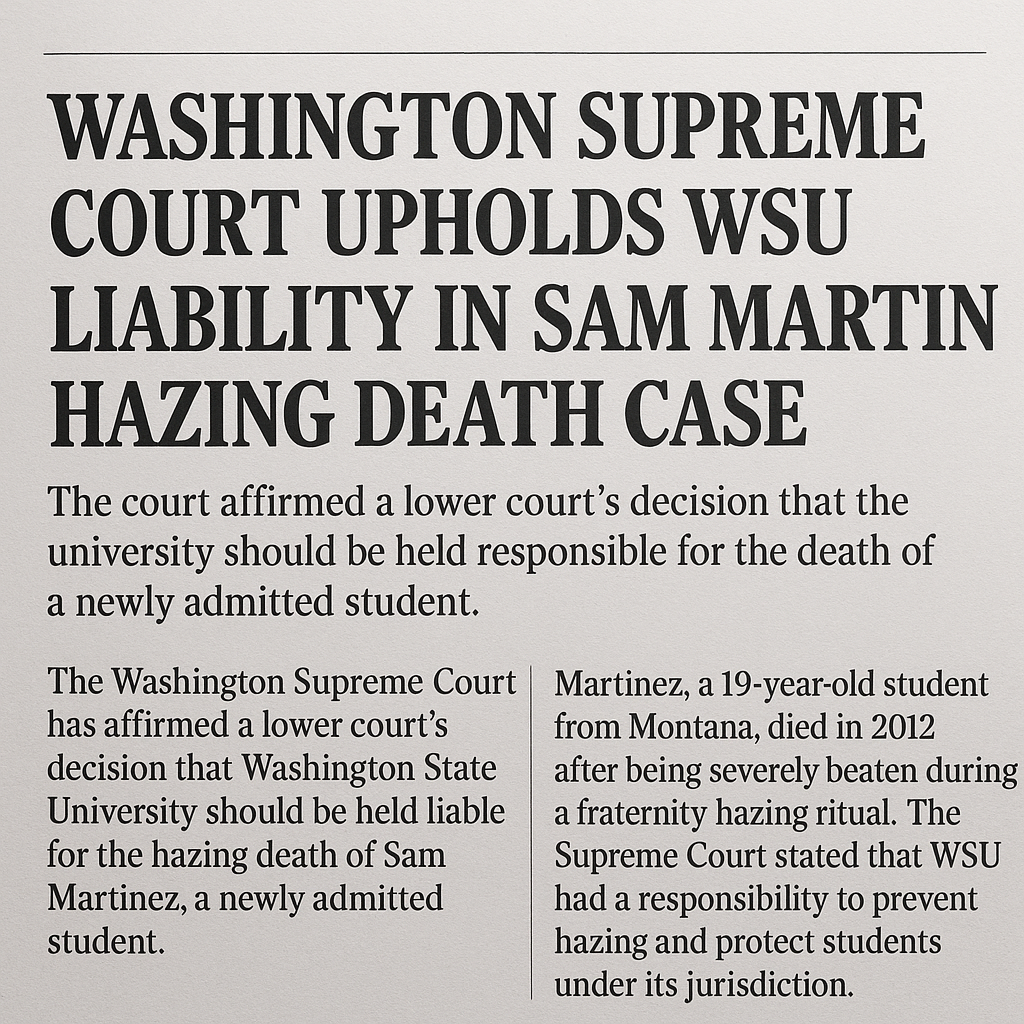
The Washington Supreme Court has put universities on notice. In a ruling tied to the hazing death of freshman Sam Martinez, the court said Washington State University had a duty to protect students like him, even when the harm grew out of a fraternity culture that was supposed to be off-campus and private. That is the core of the case.
Hazing is not harmless tradition.
It can be abuse, and when schools know that abuse is possible, the law may treat silence as negligence. What the justices affirmed matters far beyond one family’s grief. It speaks to campus oversight, student safety, and the old excuse that nobody could have seen this coming. Frankly, that excuse is wearing thin.
Key Takeaways- The Washington Supreme Court upheld a ruling that WSU can be held liable in the hazing death of Sam Martinez.
- The court found the university had a duty to protect students in certain circumstances, even from fraternity-related dangers.
- The case may affect campus liability, Greek life policies, insurance, and how universities supervise student organizations.
- Families of students say the ruling recognizes a basic moral point: institutions that collect tuition and claim stewardship over young adults cannot look away when known risks fester.
- The decision could influence future hazing lawsuits in Washington and beyond.
What is the WSU hazing liability case?
The case is about a freshman’s death, a fraternity’s conduct, and whether a public university had a legal responsibility to intervene before tragedy struck. Sam Martinez, a first-year student at Washington State University, died after a fraternity hazing incident. His family argued that the school failed in its duty to protect him from foreseeable harm.
That sounds simple. It isn’t.
Courts usually have to decide where a university’s responsibility ends and where student autonomy begins. Schools are not supposed to parent every adult on campus, and nobody serious wants a college acting like a surveillance state. But when a university knows that a student organization has a pattern of hazing or violence, the question changes. Then the issue becomes whether the school acted like a steward of student welfare or merely a landlord collecting fees.
The Washington Supreme Court’s ruling suggests that, under state law and the facts of this case, the university could not shrug off its role. The judges found that WSU owed a duty of care in the circumstances surrounding Martinez’s death. That does not mean every school is automatically liable whenever a student group behaves badly. It does mean the law may not tolerate deliberate blindness.
Most coverage reduces this to a legal procedural story. That misses the real point. This is about human dignity, and whether institutions are willing to treat young people as persons rather than statistics. The biblical standard is plain enough: if you are entrusted with another’s welfare, you do not get to wash your hands when warning signs pile up.
For readers tracking related campus policy fights, the broader issue connects to nationwide pressure on universities to crack down on abuse in Greek life, athletics, and student clubs. The same logic appears in other public safety disputes, including student accountability and campus safety, though each case turns on its own record and state law.
Core Details and Context
The ruling matters because it sits at the intersection of tort law, campus governance, and fraternity oversight. That trio is messy. Universities often promote a tidy image of student life, but the reality is less polished. Here’s the ugly part: Greek organizations can create incentives for silence, and silence is what makes hazing dangerous.

- Duty of care: The court agreed that WSU had a legal obligation toward Martinez under the facts presented. That is the central holding, and it is the part universities will study closely.
- Foreseeability: Liability in negligence cases often turns on whether harm was foreseeable. If hazing risk was known or should have been known, the school’s inaction becomes harder to defend.
- Institutional control: Schools argue they cannot control private student groups. Critics reply that universities regulate housing, conduct, recognition, disciplinary systems, and access to campus resources. In other words, they have more power than they admit.
- Public responsibility: Because WSU is a public university, the case also raises questions about government-backed institutions and their obligation to the public good. Public money should not underwrite avoidable harm. That should not be a controversial sentence, but here we are.
- Signal to other schools: The ruling may push administrators to document complaints more carefully, respond faster, and treat hazing reports as more than PR problems.
I’ve covered enough institutional scandals to know the pattern. The first response is always denial. Then comes minimization. Then the apology, once the damage cannot be hidden. This case cuts against that script.
The university’s defenders will likely argue that liability standards must remain narrow or schools will be sued for nearly everything that happens on campus. There is some truth there. If the law becomes absurdly broad, it can punish caution and create bureaucratic sludge. But the reverse is also true: if liability is too narrow, institutions learn that doing nothing is cheaper than prevention.
That is bad law and worse ethics.
The issue also overlaps with Washington state’s broader legal and policy response to hazing. State lawmakers, student groups, and parents have increasingly demanded stronger reporting rules, more aggressive penalties, and clearer authority for administrators to suspend or expel dangerous organizations. A legal ruling like this gives those demands extra weight.
Related reporting on student safety and governance has repeatedly shown how institutions respond only after scandal forces them to. For context on how courts and public institutions have handled similar accountability disputes, see coverage from Reuters, The Associated Press, and The Wall Street Journal.
The plain moral lesson is older than the law: if a community knows a vulnerable person is in danger, it has a duty to act. That is not sentimental. It is justice.
Timeline and What Actually Happened
This case did not appear out of nowhere. It developed through tragedy, litigation, and appellate review. Here’s the basic sequence.
- Martinez enrolled at WSU as a freshman.
He joined a campus environment that, like many large universities, included fraternities, social pressure, and initiation rituals that can go wrong fast.
- The hazing incident occurred.
According to the case record, fraternity conduct led to the events that caused Martinez’s death. Hazing cases often involve alcohol, coercion, humiliation, or physical strain. Sometimes all of the above.
- His family sued.
The lawsuit argued that WSU had enough knowledge and authority to take steps that might have prevented the tragedy.
- A lower court found liability.
That meant the claim did not die on the vine. The legal system was willing to say the university’s role deserved scrutiny.
- The case reached the Washington Supreme Court.
This is where the dispute turned from one family’s claim into statewide legal precedent.
- The court upheld the ruling.
The justices agreed that WSU had a duty to protect students like Martinez. That is the headline, but the reasoning matters more than the headline.
- The broader fallout begins.
Universities, insurers, student life offices, and Greek councils will read this decision closely. Some will update policies. Some will lawyer up. Some will pretend the ruling is an outlier. Let’s be real: they will not all act with the same urgency.
When I look at cases like this, I always ask one blunt question: what did the institution know, and when did it know it? That is not just a political cliché. It is the backbone of responsibility. If there were warnings, prior complaints, disciplinary issues, or a pattern of risky behavior, then the story is not simple misfortune. It is a failure of stewardship.
There is also a practical reason the timeline matters. In hazing cases, delays are deadly. A school that waits for proof beyond all doubt before acting may be waiting for a body. Courts know this. Families know it. Universities usually learn it only after the headlines.
The Martinez ruling will likely be cited by attorneys in future cases involving fraternity injury, alcohol abuse, and campus negligence. It may also shape how administrators respond to internal complaints. A paper trail can now help prove diligence—or expose the opposite.
For readers who want more context on Washington institutions and legal accountability, see coverage from The Seattle Times and Fox News, which have reported on campus disputes, state policy, and liability trends in the region.
Comparison Table
Below is the practical comparison that schools and lawmakers will care about most: the WSU liability case versus the broader defense universities usually offer when hazing claims arise.
| Issue | WSU Case / Court’s View | Typical University Defense |
|---|
| Duty to students | Court recognized a duty of care in this setting | School says responsibility is limited once students are adults |
| Hazing risk | Harm deemed foreseeable enough to justify liability | University argues misconduct was unpredictable or hidden |
| Institutional role | University had enough oversight and authority to matter | School claims fraternity conduct was private and outside control |
| Legal exposure | Liability can attach when warnings and control exist | Defense stresses narrow negligence standards |
| Policy effect | Encourages stronger intervention and documentation | Favors lighter-touch oversight and self-regulation |
| Moral lens | Protecting student dignity is part of institutional duty | Focuses on autonomy, liability limits, and bureaucratic restraint |
The contrast is stark.
The school’s defense is built around boundaries, and boundaries matter. But a boundary is not a shield against common sense. If a university recognizes dangerous conduct yet keeps its hands clean to avoid paperwork or bad press, that is not prudence. That is cowardice with a logo on it.
Common Misconceptions and What to Know
A lot of people will get this wrong.
First, this ruling does not mean every university is now liable for every bad student decision. That would be nonsense. Courts still look at notice, control, foreseeability, and the specific facts. Law is supposed to be careful, not mushy.
Second, this is not just about one fraternity. Hazing is the visible symptom. The deeper issue is institutional culture. If a campus creates an environment where junior students are expected to submit to humiliation in exchange for belonging, the problem is bigger than one house on one street.
Third, some commentators will say lawsuits are a money grab. Sometimes they are. People exaggerate, lawyers posture, and everyone pretends not to know what everyone else is doing. But that cynical blanket dismissal is lazy. When a family loses a child, the legal system is often the only mechanism left to test whether adults in authority failed their duty.
Fourth, people will claim universities already have anti-hazing policies, so what more can they do? Policies on paper are cheap. Enforcement is expensive. That is the part administrators dislike. It requires training, discipline, recordkeeping, and the willingness to punish groups that generate alumni donations. Funny how that becomes complicated when money enters the room.
Here’s the kicker: the real question is not whether universities can eliminate all risk. They cannot. The question is whether they can reduce foreseeable harm without hiding behind slogans. That includes better reporting systems, faster suspension authority, mandatory education, and stronger cooperation with law enforcement when conduct crosses into criminal territory.
There is also a quieter issue. Universities are supposed to form character as well as award degrees. If they tolerate hazing, they teach a rotten lesson: that cruelty is the price of membership. That runs straight against any serious idea of the common good. A school worthy of trust should do more than preserve its image. It should defend the weak, because the weak are exactly who institutions are meant to serve.
For related legal and public accountability coverage, these sources remain useful: NPR, Reuters, and The Associated Press. They are not perfect—no outlet is—but they usually keep the spin to a dull roar.
Frequently Asked Questions
What did the Washington Supreme Court decide in the WSU hazing case?
The court upheld a ruling that Washington State University had a duty to protect students like Sam Martinez and could be held liable in connection with the hazing death. The decision reinforces that universities may face negligence claims when they have notice of serious risks and enough authority to act.
Does this mean every university is responsible for all fraternity misconduct?
No. Courts still examine the facts. Liability usually depends on notice, foreseeability, and the school’s actual ability to intervene. This ruling is important, but it is not a blank check for every lawsuit filed after a bad night at a fraternity house.
Why does the case matter beyond Washington?
Because schools nationwide face similar hazing risks. The ruling may influence how campuses handle complaints, supervise student groups, document warnings, and discipline organizations. Other plaintiffs’ lawyers will study it, and so will university general counsels. Everyone else should too.
What should parents and students take from this?
Treat hazing as a real safety issue, not a rite of passage. Ask schools how they investigate complaints, how quickly they suspend dangerous groups, and whether they publish disciplinary records. If a campus cannot answer those questions plainly, that tells you something.
Final Thought
This ruling is about more than legal liability. It is about what kind of institutions we allow to shape young lives.
A university is not merely a business. It is a guardian of knowledge, a caretaker of students, and, in a deeper sense, a trustee of hope. When a court says it had a duty to protect a freshman from known dangers, that should not sound radical. It should sound obvious.
Too often, public debate treats accountability as an annoyance and prevention as a budget line. That is backwards. Justice begins when power accepts responsibility for the people it affects. If a college cannot protect the dignity of its students, then it has mistaken prestige for purpose.
The market of excuses is crowded. The supply of common sense is not. Universities that want the public’s trust will need to earn it the hard way: with candor, discipline, and a willingness to stop calling abuse tradition.