Washington’s $4 Billion Budget Deficit: What Lawmakers May Cut in 2027
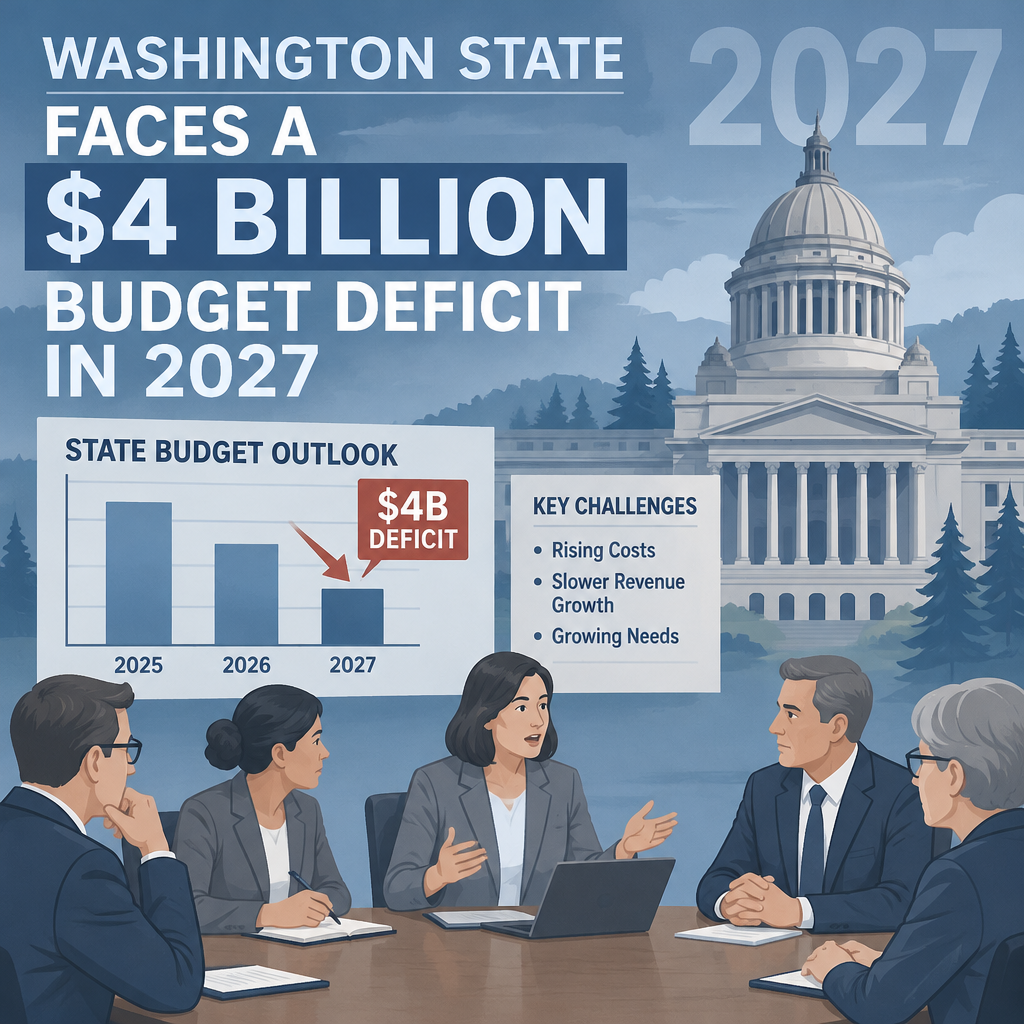
Washington is heading into the 2027 legislative session with a projected $4 billion budget shortfall, forcing lawmakers to weigh spending cuts against new revenue. House Majority Leader Joe Fitzgibbon says no option is categorically ruled out, while Republican budget negotiator Chris Gildon argues lawmakers must first rein in spending commitments.
A forecast is not a finished budget. It is a warning about the distance between expected money and expected obligations, based on assumptions that can change as revenues, costs and policy decisions shift. Washington’s official revenue forecasts are published by the Economic and Revenue Forecast Council, while the state’s budget materials explain how spending plans are assembled and updated through the budget process.
That distinction matters. Lawmakers return to Olympia at the start of 2027, but they will be negotiating the shape and timing of the state’s budget—not simply deciding whether a single bill gets paid. The public question is more concrete: which services remain protected, which programs face reductions, and who might pay more if legislators choose new revenue instead?
What Is Washington’s Budget Deficit?
A budget deficit, in this context, means projected state spending is expected to exceed the revenue available for the budget period. The reported $4 billion figure is a forecasted shortfall, not a bill already sent to taxpayers, a final cut list or proof that the state has borrowed that amount. The forecast gives lawmakers a financial problem to solve; it does not decide how they will solve it.
Washington builds its operating budget on a two-year cycle. That makes the period covered by an estimate important: a number described casually as a gap for the “next fiscal year” may relate to a wider budget outlook or a particular set of assumptions. The report puts the projected shortfall at $4 billion, but does not provide the underlying forecast tables, the precise accounting period or a line-by-line explanation of the gap. Those details matter before anyone treats the headline figure as a settled accounting result.
The state’s revenue forecast is not a promise. Forecasts are revised as economic conditions and receipts change, and lawmakers can alter spending plans as they negotiate. Readers can check the state’s published forecast material through the Economic and Revenue Forecast Council. The Office of Financial Management’s state budget information provides additional context on how Washington’s budget is developed.
Education is a central legal constraint in the debate. The state constitution identifies education as Washington’s “paramount duty,” and state law defines basic education obligations. Fitzgibbon said those legally defined basic-education commitments cannot be reduced as a budget fix. That does not mean every program connected to a school is automatically protected. The difference between core obligations and additional services is exactly where budget arguments get difficult. The state constitution is available through the Legislature’s constitution page, and the statutory definition of basic education appears in RCW 28A.150.200.
Frankly, a deficit forecast is only the start of the story. The harder question is what lawmakers count as essential when a legal duty, a public promise and an available dollar collide. That is why the possible reductions named in the debate—higher education, non-basic K–12 programs and Medicaid services—deserve more attention than a slogan about “waste.”
Core Details: Spending Cuts, Taxes and Political Priorities
The options described by lawmakers fall into three broad groups: trimming spending, raising revenue, or relying on future revenue that has not yet arrived. Each carries a different cost, and the burdens would not land on the same people.
- Higher education: Fitzgibbon identified higher education as one area that could be considered for reductions. The interview did not specify which colleges, grants, student supports or operating costs might be affected. That absence is important: “higher education cuts” is a category, not a detailed proposal. A reduction could affect institutions and students in very different ways, depending on what is targeted.
- K–12 spending beyond the legal basic-education requirement: Fitzgibbon distinguished required basic education from other K–12 components. Lawmakers may have less room to reduce the first category, but could examine programs outside it. The report does not name particular programs, so it would be premature to claim that a specific service is on the chopping block.
- Medicaid services: Adult dental care came up as an example of a benefit that could be debated. Fitzgibbon said it was eliminated during the last recession and emphasized that he did not want to cut it. He also said lawmakers would have to review what they could legally and morally reduce. For patients, the issue is not abstract accounting: a coverage change can shift costs to individuals, providers or other parts of the safety net.
- Payroll taxes: Asked whether a payroll tax could help close the gap, Fitzgibbon said he did not see strong support for it in the Legislature or a clear path for it to gain traction in the coming session. He acknowledged that some legislators support the idea. So it is not an impossibility, but the interview points to a steep political hurdle.
- Sales tax: Fitzgibbon said he was strongly averse to increasing the state sales tax. Sales taxes affect purchases broadly, which makes their distributional effects different from taxes aimed at people or businesses with greater ability to pay. He did not rule out every tax option, however; his point was that lawmakers should examine the full menu rather than promise in advance that no measure will be considered.
- The millionaires tax: The tax is projected to generate $3 billion to $4 billion annually, with the first collections expected in 2029, according to the figures discussed in the interview. That money may ease pressure in later years, but it does not automatically close a shortfall lawmakers must address before the revenue arrives. Forecasted income is also not guaranteed income.
Here’s the kicker: a future revenue stream can make an out-year budget look healthier without paying for immediate obligations. Fitzgibbon’s remark that lawmakers may need to endure “a couple of lean years” captures that timing problem. A bridge built from temporary cuts can still leave lasting damage if it removes services that are costly or difficult to restore.
The political dispute is also about what caused the gap. Gildon, the Republican chief budget negotiator in the Senate, says Democrats approved commitments that were scheduled to cost more in later years, leaving the state with bills it could not comfortably meet. He argues education, public safety and the social safety net should take priority, while other spending should wait until the state can afford it.
That is a partisan explanation, not a complete accounting. The interview does not supply a program-by-program analysis showing which spending decisions created what share of the projected gap. Gildon’s criticism should be weighed as an argument from the minority party’s budget negotiator, just as Fitzgibbon’s comments represent a majority-party leader’s description of the choices ahead. The forecast tables and enacted budgets are needed to test either account.
The Legislature’s makeup matters too. Democrats hold a supermajority in the House and a narrower majority in the Senate, according to the report. They therefore have more votes to advance a budget than Republicans, but the presence of a majority does not erase internal disagreements or the need to reconcile the chambers’ plans. Nor does a voting majority make the forecast itself less uncertain.
Timeline: How the Budget Debate Is Expected to Unfold
- The shortfall enters the debate. Washington’s budget outlook projects a $4 billion gap. That estimate frames the choices, but lawmakers still need to examine its period, assumptions and revenue and spending components. I would not treat the headline figure as a final balance sheet without those details.
- Lawmakers return at the start of 2027. The Legislature convenes and begins the work of developing a budget that addresses the projected gap. House and Senate members can put forward different priorities, and those priorities will have to be reconciled. The report does not say which specific budget proposals have already been filed or adopted.
- Protected obligations and possible reductions are separated. Fitzgibbon says legally defined basic education is not available for cuts, while higher education, non-basic K–12 spending and Medicaid services may be reviewed. That classification will matter: the label “education” covers obligations and programs with different legal status and practical consequences.
- Revenue choices are debated alongside cuts. A payroll tax appears to have limited support, and Fitzgibbon voiced opposition to raising the sales tax while refusing to close the door on every revenue measure. Lawmakers will have to compare any proposed revenue with the effect of reducing services. A tax proposal is not a revenue source until it is enacted and collected.
- The longer-term tax revenue arrives later, if forecasts hold. The millionaires tax is expected to begin producing collections in 2029, with annual revenue estimated at $3 billion to $4 billion. Gildon says he is unsure the estimate will be reached and has heard anecdotal reports of people changing their residency. He did not cite migration data in the interview, so that claim should not be treated as proof of a broad trend.
The sequence is crucial. The Legislature must make near-term choices before the projected tax receipts begin, and it must avoid treating estimates as cash already in the treasury. A 2027 budget can be affected by later revenue, but it cannot spend those dollars with certainty before they are collected. The responsible approach is to keep the timing visible, publish assumptions and explain what happens if revenue falls short.
Comparison: The $4 Billion Gap and the Millionaires Tax
The millionaires tax is the largest future revenue item discussed in the interview, so it is a natural comparison with the projected shortfall. The figures look close. The timing is not.
| Measure | Projected budget shortfall | Millionaires tax revenue |
|---|
| Amount cited | About $4 billion | About $3 billion to $4 billion per year |
| Timing | Facing lawmakers as they prepare for the 2027 session | First collections expected in 2029 |
| What the figure represents | A forecasted gap in the state budget outlook | A forecast of future annual revenue |
| Main uncertainty | Forecast assumptions and the eventual spending plan | Whether collections match the estimate and arrive as projected |
| Immediate effect | Requires lawmakers to address a near-term budget problem | Does not provide cash before collections begin |
The table should not be read as proof that one dollar of tax revenue will cancel one dollar of the current gap. The amounts refer to different things and different points in time: a projected shortfall versus a projected annual revenue stream. The report does not provide enough information to establish that they cover the same budget period, draw on the same accounts or rise and fall under identical assumptions.
Nor is the comparison a contest between a tax and a cut in which only one can win. Lawmakers could combine smaller reductions, changes in revenue and adjustments to spending schedules. Whether such a combination is wise depends on its effects and the reliability of its assumptions, not simply on whether the total adds up on paper.
Most importantly, the tax estimate should be tested. Gildon’s concern about people changing residency is anecdotal as presented; Fitzgibbon’s remarks emphasize the need to examine options, not a guarantee that the projected revenue will cover the gap. Neither statement replaces a published forecast. A careful budget discussion should state what the revenue estimate assumes, what could make it fall, and what lawmakers would do if collections arrive below projections.
Common Misconceptions: What to Know Before the 2027 Session
Misconception: The $4 billion figure is already a finalized deficit. It is described as a forecast. Forecasts inform budget decisions; they are not enacted spending plans and do not establish the final amount lawmakers will need to close. The Legislature can change appropriations and revenue policy, and the underlying estimates can be updated. The truth is, the precise period and assumptions behind the figure should be stated before people compare it with another number.
Misconception: Basic education is protected, so all school spending is protected. Fitzgibbon’s distinction is narrower. He said the state cannot cut basic education as defined in law, while non-basic components of K–12 spending remain among the possible areas for review. A program’s name does not answer whether it is legally required. The statute and constitutional duty set the framework, but lawmakers still need to explain which specific services fall into each category.
Misconception: If dental care is mentioned, lawmakers have decided to eliminate it. They have not. Fitzgibbon raised adult dental coverage as an example of a service that could be examined, referred to its elimination during the previous recession and said it was not something he wanted to cut. That is a warning about the range of choices, not a formal proposal. Patients and providers should watch for actual budget language rather than treat an interview example as a decision.
Misconception: The millionaires tax will solve the problem as soon as lawmakers meet. The revenue is not expected until 2029. Even if collections match the $3 billion to $4 billion annual forecast, that timing leaves a gap between the 2027 session and the tax’s first expected receipts. A promise about future revenue cannot substitute for a plan covering the intervening budget period.
Misconception: A reported change of residence proves the tax forecast is wrong. Gildon described what he said he had seen and acknowledged it could be anecdotal. That is not the same as verified statewide migration data or a measured estimate of lost revenue. Lawmakers should take potential behavioral responses seriously, but they should not present individual observations as conclusive evidence. The same standard applies to optimistic projections: claims need data.
Misconception: This is only a fight between Democrats and Republicans. The parties disagree about spending choices and the cause of the shortfall, but the people affected are not party abstractions. Reduced adult dental coverage, a smaller college budget or a change to school services can alter household costs and access to care. A sound budget is an exercise in stewardship: public money should be used carefully, while the dignity of workers, students, families and patients remains part of the calculation.
Frequently Asked Questions
How large is Washington’s projected budget deficit?
The figure discussed by lawmakers is about $4 billion. It is a forecasted shortfall, not a final list of cuts or a settled debt amount. The report does not provide the underlying forecast tables or exact accounting period, so those details should be checked against the state’s published budget and revenue materials.
Can Washington cut basic education to balance the budget?
Fitzgibbon said reductions to basic education as defined in law are off the table because of the state’s constitutional and legal obligations. He distinguished those obligations from other K–12 spending that could be reviewed. Any specific proposal would need to be assessed against the applicable constitutional and statutory requirements.
Will the millionaires tax cover the $4 billion gap?
It is not expected to do so immediately. The interview cited projected annual revenue of $3 billion to $4 billion, with the first collections expected in 2029. Those are forecasts, and the timing differs from the budget problem lawmakers face during the 2027 session. Sen. Gildon also questioned whether collections would reach the predicted amount.
Is a payroll tax likely in 2027?
Fitzgibbon said he did not see much legislative support for a payroll tax and did not expect it to gain traction easily, though he noted some lawmakers support the idea. That makes it a possible but politically uncertain option, not an agreed-upon proposal.
Final Thought
The most consequential part of Washington’s budget debate may not be the headline number. It is the discipline lawmakers apply after seeing it. A $4 billion forecast can be used to demand clear priorities, or it can become a blunt excuse for cuts whose effects are hidden in broad labels such as “education” and “health care.” Voters deserve a more exact account than that.
Legislators should identify the forecast period, publish the assumptions behind the gap, and show which choices would affect students, patients, public employees and families. If they argue for cuts, they should name the service and explain who bears the cost. If they argue for taxes, they should describe who pays, when the revenue arrives and what happens if collections disappoint. If they count on the millionaires tax, they should keep its 2029 timing separate from the bills due before then.
The same standard should apply to accusations about past spending and assurances about future revenue. Gildon’s claim about commitments pushed into later years deserves a documented accounting. Predictions of billions in new revenue deserve transparent estimates and regular updates. Political confidence is not a substitute for arithmetic.
Washington can protect its core obligations and still make hard choices. But the measure of a responsible budget is not merely whether the spreadsheet balances. It is whether public funds are stewarded honestly, whether legally required services remain secure, and whether the people with the least room to absorb a lost benefit are considered before lawmakers vote. That is what the 2027 session must answer.