Washington’s Phone-Free Schools Act: What Gov. Bob Ferguson Wants to Change
Washington Gov. Bob Ferguson wants students’ phones stored away for the entire school day. His proposed Phone-Free Schools Act would set a statewide rule, with exceptions for medical needs and individualized education plans. The measure is a priority for the 2027 legislative session, but it is not law.
The political argument has sharpened. On Nov. 17, Ferguson compared allowing phones in schools to permitting cigarettes on airplanes, writing on X that he expected phone use in schools to feel similarly unacceptable in a few years. U.S. Rep. Michael Baumgartner, a Washington Republican, praised the proposal, saying less teen time on phones and social media would be better. That cross-party approval is notable, but it does not settle the practical questions: how the rule would work, what counts as an exception, and whether schools can enforce it fairly.
Ferguson’s proposal arrives amid concern about student attention and academic recovery. His office says teenagers spend the equivalent of more than 41 instructional days during the school year on their phones—about a quarter of the school day. That figure deserves attention, but the publicly described material does not explain its calculation in detail. The policy debate should therefore distinguish a striking estimate from a complete account of how students use devices, or how much a ban would improve learning.
What Is the Phone-Free Schools Act?
The Phone-Free Schools Act is a proposed Washington state policy that would require students to keep smartphones and other smart devices stored away during the school day. Ferguson has described it as one of his leading priorities for the 2027 legislative session. In the draft framework, storage could mean a lockable pouch, a classroom caddy, a designated place at the front desk, or another arrangement that keeps the device away from the student.
That is more restrictive than a classroom rule that simply says “put your phone away during instruction.” The proposed standard would cover the school day, rather than only a particular lesson or teacher’s room. The stated aim is to reduce distraction and establish one consistent expectation across Washington’s public schools. The law would take effect before the 2027–28 school year, if lawmakers pass it and the governor signs it.
The plan is not a blanket prohibition on students possessing phones in every circumstance. The draft description includes exceptions for students with an individualized education program, a 504 plan, medical needs, or other qualifying circumstances. Those provisions matter. A device can be a basic communication tool for one student and a necessary part of health monitoring or disability support for another. A workable statewide rule must protect those needs without forcing families to fight for routine accommodations.
The proposal also anticipates a transition period. According to the description of the draft, students would not be suspended for violating the policy during its first year. That does not answer every enforcement question: schools could still need to decide how to respond to repeated violations, who stores devices, and how to handle a phone that is needed to contact a caregiver. Those details should be clear before implementation, not improvised in a hallway.
I see two separate questions here. First, is unrestricted phone access during lessons a distraction schools can reasonably limit? Second, does a statewide, all-day storage rule solve that problem better than narrower local policies? The first question has obvious classroom implications; the second is about evidence, design, cost, and the authority of local districts. Mixing them together makes for a sharper slogan, but weaker policy analysis.
The proposal is also distinct from current state law. Washington does not have a single statewide rule governing student phone use in class, according to the account of the proposal. The state’s education agency, the Office of Superintendent of Public Instruction, has encouraged school districts to adopt their own policies. The agency’s public information is available through the OSPI website. A statewide law would shift the question from whether each district adopts restrictions to how districts carry out a common mandate.
The Core Details—and the Questions Behind Them
The policy’s appeal is easy to understand. Teachers do not need a complicated theory to see that a glowing screen can pull attention away from a lesson. Notifications, messaging, short videos, games, and social feeds compete with whatever is happening at the front of the room. If a student checks a phone repeatedly, even briefly, the cost may be more than the minutes spent looking down; it may take time to recover concentration.
But “phones distract students” is not the same claim as “a statewide bell-to-bell rule will measurably improve test scores.” The first is a practical observation. The second is a policy outcome that needs evidence. Washington is trying to recover test results that fell to pandemic-era lows, and a phone rule may contribute to a better learning environment. It cannot, by itself, fix attendance, staffing shortages, course access, student mental health, or unfinished learning. A ban should not become a convenient stand-in for the harder work of improving instruction.
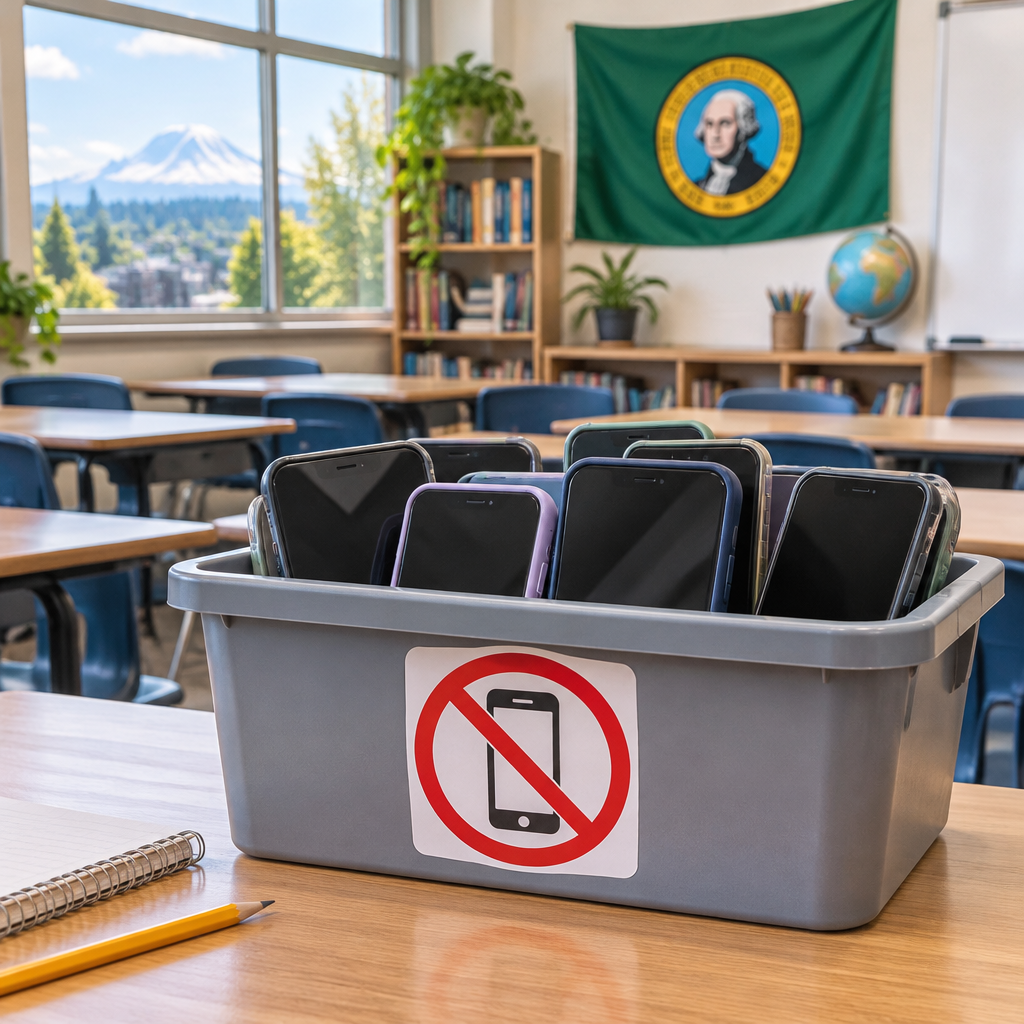
The proposed storage methods are sensible in outline, but each carries a different operational burden. A lockable pouch requires equipment, a method for locking and unlocking it, and a plan for students who arrive late or forget the pouch. A classroom caddy is cheaper, but someone must supervise it and account for devices when classes change. A central storage point may be secure, yet it can create queues and extra work at the start and end of the day. “Put it away” sounds simple until 700 students arrive at once.
Cost and responsibility are not minor details. The available description does not specify who would pay for pouches or storage systems, who would handle damaged or missing devices, or whether districts would receive state funding. Nor does it lay out the exact complaint process if a student or parent says a device was lost, accessed, or stored improperly. Before the state imposes a uniform rule, it should identify the minimum standards and the support districts need to meet them. Otherwise, the policy could be uniform on paper and uneven in practice.
Exceptions are another test of the proposal’s fairness. A student may need a phone for health monitoring, disability-related support, or another documented reason. The draft refers to IEPs, 504 plans, and medical needs, but the full implementation rules will determine how quickly a school can recognize an exception and how much private information a family must disclose. Schools should not make students repeatedly prove a need that is already documented. Respect for student dignity is not a loophole; it is part of responsible administration.
There are also emergency concerns. Parents may want direct access to their children during a crisis, while school leaders may need students to follow official instructions rather than act on rumors and scattered messages. The proposal’s described exceptions include certain needs, but the full emergency protocol is not reported. A sound policy should spell out how students can contact families, how families can reach the school, and what happens if phones are needed for safety or communication. Clear procedures beat assurances that everyone will “figure it out.”
Ferguson’s office says young people spend the equivalent of more than 41 school instructional days on phones during the school year. That is a striking figure, and it helps explain why the governor is pressing the issue. Still, the public account does not provide the underlying study, sample, age range, or definition of phone use. Does it include schoolwork, accessibility tools, or time outside class? Until the method is clear, the figure should be treated as an estimate from the governor’s office—not as a precise measure of classroom distraction.
The statewide debate is also political. Ferguson, a Democrat, has received praise from Baumgartner, a Republican member of Congress. That signals the issue can cross party lines, especially when framed around student attention and social media. But agreement on the problem does not guarantee agreement on the remedy. Legislators may disagree about local control, implementation costs, parental access, exemptions, and whether a single rule fits elementary, middle, and high schools equally well.
Timeline: How the Proposal Reached the 2027 Session
- Districts set different rules. Washington has not adopted one statewide approach to student phone use in class. Local school boards and administrators have had room to decide what restrictions make sense for their communities. That flexibility allows districts to respond to local needs, but it also creates different expectations for students moving between schools.
- OSPI urged local action. The Office of Superintendent of Public Instruction encouraged districts to adopt their own cell phone policies. In July, OSPI said close to a third of districts had not yet done so. That finding gives proponents of statewide legislation a straightforward argument: voluntary guidance may leave too many students under inconsistent rules. It also raises a different question—whether districts need a mandate or better resources and clearer guidance.
- State leaders raised a broader mandate. Superintendent of Public Instruction Chris Reykdal previously said he planned to propose a bill requiring districts to adopt “away for the day” policies, with certain exceptions, including emergencies or health monitoring. That proposal and Ferguson’s draft share the core idea of storing devices throughout the day. The reported descriptions do not establish whether their bills are identical or how their language will be reconciled.
- Ferguson released draft text. Earlier in the fall, the governor unveiled the draft Phone-Free Schools Act and called it a priority for the 2027 legislative session. The plan would require storage away from students, permit specified exceptions, take effect before the 2027–28 school year, and bar suspensions for violations during the first year. The exact draft and its eventual legislative version may differ.
- The governor made the case publicly. In a Nov. 17 post on X, Ferguson compared school phone access to smoking on airplanes and said he was confident phone access in schools would eventually feel similarly wrong. Baumgartner publicly endorsed the aim of reducing teen exposure to phones and social media. The exchange brought attention to the proposal, but social-media support is not a substitute for bill hearings or a vote.
- The Legislature must decide. The 2027 session is the next major test. Lawmakers can revise the draft, add funding, narrow or expand exceptions, set enforcement standards, or reject the proposal. The Washington Legislature’s bill search is the place to check for filed legislation and subsequent amendments. Until a bill passes both chambers and is signed, the policy remains a proposal.
The timeline shows a shift from district-by-district discretion toward a statewide standard. I would not confuse momentum with enactment. Ferguson has made the proposal a priority, and a member of Congress has praised its purpose, but the practical text still has to survive committee scrutiny, budget questions, and the ordinary bargaining of a legislative session.
Comparison: Ferguson’s Statewide Plan vs. District-Led Rules
The clearest comparison is not with a commercial competitor but with the alternative already operating in Washington: a patchwork of district-level policies. The National Conference of State Legislatures’ overview of school cellphone policies provides broader state context, while Washington’s proposal would establish a specific statewide direction.
| Issue | Ferguson’s proposed Phone-Free Schools Act | District-led approach |
|---|
| Who sets the baseline? | State law would set a common statewide requirement, if enacted. | Each district sets its own rules, within applicable law and guidance. |
| When are phones stored? | The described draft calls for devices to be away from students throughout the school day. | Rules can differ by district, school, classroom, or grade level. |
| Storage method | Possible options include lockable pouches, classroom caddies, a front desk, or another away-from-student arrangement. | The district chooses its own method; specific systems may vary. |
| Exceptions | The draft description refers to IEPs, 504 plans, and medical needs. | District policies may define exceptions locally; consistency can vary. |
| Enforcement | The draft would prohibit suspensions for violations during at least the first year. | Each district determines its own consequences and procedures. |
| Start date | Proposed to take effect before the 2027–28 school year. | Policies may already be active, changing, or absent, depending on the district. |
| Main strength | A common rule could reduce confusion when students change schools or districts. | Local leaders can tailor rules to their students, staff, and circumstances. |
| Main risk | A statewide mandate may impose costs and create rigid procedures if details are thin. | Uneven rules can leave students with different expectations and protections. |
The state model is stronger on consistency. A student should not have to learn a completely different phone rule at every school, and teachers benefit from a clear baseline. Statewide legislation can also ensure that exceptions are not left entirely to informal local practice. A consistent standard may be especially useful for families who move between districts.
The local model is stronger on adaptation. A district can test a policy, hear from teachers and parents, and adjust it without waiting for a new state law. A high school with many students who rely on phones for transit coordination may have different needs from an elementary school. Local control is not automatically better, but neither is uniformity. A statewide rule that ignores differences can create friction instead of focus.
Here’s the kicker: the comparison is not really “phones allowed” versus “phones banned.” District policies can restrict use without requiring all-day storage, and a statewide mandate can still include exceptions and local choices about storage. The real trade-off is whether Washington wants to set a hard floor for every district or let local governments decide how far to go. The answer depends partly on evidence and partly on how well lawmakers write the exceptions, funding, and enforcement provisions.
A useful national reference is the NCSL policy overview, which tracks the wider policy debate. The numbers cited in the governor’s materials say that 22 states have adopted restrictions extending from bell to bell. That figure is attributed to Ferguson’s office; state policies differ in scope, exemptions, and enforcement, so counting states does not tell Washington whether any particular model works well.
Common Misconceptions and What to Know
Misconception: The proposal is already law. It is not. Ferguson has released a draft and named it a 2027 priority. The Legislature has to consider and pass a bill, and the governor must sign it. Draft language can change substantially along the way. Families should not assume that the proposed storage rule is already in force statewide.
Misconception: The plan bans every student from having a phone under every circumstance. The draft description includes exceptions for students with IEPs, 504 plans, or medical needs, among other qualifying circumstances. The final legislation may clarify or change those provisions. The existence of exceptions is important, but it does not tell us how families request them, how quickly schools respond, or what documentation is required.
Misconception: A statewide rule will automatically raise test scores. It may reduce one source of distraction, which is a reasonable goal. But Washington’s academic recovery depends on more than phone access. Instruction quality, attendance, student support, staffing, and learning gaps all matter. A phone restriction should be measured as one policy among many, not advertised as a cure for every problem in public education.
Misconception: A striking phone-use estimate proves the case on its own. Ferguson’s office has said teenagers spend the equivalent of more than 41 instructional days on their phones during the school year. That deserves scrutiny, but the publicly described figure does not include enough methodological detail to establish exactly what was counted. The estimate may help frame the issue; it cannot answer every question about learning outcomes or the effect of a ban.
Misconception: A school-day ban means students cannot reach their families. The proposed framework concerns storing smart devices away from students; the available description does not lay out the complete school-to-family communication procedure. A final law should make that procedure plain. Parents need a dependable way to reach the school, students need to know what to do in an emergency, and staff need a communication plan that does not depend on rumors spreading through group chats.
Misconception: The only choice is state control or no rules. Districts already have room to set policies, and OSPI has urged them to act. The proposed law would change the baseline, not necessarily erase every local decision. Legislators could set statewide minimums while allowing districts to choose storage methods, staff procedures, and age-appropriate implementation. The question is how much flexibility remains after the statewide standard is written.
Misconception: Enforcement is a minor detail. The first-year suspension prohibition is a meaningful limit, but it does not settle how schools will respond. Will a student receive a reminder, have the phone held until dismissal, or face another consequence? Who records repeated violations? What happens if a device is lost or damaged? Without clear answers, enforcement can vary by school and become a source of conflict between families and staff.
The public debate tends to reward simple comparisons: phones are like cigarettes on planes, or phones are necessary lifelines. Neither analogy does the work of legislation. A school policy must protect learning while respecting disability accommodations, medical needs, family concerns, and the practical duties of teachers. Frankly, the boring details are where fairness lives.
Frequently Asked Questions
Is Washington’s Phone-Free Schools Act in effect?
No. It is a proposed measure Ferguson has identified as a priority for the 2027 legislative session. The draft would need to pass through the Legislature and receive the governor’s signature before becoming law. Until that happens, districts continue to set their own rules under existing guidance and policies. Families should check with their local school district for the current rules at their school.
Would students be allowed to bring phones to school?
The described proposal focuses on storing phones and smart devices away from students during the school day; it does not say students cannot bring a device onto campus. Possible storage arrangements include lockable pouches, classroom caddies, and a designated place at the front desk. The final bill would need to clarify how devices are collected, stored, returned, and protected from loss or damage.
What exceptions are included in the proposal?
The draft description refers to students with an IEP, a 504 plan, or medical needs, with other qualifying circumstances also possible. The exact eligibility rules and application process are not reported in the available description. Those rules matter because students may rely on a device for health monitoring, disability-related support, or another documented need. A final policy should make requests straightforward and protect private information.
When could the policy start?
The proposal is described as taking effect before the 2027–28 school year, if it becomes law. It also says students would not be suspended for violations during at least the first year. The timeline, transition period, and consequences could change as lawmakers review the bill. The Washington Legislature’s bill search can be used to follow filed bills and amendments.
Why does Ferguson want a statewide rule?
His stated case centers on student distraction and the amount of time teenagers spend on phones. His office’s estimate equates that use to more than 41 instructional days across a school year. A statewide requirement could also replace the current patchwork of district rules with a common baseline. Whether that approach improves learning will depend on implementation and evidence, not just the existence of a ban.
Final Thought
Ferguson has picked an issue parents, teachers, and students can recognize without a policy briefing: phones interrupt attention. His proposal is also more specific than a general call to “use devices less.” It names storage options, identifies several kinds of exceptions, sets a proposed start date, and bars suspensions during the first year. Those are useful starting points, not proof that the plan is ready for enactment.
The Legislature should insist on answers to the ordinary questions that determine whether a rule is fair: who pays for storage, what happens when a phone is lost, how students with medical or disability-related needs receive accommodations, and how schools handle emergencies. It should also demand a clear way to measure results. If the goal is better attention and stronger learning, the state should track whether classroom disruption falls and whether students’ academic outcomes improve—while acknowledging that a phone policy is only one part of the work.
There is a broader obligation here. Schools hold responsibility for students’ safety, learning, and dignity during the day. That calls for restraint in both directions: do not dismiss real distraction, and do not treat every student or family as though they have the same needs. A common rule can serve the public good, but only if it is built to protect those who would otherwise bear its costs most heavily.
When I weigh the proposal, I see a legitimate problem and an unfinished solution. The 2027 session should focus less on winning the best analogy and more on writing a rule that teachers can enforce, families can understand, and students can follow without losing access to necessary support. A phone-free school day may prove worthwhile. The details will decide whether it is sensible policy or just a satisfying slogan.
FAQPage Schema