Washington’s Phone-Free Schools Act: What Gov. Bob Ferguson Wants to Change
Washington Gov. Bob Ferguson wants students’ phones put away for the entire school day. His proposed Phone-Free Schools Act would set a statewide rule, require devices to be stored out of students’ reach, and create exceptions for medical needs and disability plans. The proposal is a priority for the 2027 legislative session, not a law yet.
Ferguson’s comparison is deliberately sharp. On Nov. 17, he likened allowing phones in schools to smoking on airplanes, saying he expects phone use during school to seem just as unacceptable in a few years. U.S. Rep. Michael Baumgartner, a Washington Republican, praised the idea, saying less teen use of phones and social media would be beneficial.
But a strong analogy is not an implementation plan. The question for lawmakers is whether one statewide rule can reduce distraction without creating new problems for students who rely on a device, families trying to reach children, or school staff responsible for enforcing the policy. That is where the details matter.
What Is the Phone-Free Schools Act?
The Phone-Free Schools Act is a draft proposal from Ferguson that would require Washington public schools to keep students’ smartphones and other smart devices stored away from them during the school day. The draft describes options such as lockable pouches, classroom caddies, storage at a front desk, or another arrangement that keeps a device out of a student’s hands. It would replace much of the current local discretion with a statewide standard.
The proposal is not simply a ban on using phones during lessons. Ferguson’s office describes the rule as applying for the entire school day, a scope often called bell-to-bell. That distinction matters: a classroom-only restriction leaves students to use devices during passing periods or lunch, while a full-day rule makes the school responsible for setting one consistent boundary from arrival to dismissal.
There are exceptions. The draft would account for students with medical needs, an IEP, or a 504 plan, which can provide accommodations for a disability. Those exceptions are essential, not decorative. A student may need access to a device for a medical monitor, an assistive function, or an accommodation agreed upon by the school and family. A workable law has to protect that access without forcing students to disclose sensitive information to classmates.
The draft also proposes a transition period. It would take effect before the 2027–28 school year, and schools would be barred from suspending students for breaking the phone rule during at least the first year. That provision signals an attempt to introduce the policy through practice and adjustment rather than immediate punishment. It does not, by itself, explain how repeated violations should be handled or how schools should communicate the rule to families.
I see the central issue as a question of public policy, not a referendum on whether every teenager should own a phone. Schools already set limits on items that interfere with instruction; the disputed point is whether the state should require one approach across districts. Ferguson’s office argues that phones consume a substantial share of students’ school time, citing an estimate that teens spend the equivalent of more than 41 instructional days on their devices during a school year. That figure is striking, but it is an estimate attributed to the governor’s office, not a Washington-specific measurement of time lost in classrooms.
Core Details and Context
Washington currently lacks one statewide rule that tells every district exactly how students may use phones at school. The state’s Office of Superintendent of Public Instruction (OSPI) has encouraged districts to adopt their own policies, but OSPI said in July that close to a third had not yet done so. That is the practical problem Ferguson is trying to address: students can face different rules depending on where they attend school, and some districts may have no formal policy at all.
Local control has a real case behind it. Districts differ in size, staffing, building layout, student needs, and family expectations; a small rural school may not have the same storage capacity or administrative resources as a large urban district. Local officials can tailor rules to those circumstances and adjust them when a policy creates trouble. A statewide requirement, by contrast, can make expectations easier to explain and reduce the burden on families who move between districts.
The draft’s proposed storage choices give schools some room to choose how they comply. A lockable pouch can keep a device with the student while preventing access, while a classroom caddy or front-desk storage shifts responsibility to school staff. Each method has trade-offs. Pouches need a process for opening them at dismissal, and a caddy needs secure, orderly storage; front-desk systems may be awkward in large buildings or during emergencies. The draft’s flexibility is useful, but the details of cost, security, and daily handling will shape whether the policy works.
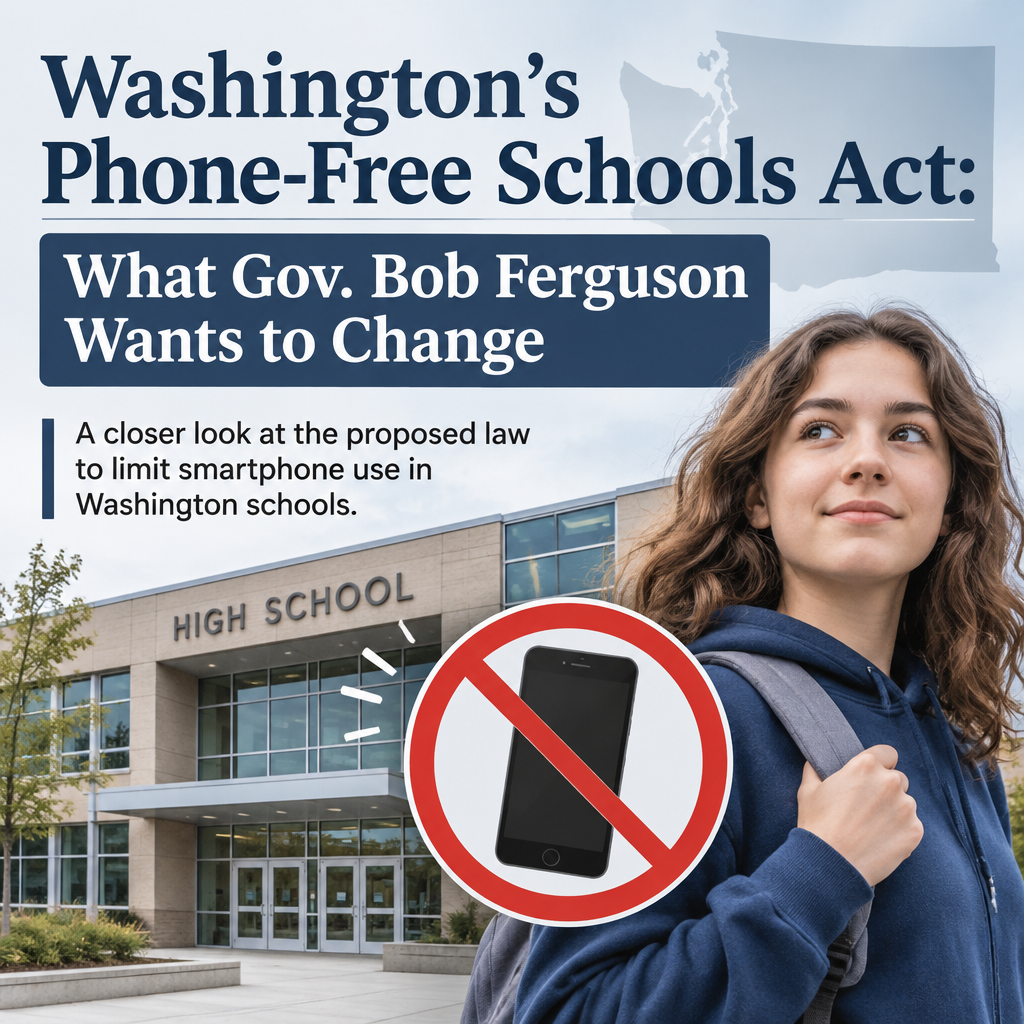
The stated educational concern is distraction. A phone can interrupt a lesson through messages, notifications, games, videos, or social media, even when a student is not actively looking at it. Teachers also have to decide whether to enforce a restriction while trying to teach. A clear schoolwide rule could reduce those interruptions and make classroom expectations less dependent on individual teachers.
Still, lawmakers should resist treating one policy as a guaranteed academic fix. Washington has been trying to recover test results from pandemic-era lows, but a phone restriction cannot, on its own, repair lost learning, improve attendance, address teacher shortages, or provide students with extra academic support. The relevant research question is narrower: does restricting access during school improve attention, classroom participation, or learning outcomes, and for which students? Evidence about general phone use is not automatically evidence that one specific storage policy will raise test scores.
National figures show why the debate has spread. Ferguson’s office says the majority of states have restrictions on student phone use and that 22 have bell-to-bell prohibitions. Earlier this year, Washington received an “F” in a national ranking for not passing a statewide ban during the 2026 session, according to McClatchy’s prior reporting. Those comparisons add political pressure, but a grade from a ranking is not a substitute for evaluating how a law is designed or enforced.
For broader context, Pew Research Center’s 2024 survey of teens and technology documents how common smartphone access is among teenagers. The U.S. Surgeon General’s advisory on social media and youth mental health also describes concerns and gaps in evidence around young people’s social media use. Neither source proves that Ferguson’s proposal will improve Washington test scores. They help explain why policymakers are considering tighter rules, while leaving the effect of this particular law to be tested.
Timeline: How the Proposal Reached the 2027 Session
- District policies remain uneven. Washington has left most school phone rules to local districts. That gives communities room to choose their own approach, but it also produces inconsistent coverage. OSPI’s July update said close to a third of districts had not adopted a policy, a gap that makes a statewide debate hard to avoid.
- Ferguson unveils draft language. Earlier in the fall, the governor released draft text and identified the Phone-Free Schools Act as one of his priorities for the 2027 legislative session. The proposal set out the core mechanism—devices stored away throughout the day—along with exceptions and a delayed start. At this point, it is a proposal for lawmakers to consider, not a rule schools have to follow.
- The proposal draws attention beyond Olympia. On Nov. 17, Ferguson posted on X that he was confident allowing cell phones in schools would eventually feel as wrong as smoking on planes. Baumgartner, a Republican member of Congress from Washington, publicly supported the goal of reducing teen use of phones and social media. The exchange shows some cross-party agreement on the concern, but a supportive post is not a vote in the state Legislature.
- Lawmakers face the design questions in 2027. The proposal must be considered through the state legislative process before it can become law. Legislators can debate its scope, exceptions, costs, enforcement, and start date; they can also amend or reject it. As of Nov. 23, the reported draft has not crossed that line.
- Schools would need time to prepare. If the measure passes in a form close to the draft, the planned start would be ahead of the 2027–28 school year. Districts would need to choose storage methods, set procedures for exceptions, brief teachers and families, and explain what happens after a violation. The first-year ban on suspensions would provide a period to adjust, but the text still needs clear guidance on responses that are fair and consistent.
When I trace the timeline, the key point is that the public debate is ahead of the lawmaking. The governor has announced a priority and published draft text; the Legislature has not yet enacted a statewide requirement. That distinction matters to parents and school staff deciding whether to change current routines. Until a law is passed and its terms are settled, existing district rules remain the ones that govern daily practice.
Comparison Table: Statewide Proposal vs. District-by-District Rules
The proposal’s main alternative is the current district-led approach, not another single statewide program. The comparison below uses details reported by Ferguson’s office and OSPI; where the draft does not specify an operational detail, it is marked as not reported rather than guessed.
| Issue | Ferguson’s proposed Phone-Free Schools Act | Current district-by-district approach |
|---|
| Who sets the rule? | A statewide requirement would apply across districts if passed. | Districts make their own choices; OSPI has urged them to adopt policies. |
| When would devices be put away? | The draft calls for storage away from students for the entire school day. | Rules vary by district; there is no single statewide schedule. |
| Storage method | Options include lockable pouches, classroom caddies, a front desk, or another arrangement that keeps devices away. | Storage methods depend on local policy; a statewide method is not reported. |
| Exceptions | The draft identifies circumstances such as medical needs, an IEP, or a 504 plan. | Exceptions depend on district rules and individual student needs. |
| Enforcement | No suspensions for violations during at least the first year, under the draft. | Consequences vary; no common statewide enforcement approach is reported. |
| Timing | Intended to take effect before the 2027–28 school year. | Policies already in place continue under local rules. |
| Coverage | Would establish a statewide baseline if enacted. | OSPI said close to a third of districts had not adopted a policy as of its July update. |
A statewide rule could make the basic expectation simpler. Families would not have to learn a wholly different standard every time a student changes schools, and teachers would have a shared baseline to enforce. The other side of that convenience is reduced flexibility: districts may be required to implement a system that does not fit their building, staffing, or student population without careful local planning.
The proposed storage options appear designed to preserve some local choice inside a common rule. That is a sensible distinction. A law can set the goal—students do not have access to phones during the school day—while allowing districts to select practical storage methods. But lawmakers should specify what counts as adequate storage, who is responsible for a device, and how schools must accommodate students who have authorized access needs.
The first-year suspension limit also deserves close attention. It can prevent a new policy from turning immediately into a pipeline to exclusion from class, especially while families and students learn the procedures. Yet “no suspension” leaves room for other consequences, and the draft details reported so far do not settle what those should be. Clear, proportionate responses would help avoid arbitrary enforcement and protect the dignity of students, including those whose disability or medical needs make compliance more complicated.
Frankly, the table shows a genuine policy choice, not a contest between order and chaos. Local discretion allows adaptation, while a statewide baseline can close gaps and simplify expectations. The useful question is whether the Legislature can preserve local implementation without letting the core protection disappear in practice.
Common Misconceptions and What to Know
Misconception: The proposal is already law. It is not. Ferguson has identified the measure as a priority for the 2027 session and released draft text, but that is not the same as legislative approval. The proposal still has to move through the lawmaking process, and its final language could change. Until that happens, families should check their own district’s current rules rather than assume a statewide ban has begun.
Misconception: Every student would lose access to every device in every circumstance. The draft includes exceptions for situations such as medical needs, an IEP, or a 504 plan. Those provisions matter because a phone or smart device can serve a purpose beyond entertainment or messaging. The hard work will be translating exceptions into straightforward procedures that respect privacy, support disability accommodations, and prevent a student from being unfairly singled out.
Misconception: A phone rule alone will restore learning lost during the pandemic. That claim goes further than the reported evidence. Phone restrictions might reduce one source of interruption, but they cannot replace effective teaching, tutoring, stable attendance, or attention to student well-being. If test scores improve after a new policy, schools should still examine what else changed rather than crediting the phone rule by default. If scores do not rise, that does not automatically mean classrooms saw no benefit; attention and student experience also matter, but they need to be measured honestly.
Misconception: Agreement about the problem means agreement about the solution. Baumgartner’s praise indicates support for reducing teen phone and social media use, but it does not establish agreement on the proposal’s exact terms. Legislators may support phone-free classrooms while disagreeing about whether rules should apply through lunch, how exceptions are approved, or what consequences are appropriate. A broad political slogan can hide those practical disputes.

Misconception: The comparison with smoking on planes settles the argument. Ferguson’s analogy is memorable because it describes a norm that changed over time. But analogies do not answer questions about student rights, medical accommodations, school safety, or enforcement. A school phone policy has to be judged on its own purpose and effects. The rhetoric may open the debate; it cannot do the legal or educational analysis for lawmakers.
What to watch: The next useful evidence will come from the bill’s final language, fiscal details, implementation guidance, and any evaluation plan. Does it say how schools handle emergencies? Who pays for pouches or secure storage? How do students access a device needed for an accommodation? Will the state track classroom disruption, attendance, academic measures, and discipline? Those questions are less catchy than a ban, but they will decide whether the policy serves students fairly.
The state has a responsibility to protect learning and student welfare, while recognizing the dignity and needs of each child. That means treating phones as a serious classroom concern without assuming that every student, family, or school has the same circumstances. Good policy sets a clear standard, provides workable exceptions, and checks its results instead of declaring victory before the first school day.
Frequently Asked Questions
What would Washington’s Phone-Free Schools Act require?
The draft would require student phones and smart devices to be stored away from students for the entire school day. It lists possible arrangements such as lockable pouches, classroom caddies, or storage at a front desk. The exact operational rules could change as lawmakers consider the proposal.
Is the Phone-Free Schools Act already in effect?
No. Ferguson has described it as a priority for the 2027 legislative session and released draft text. As of Nov. 23, the proposal is not a law. Existing district policies remain in effect unless and until a statewide measure is passed and takes effect.
Would students with medical or disability-related needs be exempt?
The draft identifies exceptions for circumstances including medical needs, an IEP, or a 504 plan. Schools would need clear processes to provide authorized access without exposing private information or disrupting instruction. The specific procedures depend on the final law and any implementation guidance.
When would the proposed rule begin, and what would happen after a violation?
The draft aims for implementation before the 2027–28 school year. It also says students could not be suspended for violations during at least the first year. The reported details do not fully specify other consequences, so enforcement procedures remain an important issue for lawmakers and school districts.
Ferguson is asking Washington to replace uneven local rules with a shared expectation: phones stay out of students’ reach during the school day. That is a clear goal, and the concern about distraction is not hard to understand. The test is whether lawmakers can turn that goal into a rule schools can apply without punishing students for disability-related needs, creating needless burdens for staff, or pretending a storage pouch will solve every academic problem.
The distinction between a proposal and a law should stay visible. So should the difference between a policy’s promise and its measurable result. If lawmakers approve the act, Washington should assess how it affects instruction, discipline, student access, and school operations—not just count how many devices were stored. Good stewardship of public resources requires that kind of follow-through.
A phone-free school day may become a durable norm, as Ferguson predicts. Or the details may prove harder than the slogan. The Legislature’s job is to decide what standard serves students and the common good; schools’ job, if the measure passes, will be to carry it out fairly. That work deserves more than a catchy comparison and less than blind faith in a ban.
Sources