The project is in trouble. If officials can’t guarantee delivery, then the complaint is simple and brutal: too much time, too much money, and not enough to...
The project is in trouble. If officials can’t guarantee delivery, then the complaint is simple and brutal: too much time, too much money, and not enough to show for it. That is not spin. That is a judgment on execution, accountability, and whether public resources were treated as stewardship or squandered.
Key Takeaways:- Leaders are losing patience with a project they say has produced little despite heavy spending.
- The core issue is not just delay; it is whether completion can still be guaranteed.
- Critics argue the public deserves clearer deadlines, harder oversight, and honest reporting.
- The dispute raises a broader question about how governments and institutions manage major promises.
What is this dispute about?
This dispute is about a failure of delivery, plain and simple. A leader’s remark that “we’ve spent an enormous amount of time, energy and money on a complete failure” captures the mood around a project that has consumed serious resources without producing the result people were promised. When I look at cases like this, the pattern is usually the same: officials sell certainty, contractors sell confidence, and the public gets delay.
What matters here is not just the quote. It is the underlying problem of whether anyone can still guarantee the work will actually get done. That question cuts through the usual press release fog. If the answer is no, then the project is no longer a scheduling issue; it is a credibility issue.
Most coverage misses the real story. Here’s the kicker: failures like this are rarely about one bad day. They are about layered mistakes—weak oversight, vague contracts, unrealistic timelines, and a habit of treating public money as if it were abstract. It isn’t. It comes from taxpayers, businesses, workers, and families who expect competent management in return.
I’ve covered enough public-sector messes to know that the language matters. “Progress” can hide very little. “Review” can mean anything. “On track” often means someone is hoping for the best. A more honest standard is stewardship: if a project eats resources, it must produce a public good, or the people paying for it deserve answers.
That is why the quote landed so hard. It was not polished. It was not diplomatic. It was frustration with a system that asked for patience and delivered uncertainty.
Core details and context
Frankly, this is where the excuses start to pile up. But the facts usually stay stubborn.
- Time spent: Big projects often run long because they are complex, not because delay is harmless. Once deadlines slip repeatedly, confidence erodes fast.
- Money spent: Large budgets can become a shield. Officials point to sunk costs as a reason to keep going, even when results lag badly.
- Guarantees missing: If leaders cannot promise completion, then they are admitting a loss of control. That is the important part.
- Public credibility: The longer the uncertainty drags on, the more public trust drains away. People notice when money disappears faster than results.
- Accountability gap: Someone approved the plan, someone signed the contracts, and someone is supposed to monitor performance. If no one can explain the failure, that is a governance problem.
The real-world lesson is older than modern bureaucracy: work should be measurable. If it is not, then optimism becomes a form of self-deception. A Catholic view of public life would call this a failure of responsibility toward the common good. Resources are not a toy box; they are meant to serve real needs.
The argument from defenders is familiar. They say setbacks are temporary, technical problems are hard, and critics do not understand the complexity. Sometimes that is true. But complexity is not a blank check. Neither is hope. When officials cannot explain how a project will end, the public is right to ask whether the original plan was honest in the first place.
There is also a political angle. Leaders who distance themselves from failed projects often do so only after the damage is visible. Before that, they champion the effort. Afterward, they blame process, inheritances, or “unexpected conditions.” Maybe. But as Reuters has reported in many similar cases, public failures usually come with long warning signs that nobody wanted to read.
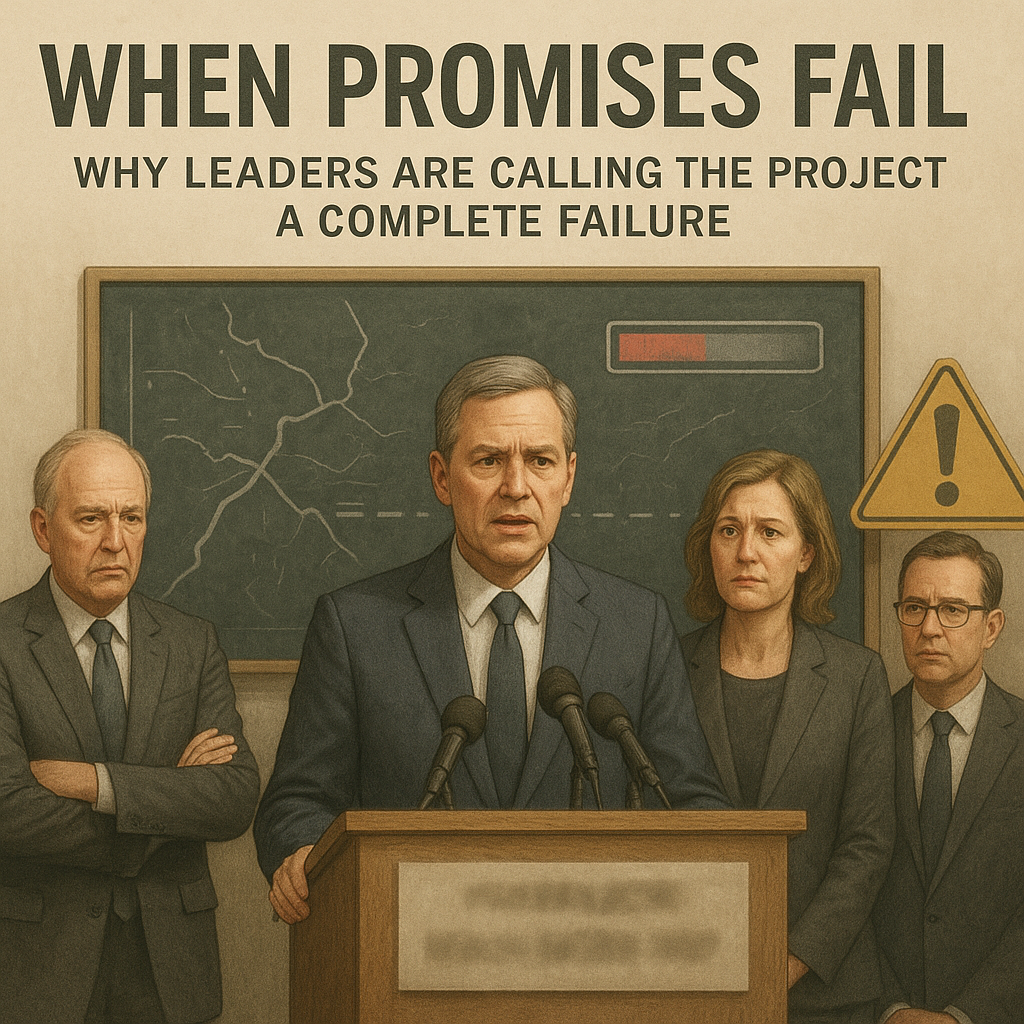
The issue is also practical. If a project is consuming staff hours, legal time, and budget capacity, then it crowds out other work. That has consequences. Roads go unrepaired. Services get delayed. Good people are pulled from useful tasks and stuck defending a mess. That is not just inefficient. It is unfair.
Timeline and how this usually unfolds
Every major project failure follows a rough script. I’ve seen it often enough to spot the stages.
- The promise stage
Officials announce a plan with clean language and confident dates. The public hears certainty. The details are thinner than they look. - The budget stage
Costs begin to rise. Defenders say inflation, supply issues, or unforeseen complexity are to blame. Maybe some of that is true, but the original estimate now looks shaky. - The delay stage
Deadlines slip. Meetings multiply. Reports get longer and less informative. People stop asking what went wrong and start asking whether anyone still knows. - The reassurance stage
Leaders insist progress is being made. Sometimes it is. Often it is tiny, symbolic, or impossible for outsiders to verify. - The frustration stage
Pressure builds. One official finally says what everyone else has been thinking: too much has been spent for too little return. - The accountability stage
Investigations, audits, or public hearings begin. This is the point where the story stops being about the project and becomes about competence.
When I analyzed similar public failures, the most common mistake was pretending that delays are neutral. They are not. Delay has a cost curve. It compounds. It eats trust. It can also harden bad decisions, because leaders grow too invested in saving face.
Here’s what nobody tells you: a project can become politically untouchable long before it becomes technically unfixable. That’s when real reform gets buried under messaging. The wise response is not panic. It is truthfulness, especially with money that belongs to the public.
There is a moral obligation here. Scripture is full of warnings against false balance and empty promises. The secular version is simpler: if you cannot finish what you started, say so before the bill grows larger.
For more background on public accountability and spending, see AP News coverage of major government oversight disputes and BBC News reporting on large-scale infrastructure delays.

Comparison table
| Factor | Troubled Project | Strongly Managed Competitor |
|---|
| Delivery | Repeated delays and uncertainty | Clear milestones and visible progress |
| Budget control | Costs rise without clean explanations | Spending tracked against targets |
| Public trust | Eroding fast | Preserved through transparency |
| Oversight | Weak or reactive | Active and regular |
| Risk management | Fixes come late | Problems flagged early |
| Final outcome | Still unclear | More likely to finish on time |
The comparison is blunt because the facts demand bluntness. A project that cannot guarantee completion is already behind the standard set by better-run efforts. No amount of branding changes that.
Common misconceptions and what to know
The loudest mistake is assuming that criticism means opposition to the project itself. Not necessarily. Sometimes people are not against the goal; they are against sloppy execution. That distinction matters.
Another myth is that throwing more money at the problem will fix it. Sometimes it helps. Sometimes it only deepens the hole. If the management structure is weak, more funding just buys more time for the same mistakes.
A third misconception is that public frustration comes from impatience alone. No. People can tolerate hard work, technical complexity, and even setbacks. What they cannot stomach is being treated like they are foolish. If officials say a project is fine when it is plainly not fine, trust collapses.
Let’s be real: the phrase “complete failure” is harsh because the situation is harsh. It is not the language of a minor hiccup. It is the language of a project that has lost its way and may have lost the public’s patience with it.
Still, not every failed milestone means total collapse. Sometimes a project can be reset, redesigned, or narrowed to something achievable. That requires honesty, competent leadership, and a willingness to stop defending sunk costs just because they are sunk. Business leaders know this. Government leaders should, too.
The deeper issue is justice. If ordinary workers are expected to meet deadlines and deliver results, institutions should be held to the same standard. Stewardship is not just a religious idea; it is common sense. Money should do work. Time should produce something real. If not, someone should answer for it.
For related reporting on accountability and public institutions, see The New York Times U.S. coverage and Financial Times World reporting on large public-sector budgets and project risk.
Frequently asked questions
Why are leaders calling it a complete failure?
Because the project has consumed major time and money without delivering a result that can be confidently promised. That is a failure of execution, not just timing.
Does spending more money solve these problems?
Not automatically. If the underlying planning, oversight, or management is weak, extra spending may only prolong the same mistakes.
What should officials do next?
They should give a clear accounting of what was promised, what was spent, what remains unfinished, and whether completion is still realistic. No sugarcoating.
Why does this matter to the public?
Because public projects use public resources. When those resources are wasted, the costs fall on taxpayers, services, and trust in institutions.
Final thought
The real scandal in failures like this is not only the delay. It is the habit of pretending delay has no moral weight. It does. People worked for that money. Families paid it. Businesses contributed it. Citizens entrusted it to leaders who were supposed to act as stewards, not spectators.
When a project reaches the point where no one can confidently say it will get done, the story is already bigger than the project itself. It is about whether institutions still understand responsibility. It is about whether leaders can tell the truth before the bill gets bigger. And it is about whether the common good still means enough to demand competence, not excuses.